About Kreuzberg Audio
Kreuzberg Audio was founded in 2025 by Frank Hahn in Berlin-Kreuzberg. Frank has spent more than two decades at the intersection of music and technology, at companies including Musik Meyer, Korg & More, GSM Multimedia and inMusic. Together with then-Vestax CEO Toshi Nakama he worked on the VCI-100, the first professional DJ MIDI controller, which shipped in 2006 and set the format that DJ controllers still follow today. In parallel he founded DJ-LAB.de, for years the leading German-language online magazine for DJ gear.
As a producer Frank has been active in the German drum and bass scene since 2000 as Giana Brotherz, with releases on Basswerk and Pathfinder and a label of his own. Under the names Disco Tetris and Frank Hahn he produces tech house and uptempo. He is part of the Riverside Studios community in Berlin.
The catalogue covers eleven plugins: the KA-303 acid synthesizer, the OBERTON multiband saturator, the EXTRAKT stem separation tool, the Amen Machine slice sampler, the UPLIFTER transition designer, the RUMBLE FORGE sub bass generator, the Grid-909 pattern generator, the BREITSEITE spectral stereo widener, the STAFFEL creative filter, the free RASPEL saturating filter and the Acid Distortion Pro Suite. All run as VST3, AU and standalone, seven of them also as CLAP (KA-303, OBERTON, UPLIFTER, RUMBLE FORGE, BREITSEITE, STAFFEL and RASPEL), and all of them on macOS, Windows and Linux.
Kreuzberg Audio sells direct through its own shop only. No subscription, no dongle, no activation through a third-party service. Every plugin comes with a demo that has full functionality and can be downloaded free of charge through the shop. A customer account is created for the download. The demos are limited to a number of starts and play an audible marker at intervals until then, the exact terms are listed with each product.
Contact: Frank Hahn, [email protected]
Logos




Press reviews of the KA-303
All products at a glance
| Product | Price | Formats | Version | Link |
|---|---|---|---|---|
| KA-303 | 69.00 euros | VST3, AU, CLAP, Standalone | 2.1.0 | Product page |
| BREITSEITE | 49.00 euros | VST3, AU (macOS), CLAP, AAX (macOS and Windows), Standalone | 0.3.4 | Product page |
| EXTRAKT | 49.00 euros | VST3, AU, Standalone | 1.0.3 | Product page |
| Grid-909 | 49.00 euros | VST3, AU, Standalone | 1.1.2 | Product page |
| OBERTON | 49.00 euros | VST3, AU, AAX, CLAP, Standalone | 1.7.2 | Product page |
| RUMBLE FORGE | 49.00 euros | VST3, AU (macOS), CLAP, standalone | 1.3.4 | Product page |
| STAFFEL | 49.00 euros | VST3, AU (macOS), CLAP, standalone | 1.1.0 | Product page |
| UPLIFTER | 49.00 euros | VST3, AU, CLAP, Standalone | 1.2.0 | Product page |
| Amen Machine | 19.00 euros | VST3, AU, Standalone | 1.3.0 | Product page |
| Acid Distortion Pro Suite | 9.99 euros | VST3, AU, Standalone | 1.1.0 | Product page |
| RASPEL | free | VST3, AU (macOS), CLAP, standalone | 1.0.2 | Product page |
KA-303: Acid Synthesizer
Acid synthesizer whose composing engine writes the bassline, not just the timbre.
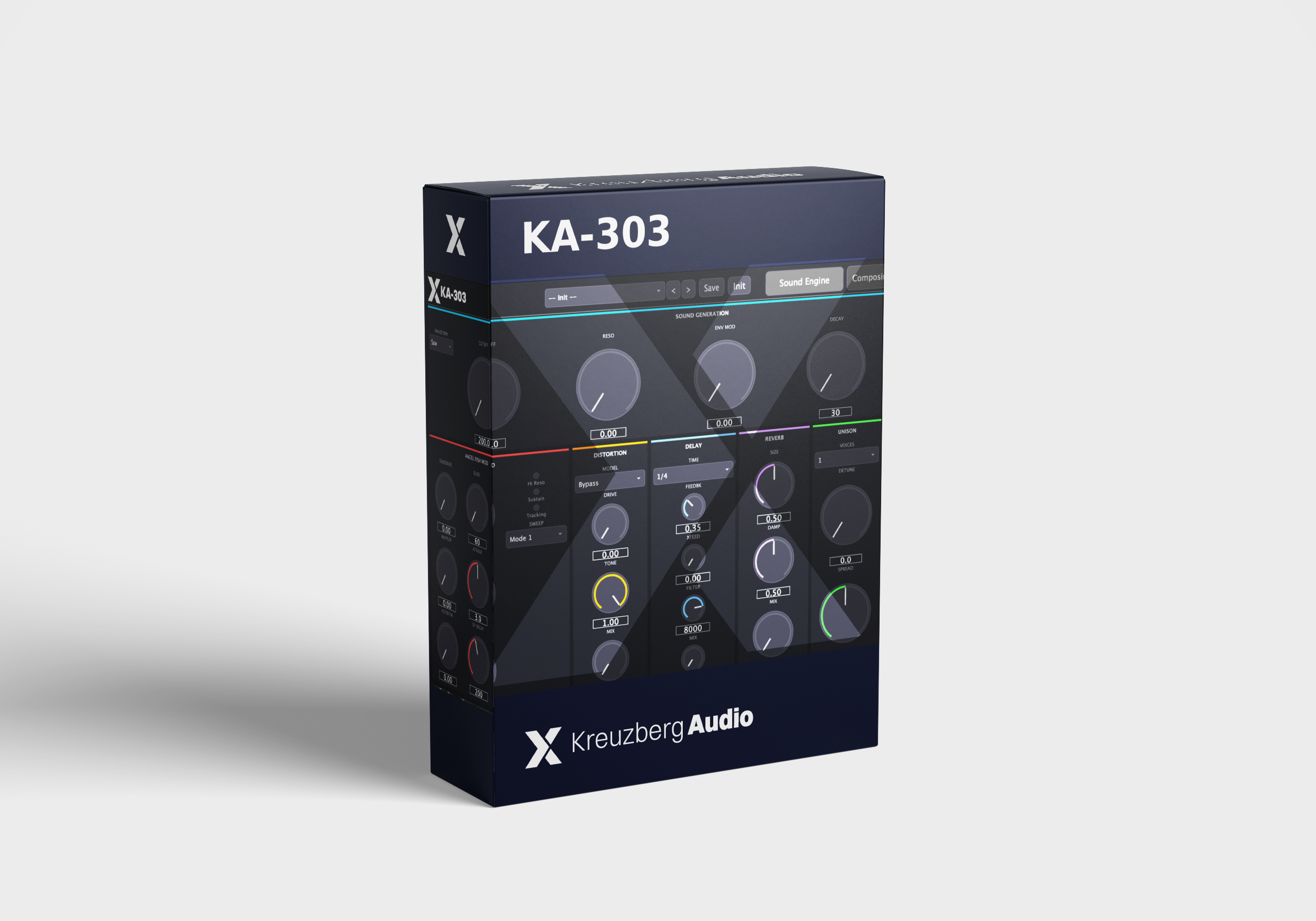
Kreuzberg Audio has released KA-303 2.1.0. The acid synthesizer combines a diode ladder filter modelled at component level with eight modes and a composing engine that builds acid patterns from 1 to 64 steps. Version 2.1.0 unfolds the performance tab into an 8x8 view where all eight pad modes play at once, gives each of the 64 tiles its own parameter for MIDI and automation, and grows the composing tab to 22 scales, a keyboard along the piano roll and a grid that knows triplets. The preset bank holds 274 sounds. The demo has the full feature set and runs for 30 starts.
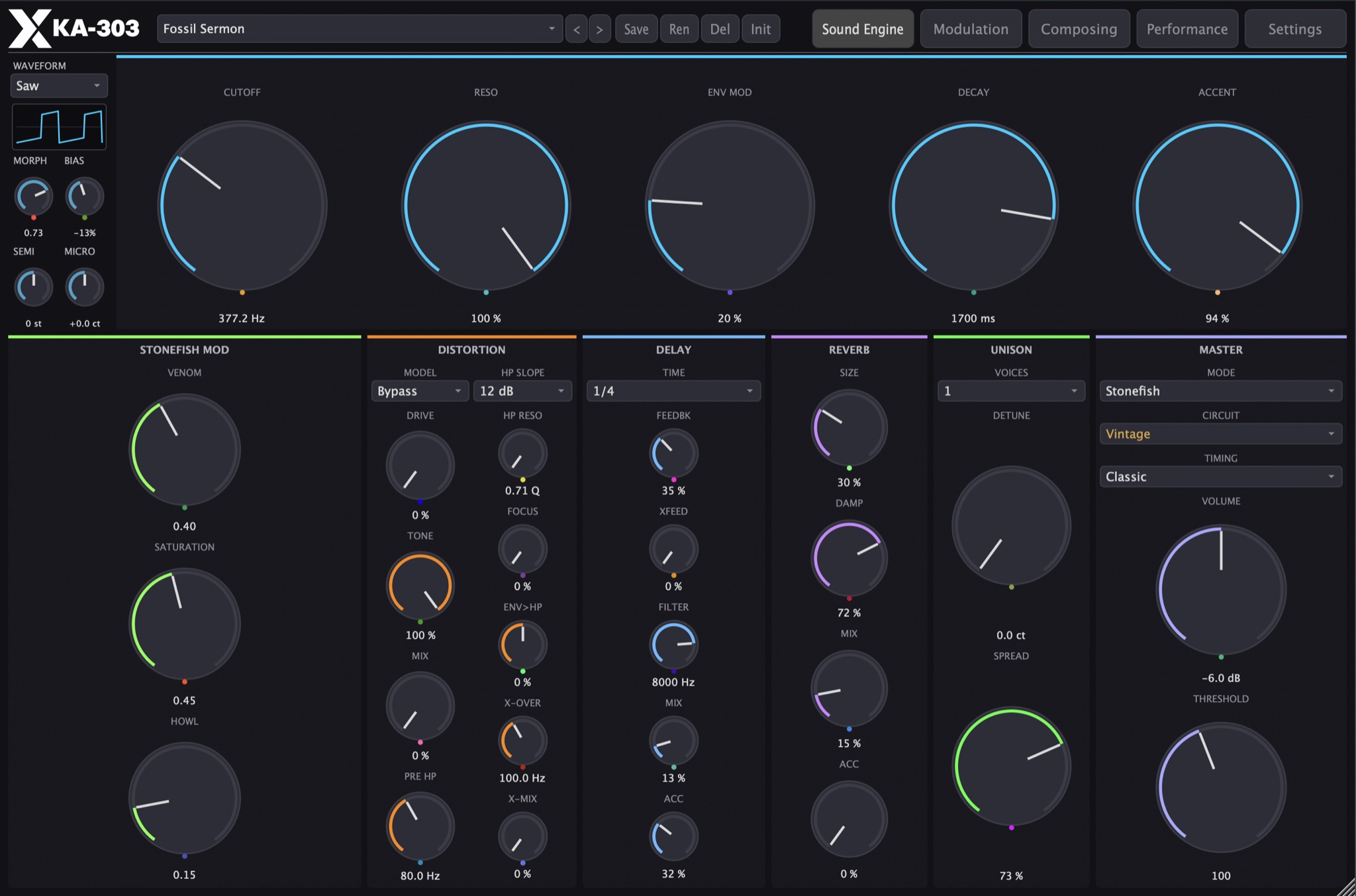
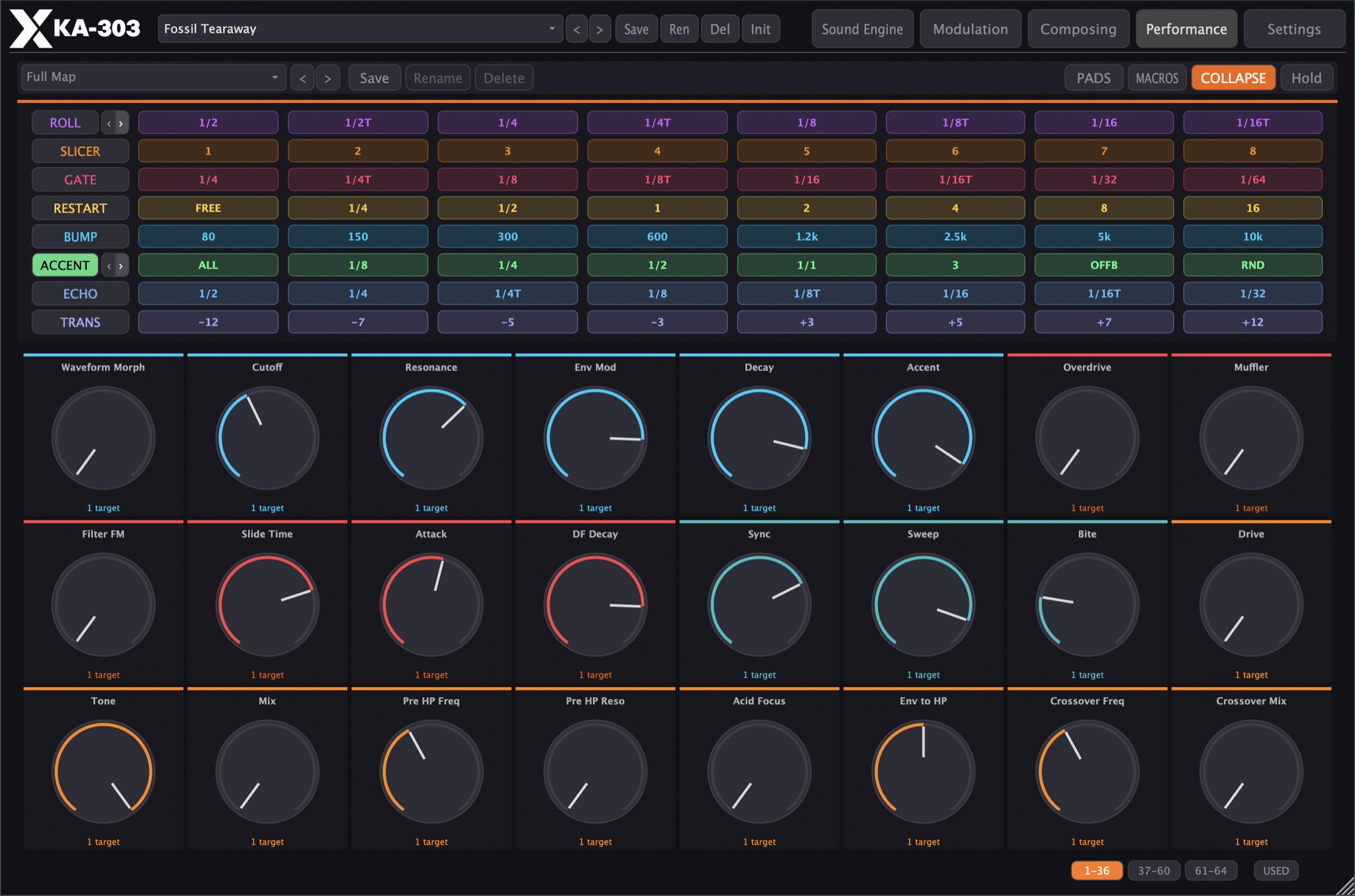
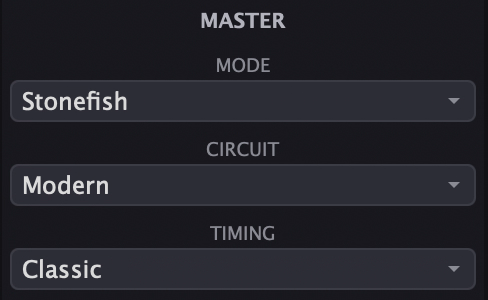
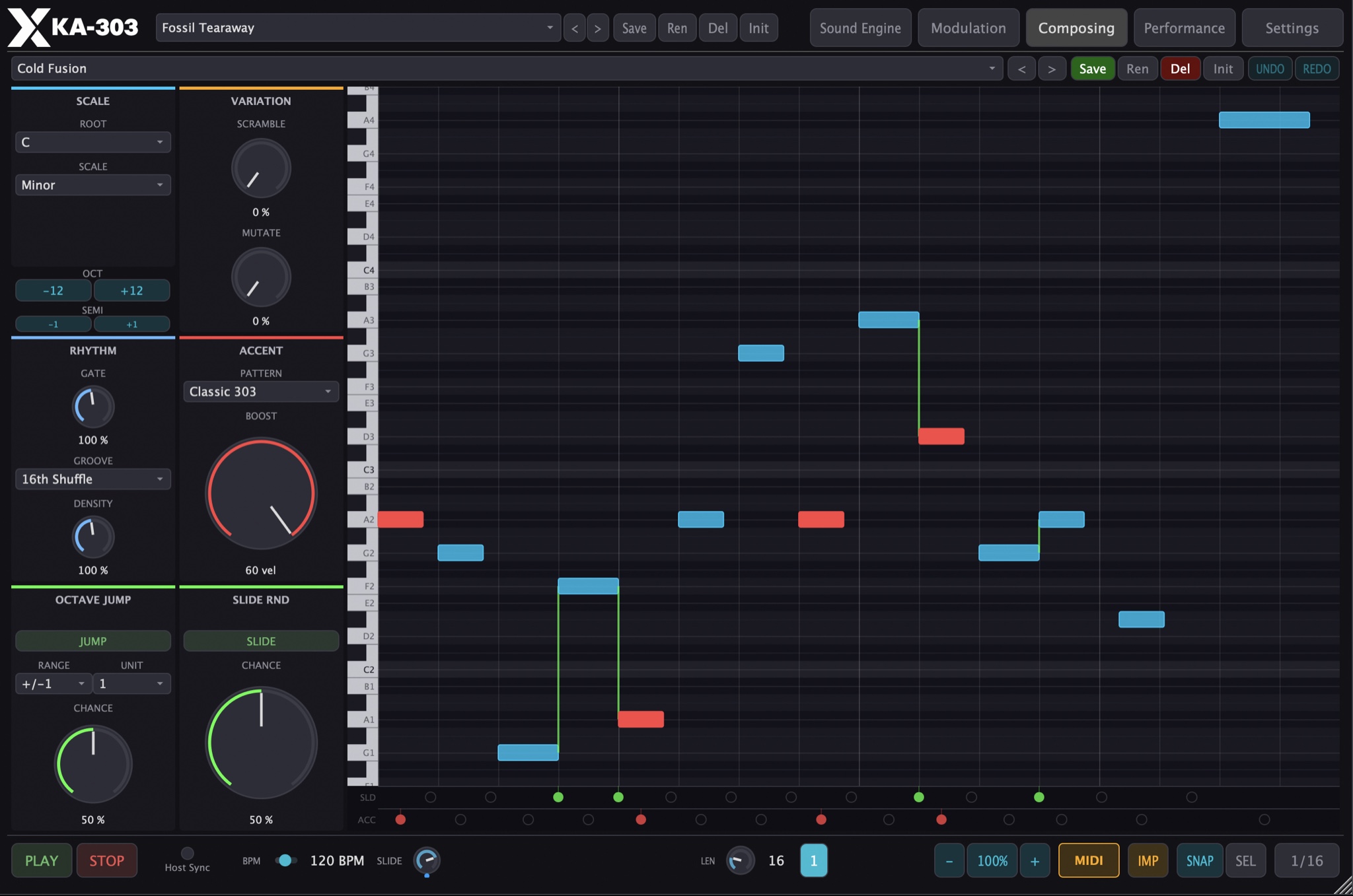
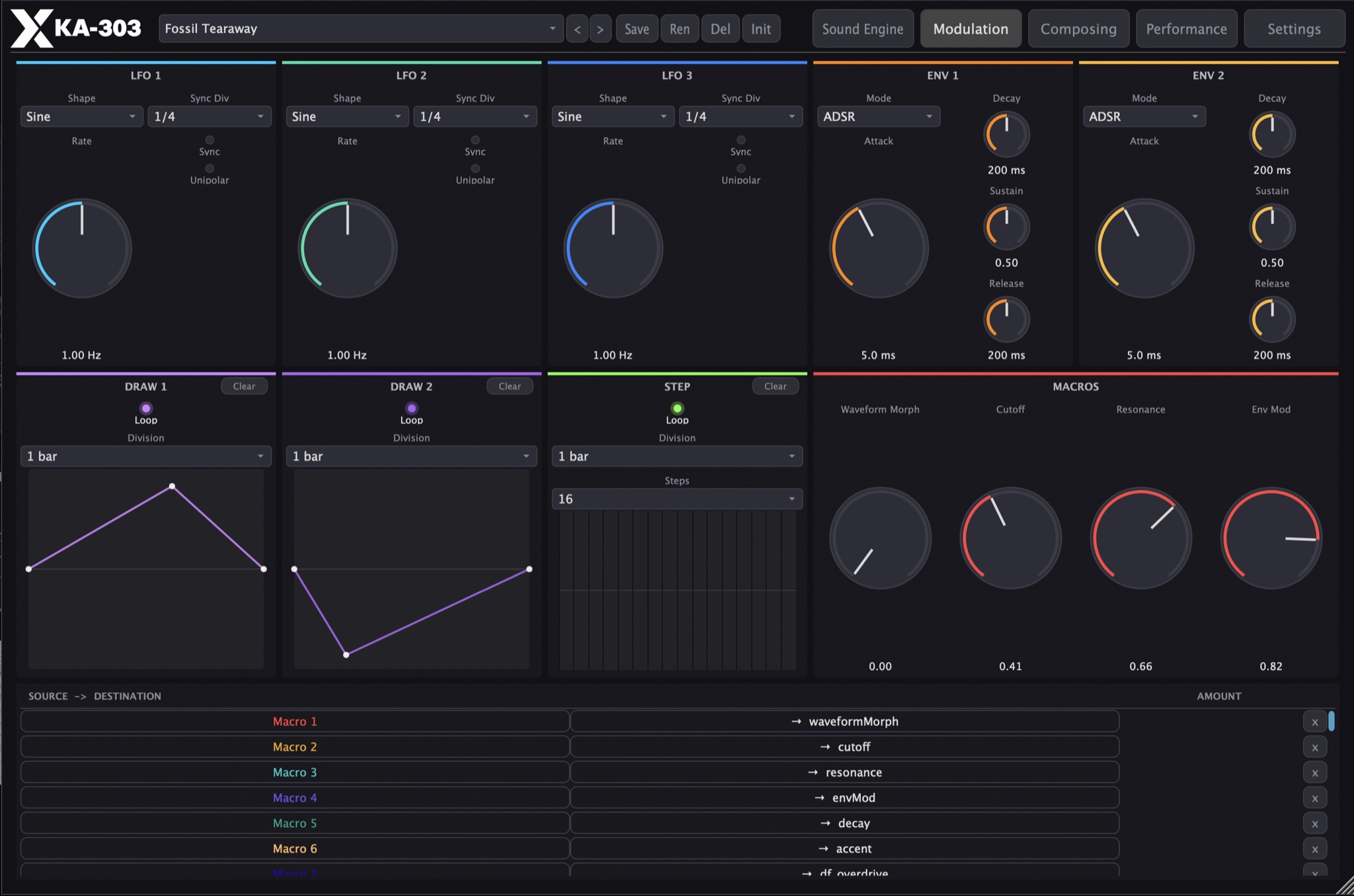
The KA-303 takes the sound of the TB-303 as its starting point and builds an instrument of its own around it. The filter is a recreation of the original diode ladder with zero-delay feedback: four cascaded integrator stages with asymmetric coefficients, soft-clipping saturation after 1S2473 silicon diodes, and the original 150 Hz highpass in the feedback path. Slide, accent and the gimmick circuit are modelled at component level as well, including the capacitor-based accent sweep that accumulates across consecutive accented notes. The composing engine carries the most weight in practice, and all three published reviews single it out independently as the real strength. bonedo calls it the plugin's secret strength. The pattern editor runs 1 to 64 steps per pattern. Odd lengths such as 3, 5, 7 or 11 run against the host's 4/4 grid, creating shifts that build over several bars and resolve again. Scramble, Mutate, Density and a groove engine with five characters (Tight, Shuffle, Funk, Push, Laid Back) move timing and velocity. The MODE selector has eight positions: the dry Standard voice and seven character engines, from Angel Fish through Stonefish, Sea Devil, Lionfish, Dragonfish and Torpedo Ray to Angel Fish II. The CIRCUIT switch moves envelope and accent over to the documented original wiring: the filter envelope then shapes level on accented notes only, an accent shortens the filter sweep instead of stretching it, and nothing rings on after note-off. Added to that are three LFOs, two modulation envelopes, two drawable curves, a step sequencer, a unison engine with up to seven voices and 372 presets. The interface, repeatedly described as plain, can be switched to a light colour scheme in the settings. Version 2.0.0 adds a two row performance tab beside all that. The upper row picks the mode, the lower row holds eight fixed values of it: ROLL with window lengths, SLICER with eight slices of the phrase, GATE with eight gate rates on the final mix, RESTART immediate or quantised up to 16 beats, BUMP with eight absolute cutoff values, ACCENT with eight patterns or strengths, ECHO with eight delay divisions and TRANS with eight intervals. A held pad overrides the value, it does not write it, so the pattern stays intact. There are 64 macros now in the place of four: a macro is a second knob rather than a modulator, its position is the value of its destinations, it has no depth and shows a marker instead of a ring at the destination. The TIMING switch below CIRCUIT charges the accent ten times faster, so the peak arrives after 47 instead of 141 milliseconds and the filter swings 2.91 instead of 1.18 octaves. Two ACC knobs send accented notes only into delay and reverb, SEMI and MICRO tune the oscillator in semitones and cents, and cutoff now reaches down to 60 Hz instead of stopping at 200 Hz. Version 2.1.0 lets the eight pad modes play together. EXPAND unfolds the performance tab into an 8x8 view, all eight rows with eight pads each, visible and playable at the same time: GATE chops while ROLL repeats and TRANS transposes. Each of the 64 tiles carries its own parameter for that, opened for MIDI Learn with a right click, so a controller can be laid across the whole matrix in one go. A right click on a mode button also learns that button's position: the switch then reads go to ROLL instead of stepping through all eight rows. ROLL and SLICER nest, with the roll sitting inside the slice: shorter repeats its beginning, longer widens it into a loop across the neighbouring slices. The composing tab now holds 22 scales from two to twelve notes, fourteen of them new, among them Blues, Harmonic Minor, Phrygian Dominant, Whole Tone, Hirajoshi and Double Harmonic. A keyboard with white and black keys and note names runs along the left edge of the piano roll, the horizontal grid knows triplets and can be switched off entirely, and SNAP when off releases both directions, pitch and time.
- Diode ladder filter with zero-delay feedback, modelled at component level: 1S2473 diodes, 150 Hz highpass in the feedback path
- Composing engine with 1 to 64 steps per pattern, page system, MIDI import and MIDI export by drag and drop
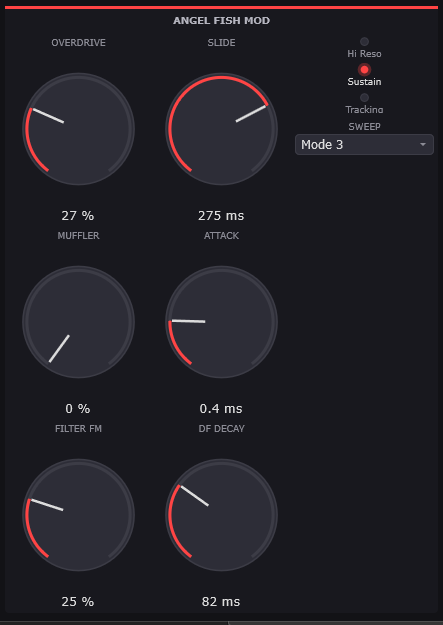
- Eight modes: Standard plus seven character engines, among them Angel Fish II with up to roughly 41x overdrive gain
- CIRCUIT switch between the modern and the documented original envelope wiring, stored per preset
- Modulation system with three LFOs, two envelopes, two drawable curves, a step sequencer, 51 destinations and 77 sources
- Performance tab with eight pad modes (ROLL, SLICER, GATE, RESTART, BUMP, ACCENT, ECHO, TRANS), all eight playable at once in the 8x8 view, plus 64 macros
- 64 row-bound pad parameters for MIDI Learn and automation, a right click on a mode button learns its position as a switch
- 22 scales from two to twelve notes, keyboard along the piano roll, horizontal grid with triplets or switched off entirely
- TIMING switch between modern and original accent time constants, ACCENT ONLY for delay and reverb
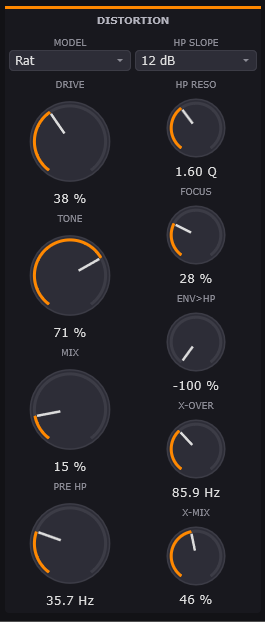
- Four distortion models (DS-1, Tube, Rat, Fuzz) behind a pre-distortion crossover that keeps the sub bass clean
- Unison with up to seven voices, detune, stereo spread and automatic gain compensation
- SEMI and MICRO for tuning in semitones and cents, cutoff from 60 to 5000 Hz
- 274 sound presets and 98 pattern presets, up to 8x oversampling, dark and light colour scheme
- Price: 69.00 euros
- Formats: VST3, AU, CLAP, Standalone
- Systems: macOS 11.0 or later (Universal Binary, Intel and Apple Silicon), Windows 10 64-bit or later, Linux x86_64
- Version: 2.1.0
- Demo with full functionality, 30 starts
What was added recently
Version 2.1.0, 2026-09-22
- The 8x8 view in the performance tab. EXPAND unfolds all eight modes at once, eight pads each, and they play together: GATE chops while ROLL repeats while TRANS transposes. COLLAPSE folds it back. The row header picks the row the eight generic pad parameters act on, so a mapping from 2.0.0 keeps working unchanged. The chosen view belongs to the window, not to the project.
- 64 row-bound pad parameters, perf_row_1_1 through perf_row_8_8: one tile, one parameter, no matter which row is selected. A right click on a tile opens MIDI Learn for it, and all 64 appear in the host's automation list. That lets a controller be laid across the whole matrix in one go, GATE on one pad bank and TRANS on the next. The eight generic pads remain and keep following the selected row.
- A switch can pick a row instead of stepping through all of them. A right click on a mode button or a row header learns its position along with it: the CC then reads go to ROLL, it switches from value 64 upwards, and releasing it leaves the row where it is. Eight buttons on eight CCs are eight fixed rows. Existing assignments stay linear and behave exactly as before.
- ROLL and SLICER nest. The roll sits inside the slice: shorter repeats its beginning, longer widens it into a loop across the neighbouring slices. Slicer Loop survives a mode change, and ROLL already takes effect while SLICER is merely selected.
- Fourteen new scales in the composing tab, 22 in total from two to twelve notes: Minor Pentatonic, Blues, Harmonic Minor, Phrygian Dominant, Major Pentatonic, Lydian Dominant, Melodic Minor, Whole Tone, Half-Whole Dim., Hungarian Minor, Hirajoshi, Double Harmonic, In-Sen and Fifth. They are appended rather than sorted in, so not a single note moves in the previous eight.
- A keyboard along the left edge of the piano roll, white and black keys with names wherever there is room, otherwise the C keys as a marker to count from. The horizontal grid now knows triplets and can be switched off: 1/8, 1/8T, 1/16, 1/16T, 1/32 and OFF. Cmd while dragging releases a single move. SNAP is now the upper switch and releases both directions, pitch and time. USED in the macro grid hides unassigned macros, and the page buttons carry real macro numbers.
Version 2.0.0, 2026-09-16
- Two row performance tab: the upper row picks the mode, the lower row holds eight fixed values of it. ROLL gives window lengths, SLICER eight slices of the phrase with Slicer Loop, GATE eight gate rates on the final mix, RESTART immediate or quantised up to 16 beats, BUMP eight absolute cutoff values up to 10 kHz, ACCENT eight patterns or strengths, ECHO eight delay divisions as a throw and TRANS eight intervals. A held pad overrides the value, it does not write it.
- 64 macros in the place of four, as a grid in the performance tab, 32 per page or all 64 at once. A macro is a second knob rather than a modulator: its position is the value of its destinations, it has no depth and shows a marker instead of a ring at the destination. The mapping belongs to the sound and is mode aware, HOLD freezes it, and your own layouts live in the PerformancePresets folder. There are 51 destinations now, among them MORPH, PULSE BIAS, the delay's XFEED and FILTER, the limiter ceiling and the two ACC knobs.
- TIMING switch below CIRCUIT with the positions Modern and Classic. Classic charges the accent ten times faster, so the peak arrives after 47 instead of 141 milliseconds and the filter swings 2.91 instead of 1.18 octaves, and in Vintage every note holds for 8 milliseconds before it falls. Modern stays the default, so all 274 factory presets sound unchanged.
- ACCENT ONLY for delay and reverb. One ACC knob per effect sends accented notes only into the echo and the reverb, while the dry path and running tails stay untouched. At 0 percent the result is bit identical to the state before.
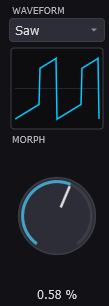
- SEMI and MICRO in the waveform column tune the oscillator in semitones from minus 24 to plus 24 and in cents from minus 50 to plus 50, both saved with the preset. Cutoff now reaches down to 60 Hz instead of stopping at 200 Hz, as deep as the filter has always run internally. The composing engine works with up to 64 steps per pattern.
Version 1.9.0, 2026-08-31
- 49 modulated twins for the Vintage bank, growing it from 225 to 274 presets. Every Ground, Vintage and Fossil patch gains a companion with the identical sound plus its own modulation recipe: the Pillar's 105 Hz hump sways, the Pinhole's aperture eases open and shut, and every Mutter note speaks a different vowel.
- Browsing the MODE list now sounds different per engine. Stonefish, Sea Devil, Lionfish, Dragonfish and Torpedo Ray are additive engines whose macros default to zero, so with untouched knobs they sounded exactly like Angel Fish and stepping through them proved nothing. Selecting one now seeds its three macros with a characteristic setting, so you hear the choice instead of reading it.
- Clear buttons in the step sequencer and in both drawable curves, each in the section's title bar. One click resets all 16 bars, or the drawn curve, back to zero. Before that, every bar had to be dragged down by hand.
- Master tune and limiter ceiling can be stored as this machine's defaults. Anyone tuning to 432 Hz and limiting at minus 1 dB had to redo both on every fresh instance. The values go into the same preferences.xml that already holds the interface settings and apply to every newly created instance.
- In the standalone, the space bar starts and stops the composing engine exactly like the transport buttons, host-sync lockout included. Inside a DAW the space bar is left alone because it belongs to the host, and while a text field has focus it does nothing either.
Version 1.8.0, 2026-08-14
- The CIRCUIT switch next to MODE moves envelope and accent over to the documented behaviour of the original circuit: the filter envelope then shapes level on accented notes only, an accent shortens the filter sweep instead of stretching it, and nothing rings on after note-off. It is stored with the patch and Init resets it to Modern, so no existing preset changes its sound.
- 50 new presets, growing the bank from 175 to 225. They come in three families: Ground with eleven low-end patches built around the pre-distortion highpass, Vintage with 22 squelch, lead and stab sounds that differ in the shape of the filter sweep rather than in cutoff alone, and Fossil with eleven patches for the new vintage wiring. All are appended, so no existing preset index moves.
Version 1.7.0, 2026-07-11
- Angel Fish II as the eighth mode: the same structure as Angel Fish but driven far harder. Overdrive up to roughly 41x with sine fold-back, level-matched so that at full crank the voice stays within about 1 dB of Angel Fish instead of collapsing. Hi Reso reaches into pitched scream territory, turning the resonance knob into a scream throttle.
Video: KA-303 overview
Video: KA-303 in action
Product page: German · English
BREITSEITE: Spectral stereo widener and correlation analyzer
BREITSEITE draws stereo width as a curve across the spectrum, with bass mono and correlation per frequency band.
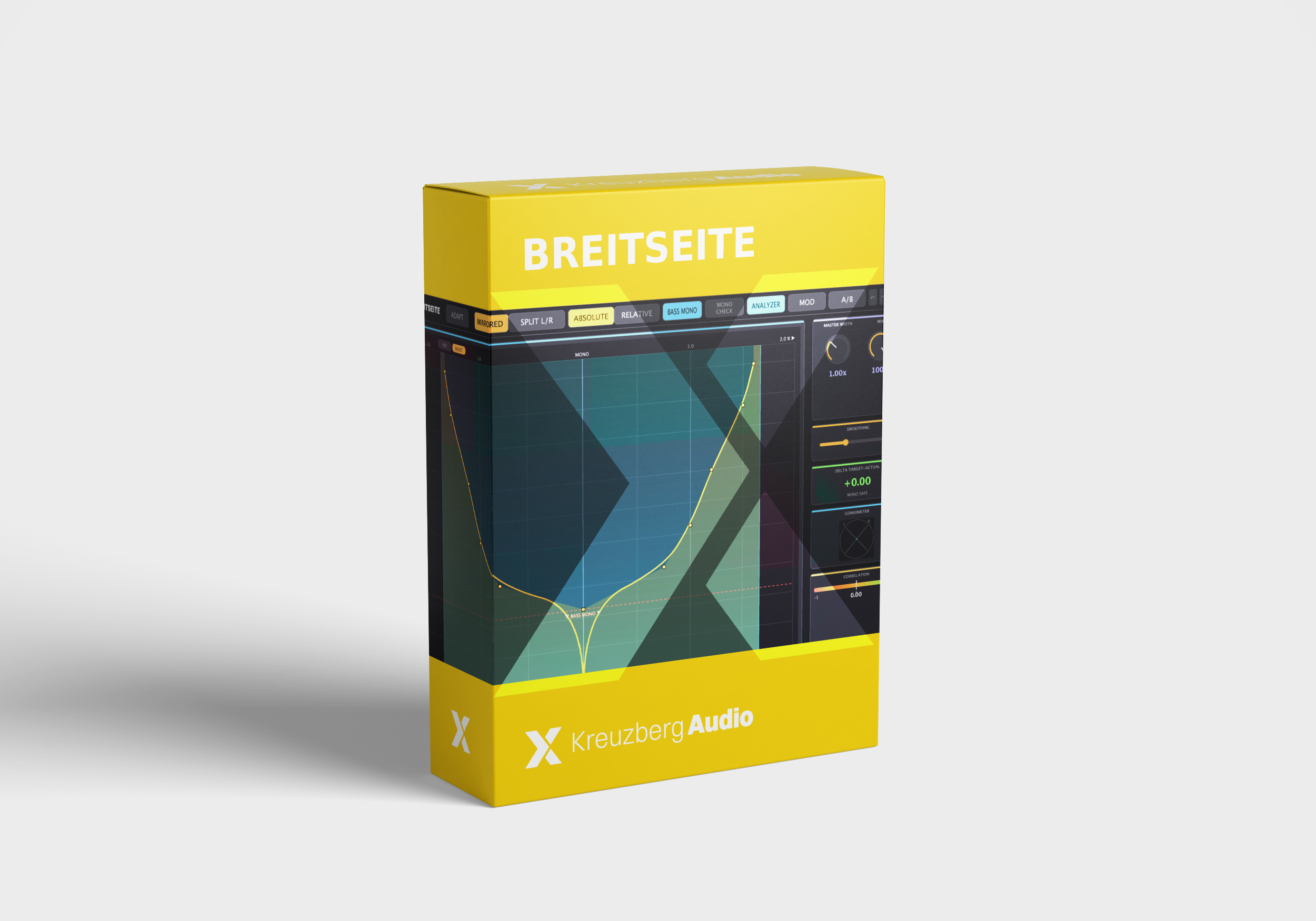
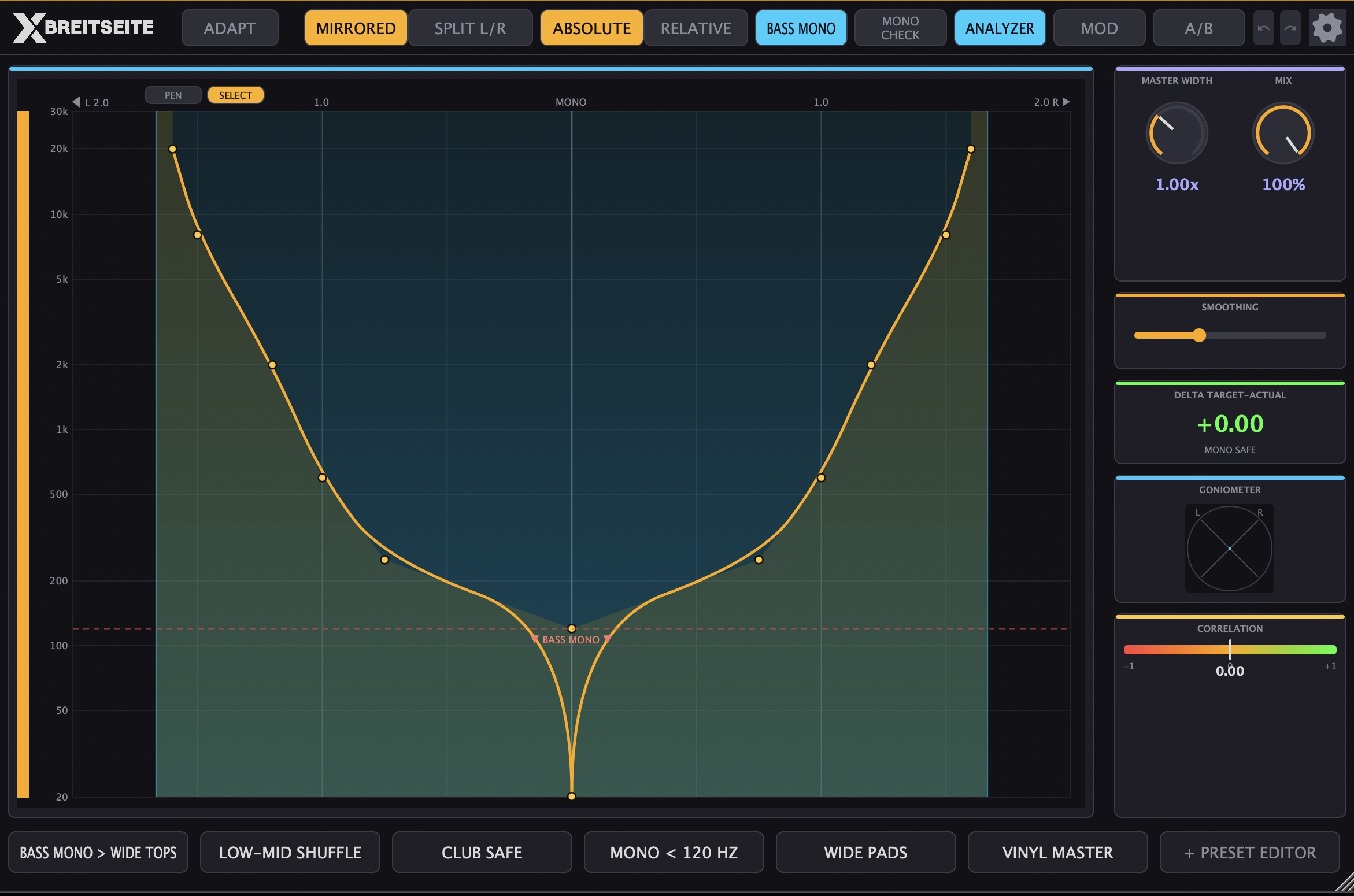
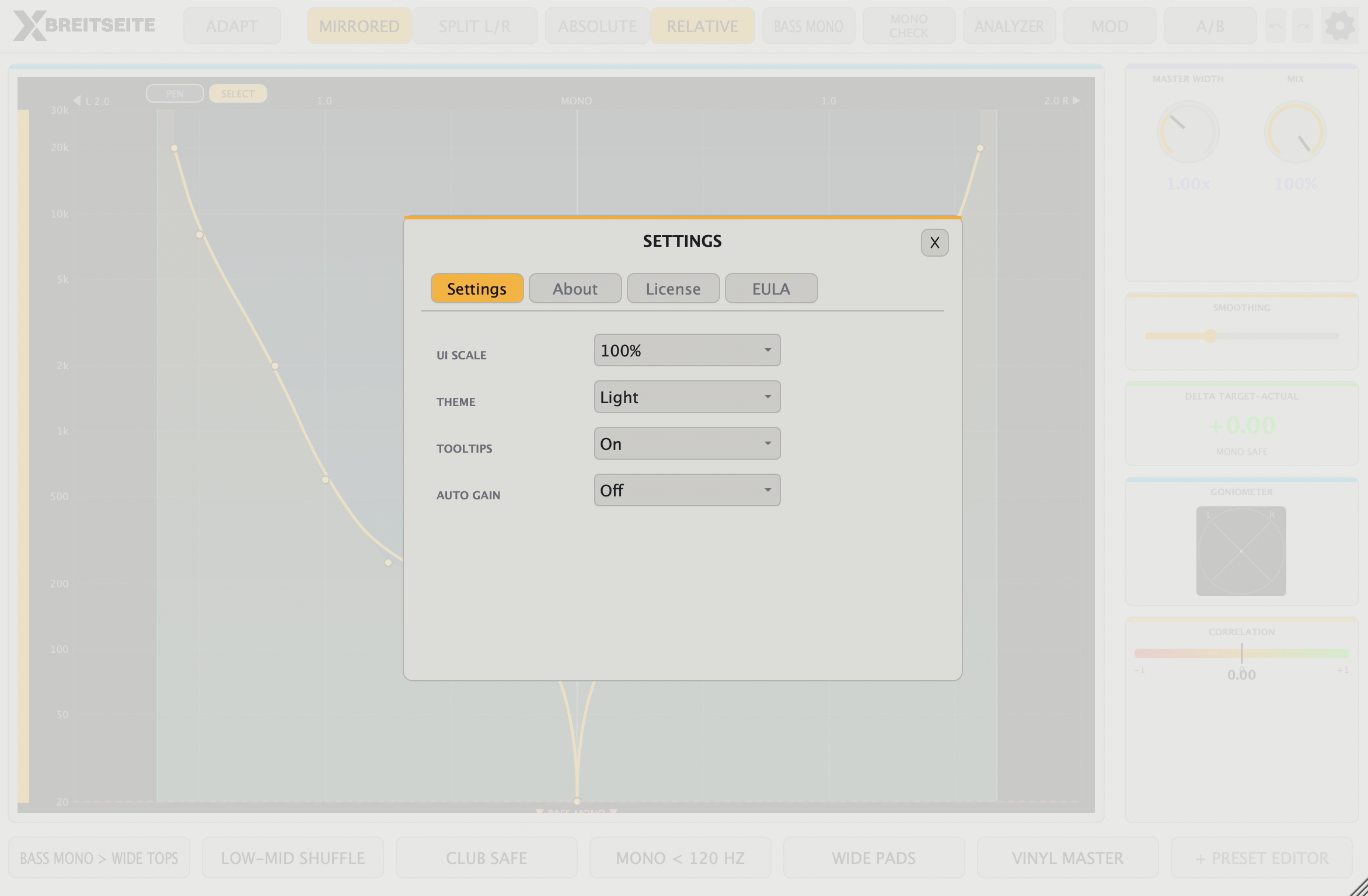
BREITSEITE replaces the single width knob of a classic widener with a curve across the spectrum that sets how wide the signal gets in every frequency band. An analyzer shows at the same time how wide the material already is in each band and where it goes out of phase. Every curve point can move its width with an LFO locked to song tempo, joined by bass mono, level-matched A/B, AUTO GAIN and eight factory presets for mixing and mastering.
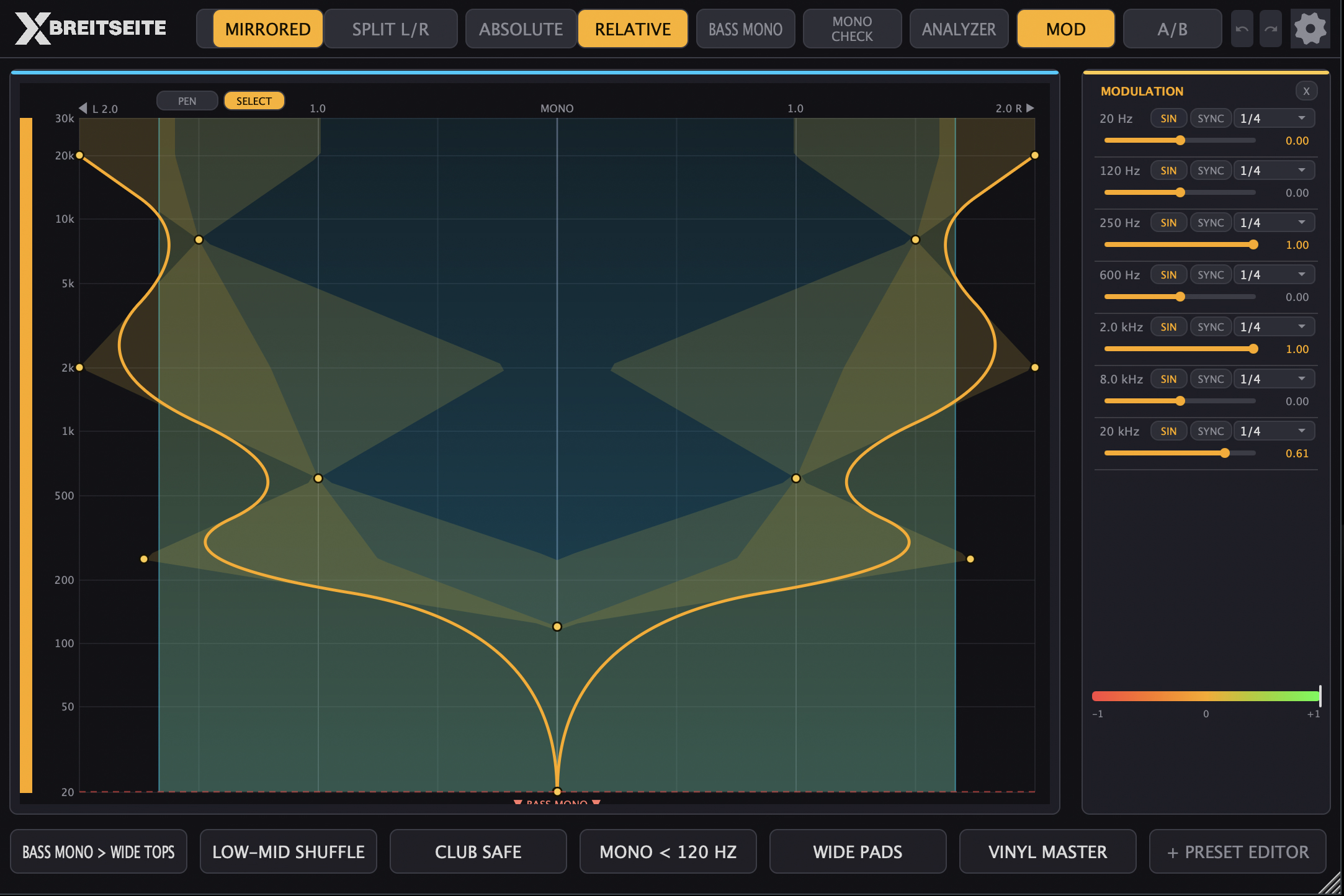
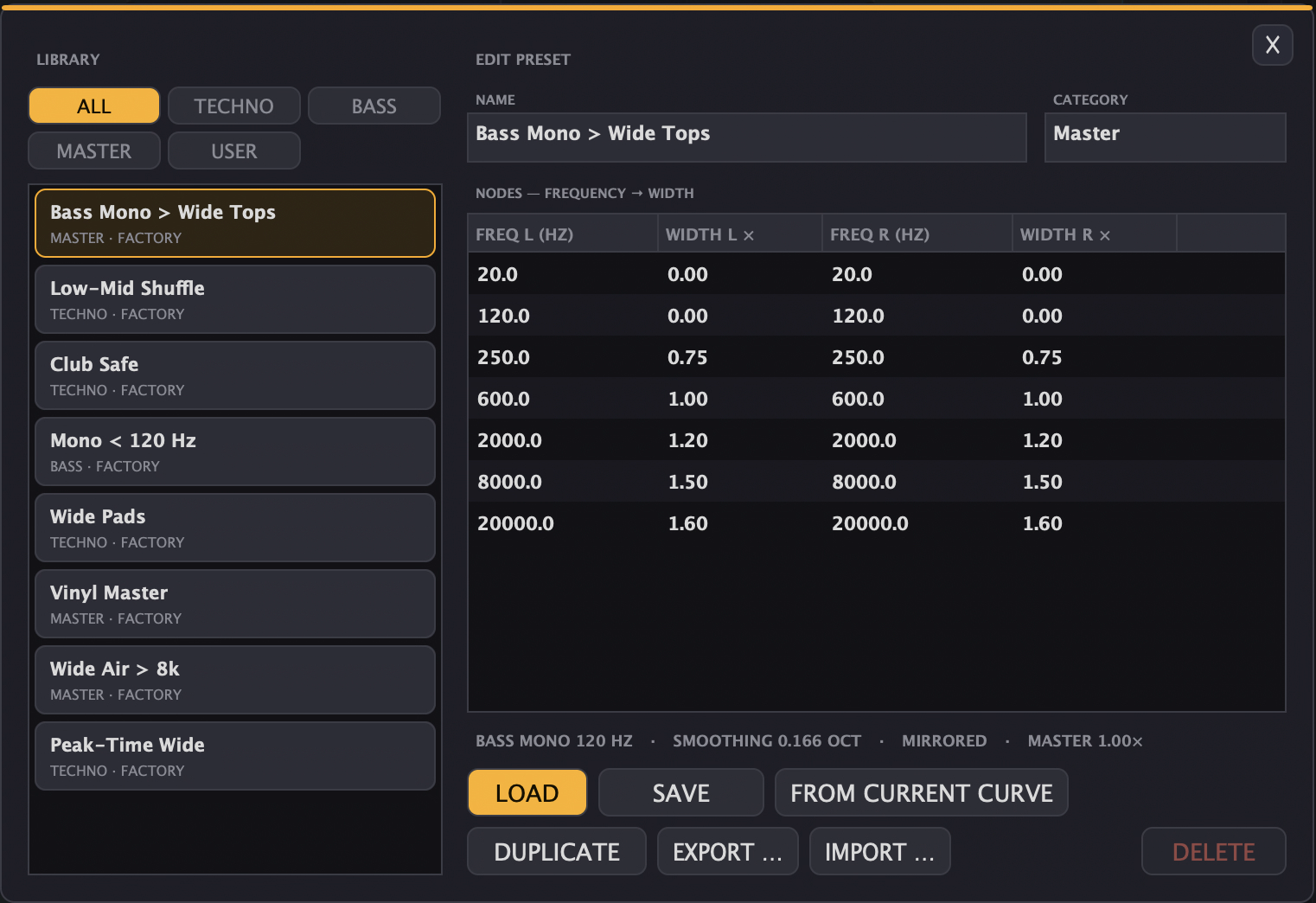
BREITSEITE is a spectral stereo widener for mixing and mastering. Instead of a single knob that widens the whole spectrum evenly, a curve across frequency sets the width: bass mono, mids under control, top open, all in one window. Processing happens in the frequency domain. A short time Fourier transform with a 2048 window and a hop of 512 splits the signal into 1025 bands, and in each band only the side content is multiplied by the value of the curve. There are no time offsets, allpass filters or artificial decorrelation. As long as the left and right curves match, the mid signal stays untouched, and because the side factor never goes negative, the stereo image cannot flip into reverse phase. Behind the curve, an analyzer on the same grid measures how wide the input already is in every band. A correlation strip with 90 logarithmically spaced bands separates in-phase, uncorrelated and out-of-phase content by frequency, backed by a goniometer and a broadband correlation readout. BASS MONO removes the side content below an adjustable boundary from 0 to 300 Hz and brings it back above that over a soft 100 Hz ramp. ADAPT learns a mirrored ten point starting curve from a passage as it plays. Every curve point can move its width with its own LFO, up to eight points per side, with five waveforms taken from KA-303, 14 note values in SYNC mode and 0.01 to 20 Hz in FREE mode. In SYNC the phase comes from the song position alone, so a bounce sounds exactly like playback. Two tools guard against being fooled by loudness: A/B crossfades to the original in 7 ms and matches loudness by up to 12 dB, and AUTO GAIN pulls the processed signal down by the level gain that extra width brings with it. Eight factory presets in the Master, Techno and Bass categories cover typical jobs, among them Club Safe and Vinyl Master. A preset editor shows every node in an editable table. Latency is a constant 2048 samples, 42.7 ms at 48 kHz, and is reported to the DAW, which makes BREITSEITE a tool for mixing and mastering rather than for monitoring while tracking.
- A width curve across the spectrum instead of a single knob, 1025 frequency bands via STFT (window 2048, hop 512, 75 percent overlap)
- Only the side content is scaled: with a mirrored curve the mid stays untouched, and the side factor never goes negative
- Correlation strip with 90 logarithmically spaced bands, plus goniometer and broadband correlation
- Movement per curve point: up to eight points per side, five waveforms, 14 note values in SYNC, 0.01 to 20 Hz in FREE
- ADAPT learns a mirrored ten point starting curve from the material as it plays
- A/B with a 7 ms crossfade and loudness matching up to 12 dB, AUTO GAIN against the level gain from added width
- BASS MONO from 0 to 300 Hz with a soft 100 Hz ramp, ABSOLUTE and RELATIVE modes, MASTER WIDTH from 0 to 3.0
- Eight factory presets in three categories, preset editor with an editable node table
- Constant latency of 2048 samples reported to the DAW, tested with pluginval, auval and clap-validator
- Price: 49.00 euros
- Formats: VST3, AU (macOS), CLAP, AAX (macOS and Windows), Standalone
- Systems: macOS 11 Big Sur or later (Universal Binary, Intel and Apple Silicon), Windows 10 and 11 (64-bit), Linux x86_64 from Ubuntu 22.04 (glibc 2.35), JACK or ALSA
- Version: 0.3.4
- Demo with full functionality, short noise burst every minute, 29 launches
What was added recently
Version 0.3.4, 2026-09-21
- AAX for Pro Tools, on macOS and on Windows, PACE-signed as Avid requires and listed under Sound Field. The macOS installer offers it as a fifth component, the Windows installer includes it in the full installation. There is no AAX on Linux.
- The host bypass is time-accurate. It used to pass the signal through undelayed while BREITSEITE kept reporting 2048 samples of latency: the host shifted every other track, leaving a bypassed track almost 43 ms ahead of the mix at 48 kHz. VST3, AU and CLAP were affected in the same way. BREITSEITE now reports a bypass parameter of its own and crossfades over 7 ms to the latency-delayed original, unchanged in level.
Version 0.3.2, 2026-09-17
- BREITSEITE arrives. Stereo width sits as a curve across the spectrum instead of on a single control: an STFT with a 2048 window and a 512 hop splits the signal into 1025 bands, and in each band only the side component is multiplied by the curve value. No time shifts, no allpass filters, no artificial decorrelation. Behind it an analyzer measures on the same grid, joined by a correlation bar with 90 logarithmically spaced bands, a goniometer and a broadband correlation readout.
- Every curve point can move its width with its own LFO, up to eight points per side, with five waveforms, 14 note values in SYNC mode and 0.01 to 20 Hz in FREE mode. In SYNC the phase follows from the song position alone, so a bounce sounds exactly like playback. Depth is signed, so two points can counter-move against each other.
- Two tools work against being fooled by loudness: A/B crossfades to the original in 7 ms and matches loudness up to 12 dB, while AUTO GAIN pulls the processed signal down by the level increase that extra width brings. BASS MONO removes the side component below a threshold between 0 and 300 Hz and fades it back in above that with a gentle 100 Hz ramp. ADAPT learns a mirrored ten-point starting curve from a passage you play.
Product page: German · English
EXTRAKT: Stem separation, MIDI, BPM and key detection
Stem separation, MIDI, BPM and key detection in one plugin, running entirely locally.
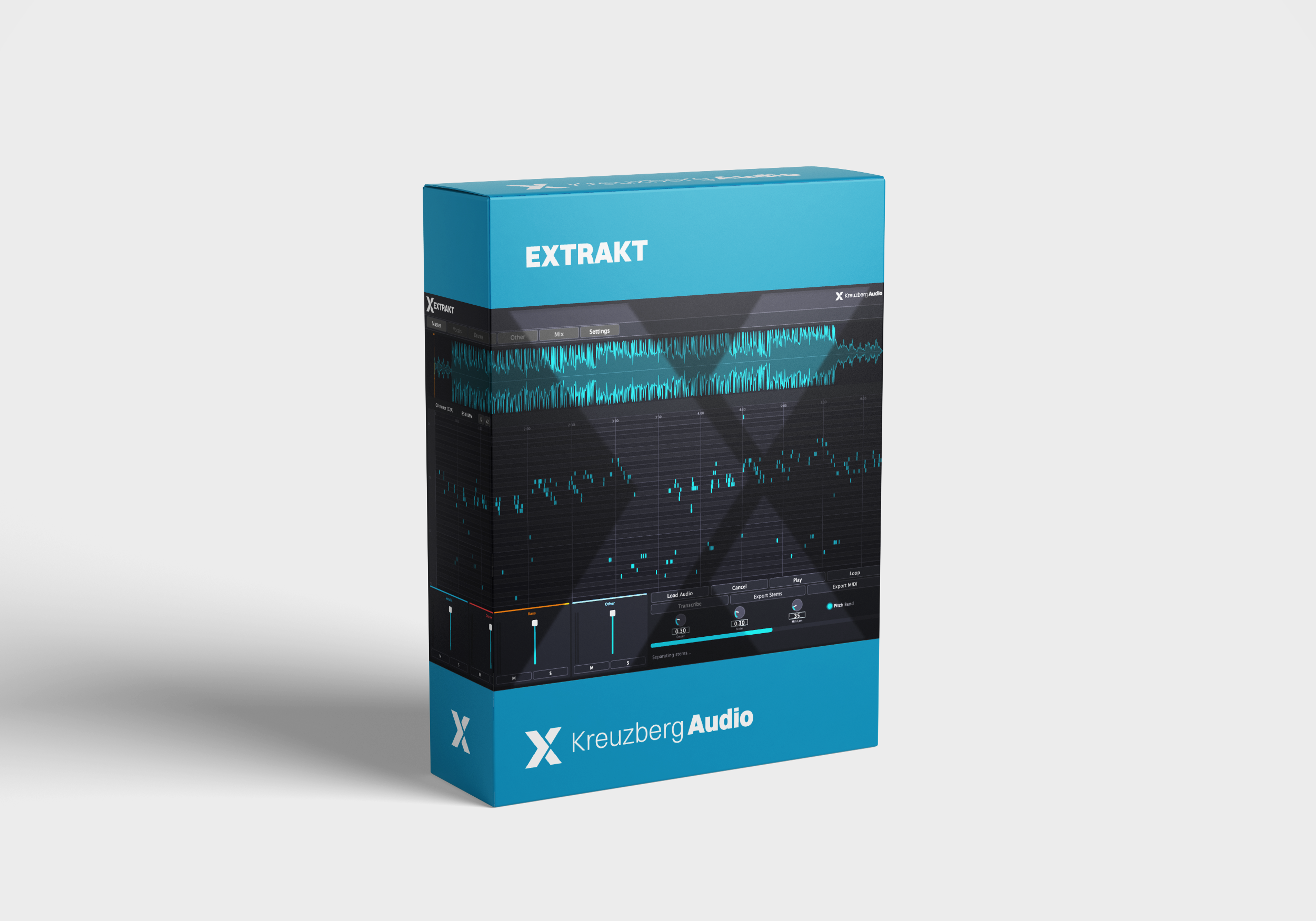
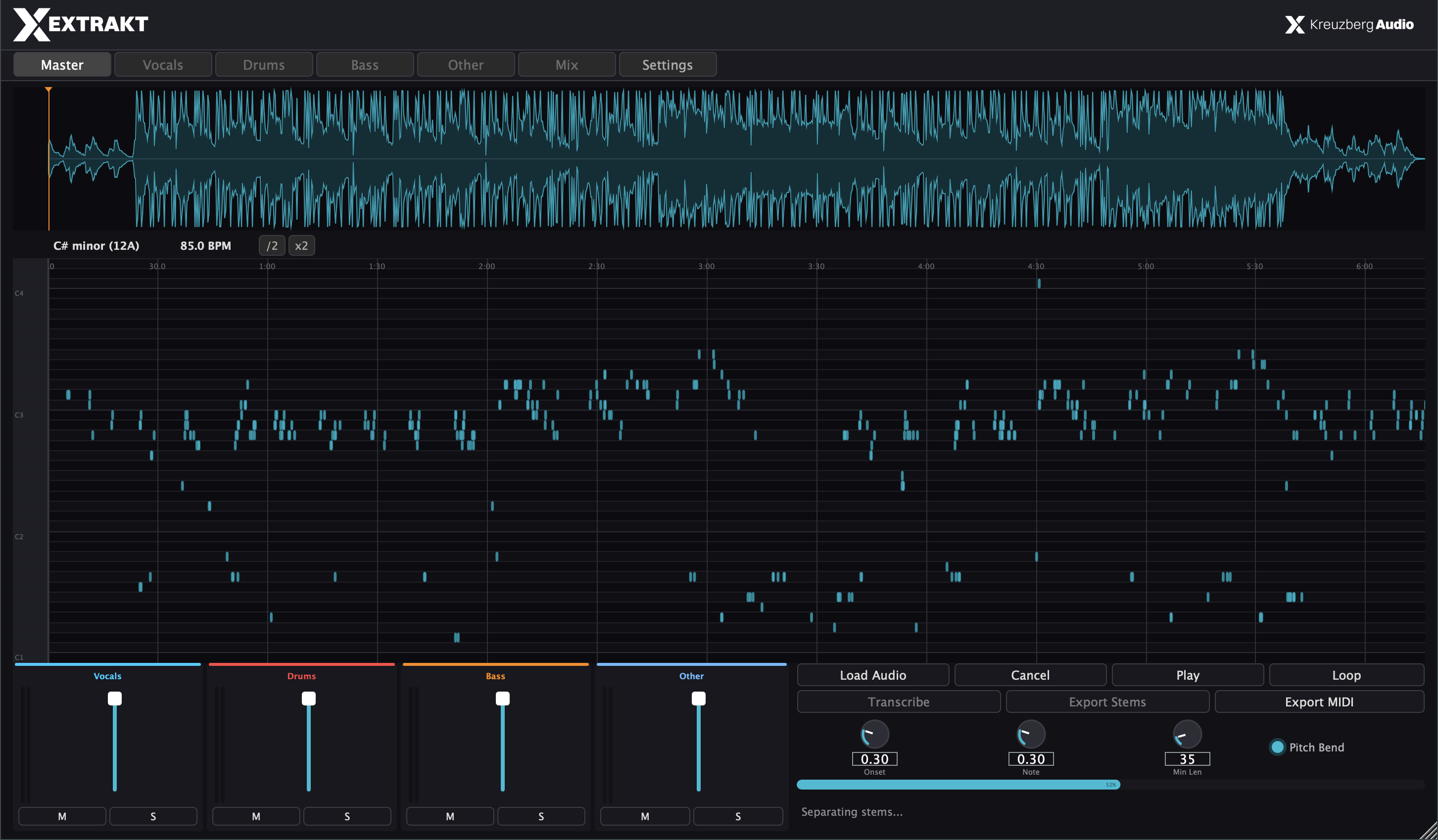
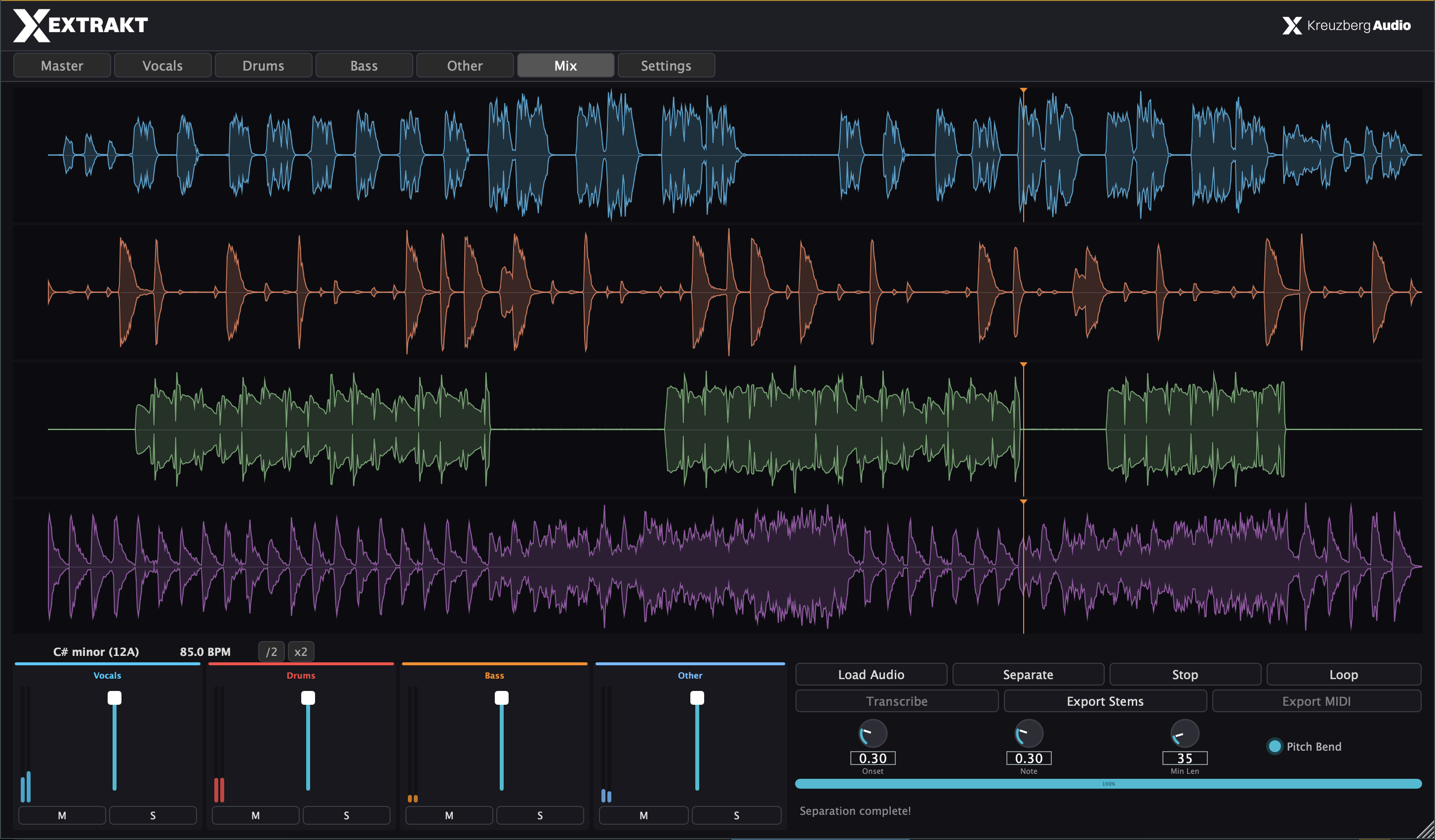
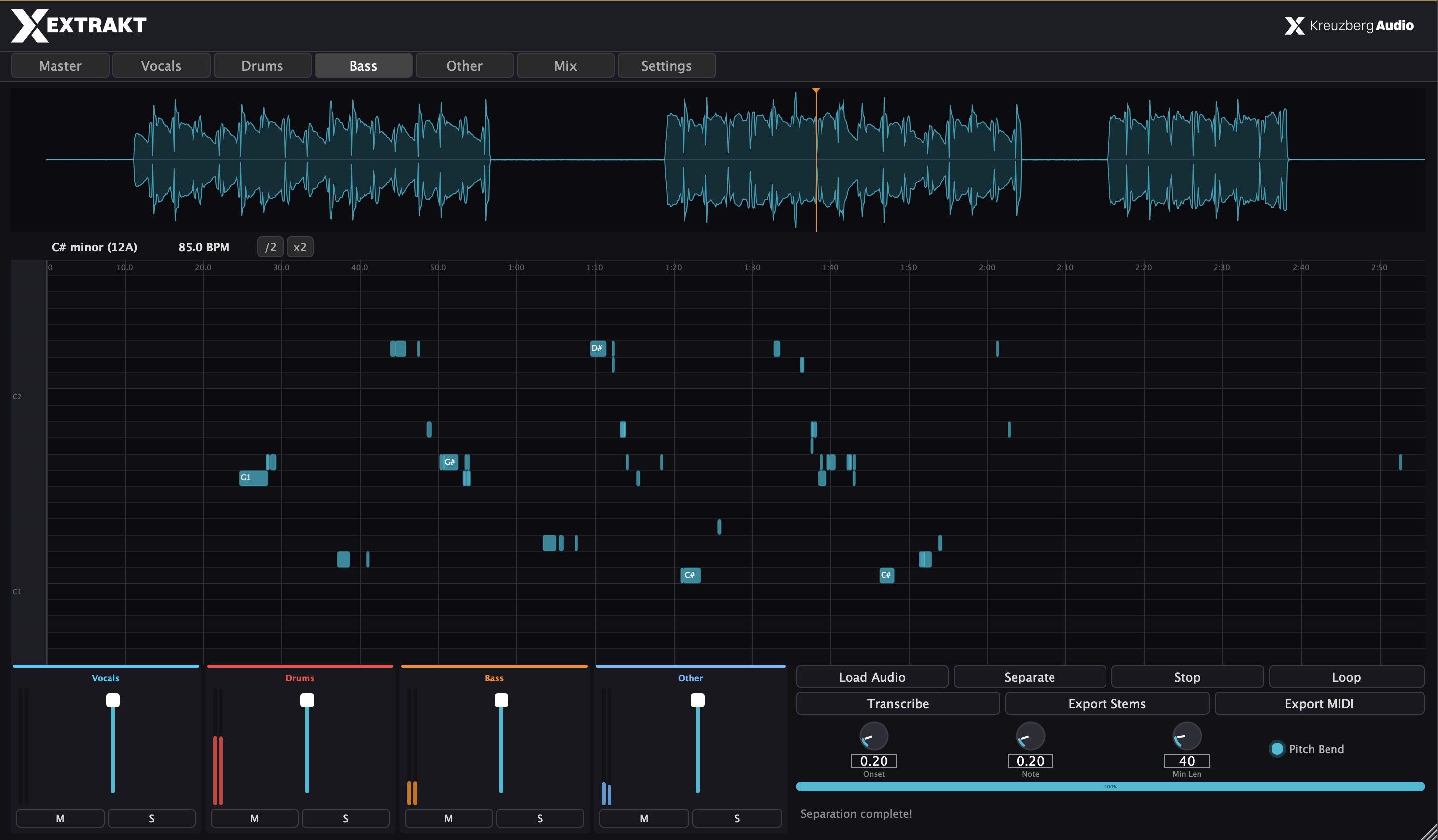
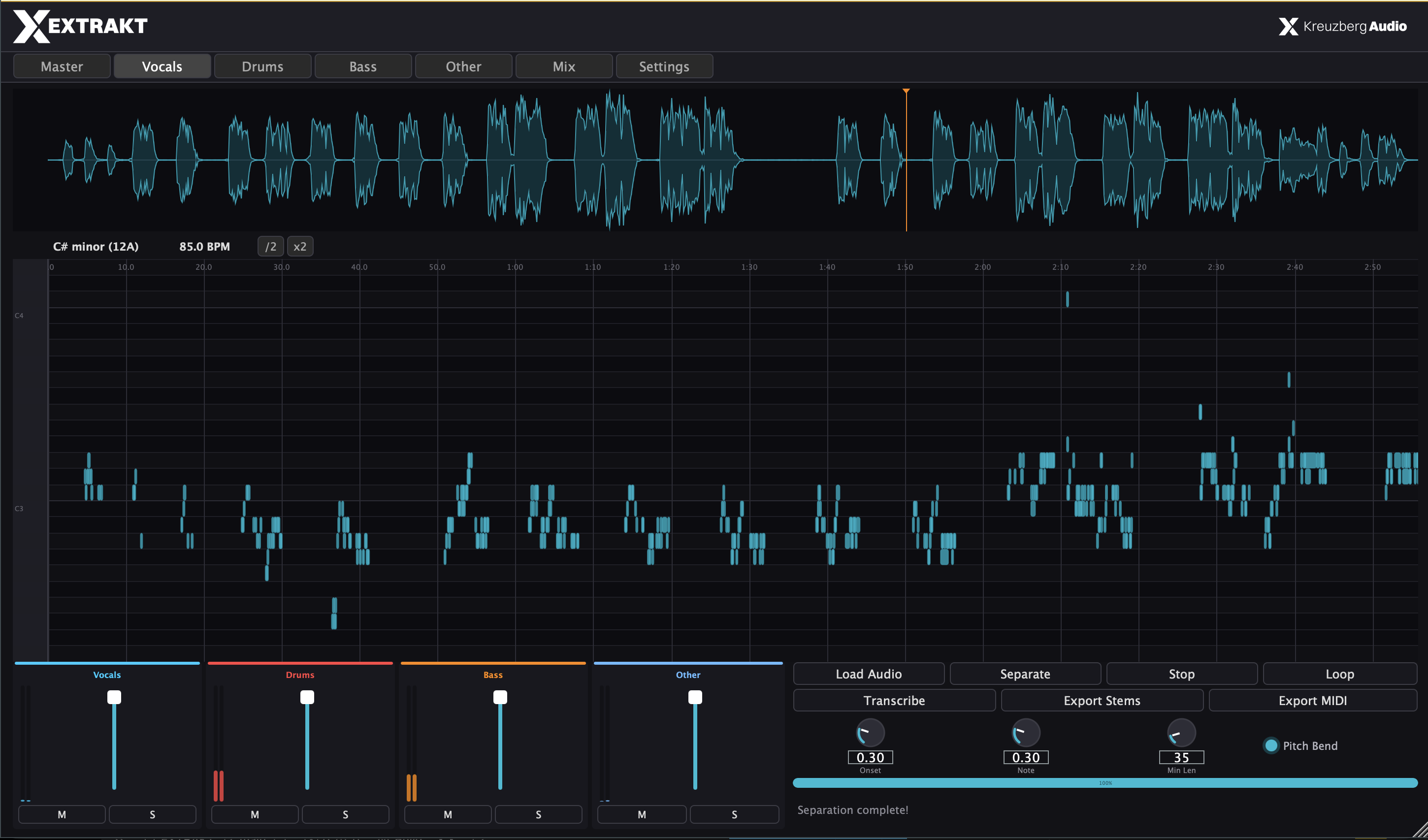
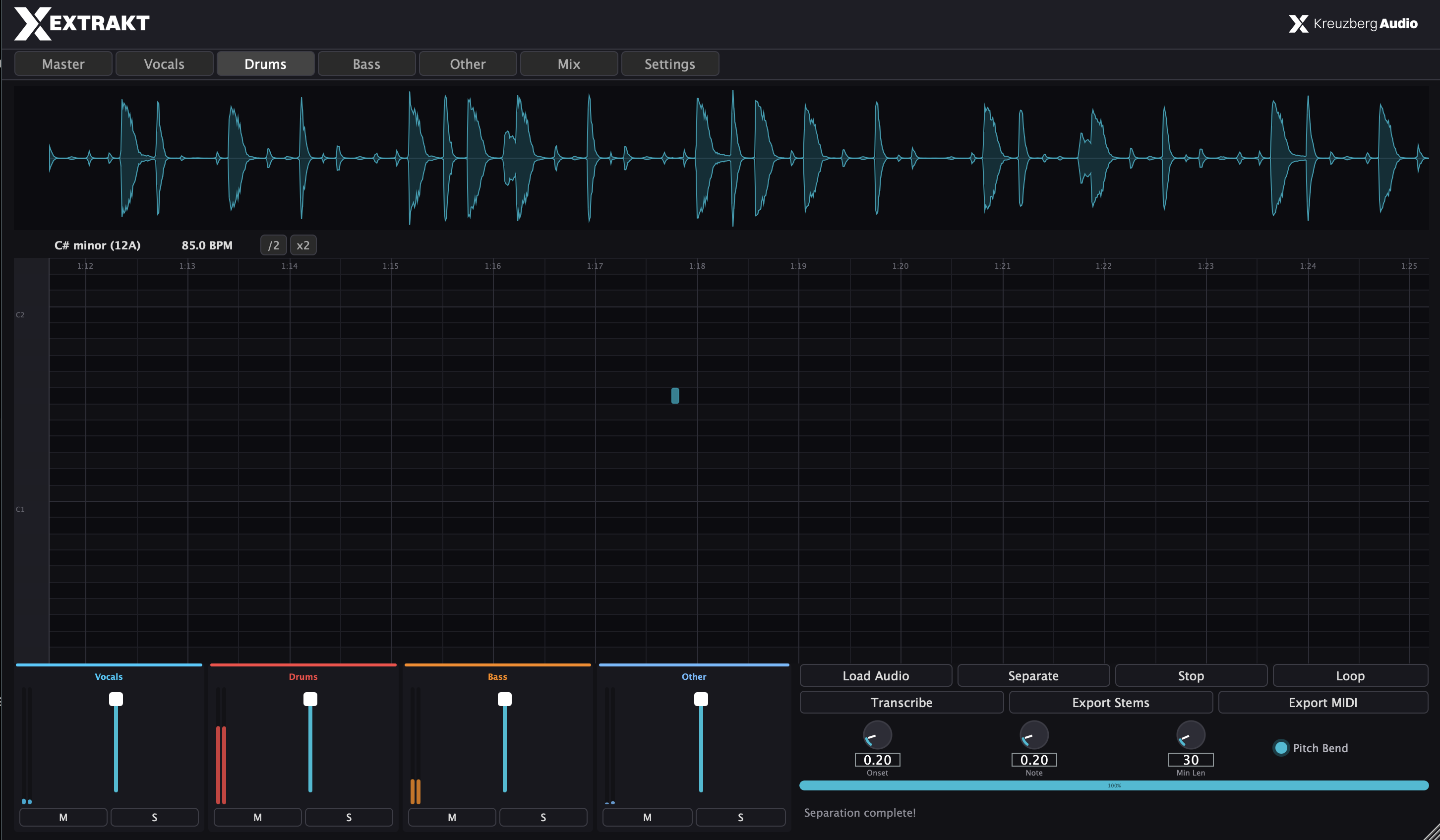
EXTRAKT 1.0.3 combines four tools in one plugin: stem separation into vocals, drums, bass and other based on HTDemucs, per-stem MIDI transcription via Spotify Basic Pitch, BPM detection from 60 to 200 BPM, and key detection via Krumhansl-Schmuckler with a Camelot readout. Everything runs locally after a one-time model download. A demo with the full feature set is available.
EXTRAKT bundles four jobs that are normally spread across several tools and, in most cases, a cloud service: stem separation, MIDI transcription, BPM detection and key detection. Separation into vocals, drums, bass and other runs on HTDemucs, the hybrid transformer model from Meta. Transcription is handled by Spotify Basic Pitch, polyphonic and with optional pitch bend. BPM detection uses onset energy autocorrelation and reports a value between 60 and 200 BPM to one decimal place; key detection follows Krumhansl-Schmuckler and also shows the result as a Camelot position. The order of operations is what matters. Standard audio-to-MIDI tools read notes out of the full mix and return a cloud of bass, chords, snare transients and vocal frequencies. EXTRAKT separates first and transcribes each stem on its own afterwards. The bassline comes out as a bassline, the other stem as chord voicing, the vocal melody as a monophonic line with its vibrato intact. All processing happens on the user's own machine. On first launch EXTRAKT pulls roughly 170 MB of model data once; after that there is no upload and no network connection required. On Apple Silicon the inference runs through CoreML, separating three minutes of audio in 25 to 35 seconds. On Windows and Linux an AVX2-optimised CPU path takes over. Three thresholds control transcription per stem: Onset for note starts, Note for frame confidence and Min Length for the shortest note duration. Pitch bend is switchable per stem, which suits vocals with vibrato and lead synths with glides. Export writes four 24-bit WAV files and a standard MIDI file with a correct tempo map. In parallel, EXTRAKT emits the notes in real time onto the DAW track.
- Stem separation into vocals, drums, bass and other based on HTDemucs
- Per-stem MIDI transcription via Spotify Basic Pitch, polyphonic, with optional pitch bend
- BPM detection by onset energy autocorrelation, 60 to 200 BPM to one decimal place
- Key detection via Krumhansl-Schmuckler, additionally shown as a Camelot position
- All processing local, with no network connection after the one-time 170 MB model download
- CoreML on Apple Silicon: three minutes of audio separated in 25 to 35 seconds, AVX2 path on Windows and Linux
- Three thresholds per stem (Onset, Note, Min Length) with per-stem-type defaults, remembered between sessions
- Export as four 24-bit WAV files and a standard MIDI file, plus real-time MIDI output onto the DAW track
- Price: 49.00 euros
- Formats: VST3, AU, Standalone
- Systems: macOS 11.0 or later (Universal Binary, CoreML on Apple Silicon), Windows 10 64-bit or later, Linux x86_64 from Ubuntu 22.04
- Version: 1.0.3
- Demo available
What was added recently
Version 1.0.0, 2026-05-11
- EXTRAKT arrives. Four tools in one plugin: stem separation into vocals, drums, bass and other via HTDemucs, MIDI transcription per stem via Spotify Basic Pitch, BPM detection from 60 to 200 BPM to one decimal place, and key detection after Krumhansl and Schmuckler with a Camelot readout. Everything runs locally on your own machine, with no network connection needed after the one-off model download of around 170 MB.
Version 1.0.1, 2026-05-16
- Two buttons beside the BPM readout halve and double the detected value, for the classic octave confusion where 120 BPM reads as 60. Transcription now works reliably on the Mac, with three minutes of audio taking around eight seconds on Apple Silicon. And when something goes wrong inside the inference, the reason now appears in the status line instead of the process quietly stalling.
Version 1.0.2, 2026-05-20
- The Mac installer ships a genuine universal binary for Intel and Apple Silicon again. That is now verified on all three bundles, VST3, Audio Unit and standalone, before the package is signed.
Version 1.0.3, 2026-10-05
- Maintenance update. On some Macs CoreML returned invalid output during separation without raising an error, and EXTRAKT still reported success over silent stems. Every segment is now checked and redone on the CPU when needed. Activation survives system and plugin updates without using another machine slot, and errors go to a log file for support.
Product page: German · English
Grid-909: MIDI drum pattern generator
Grid-909 generates drum patterns as pure MIDI, from 440 pattern sets across 22 genres.
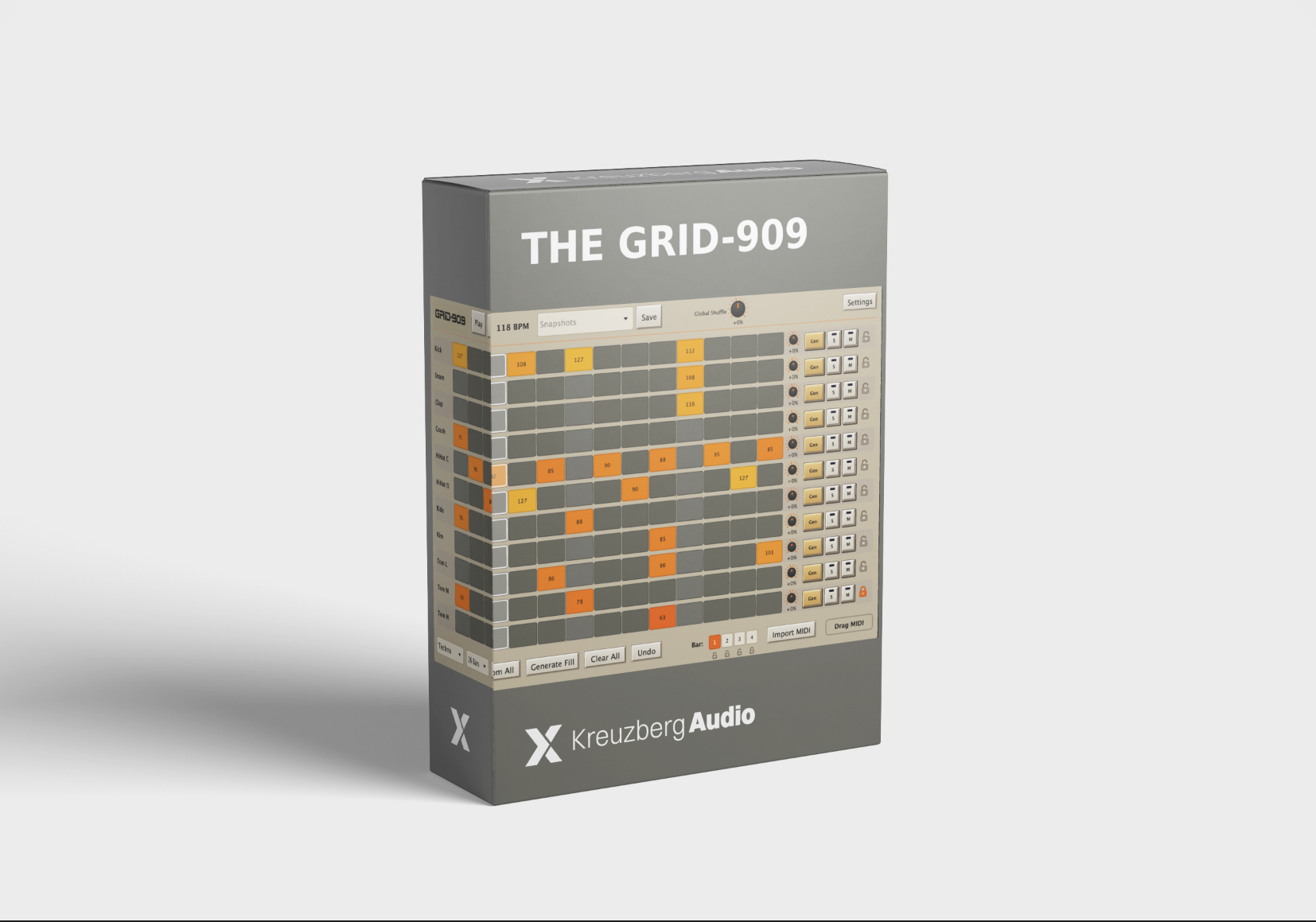
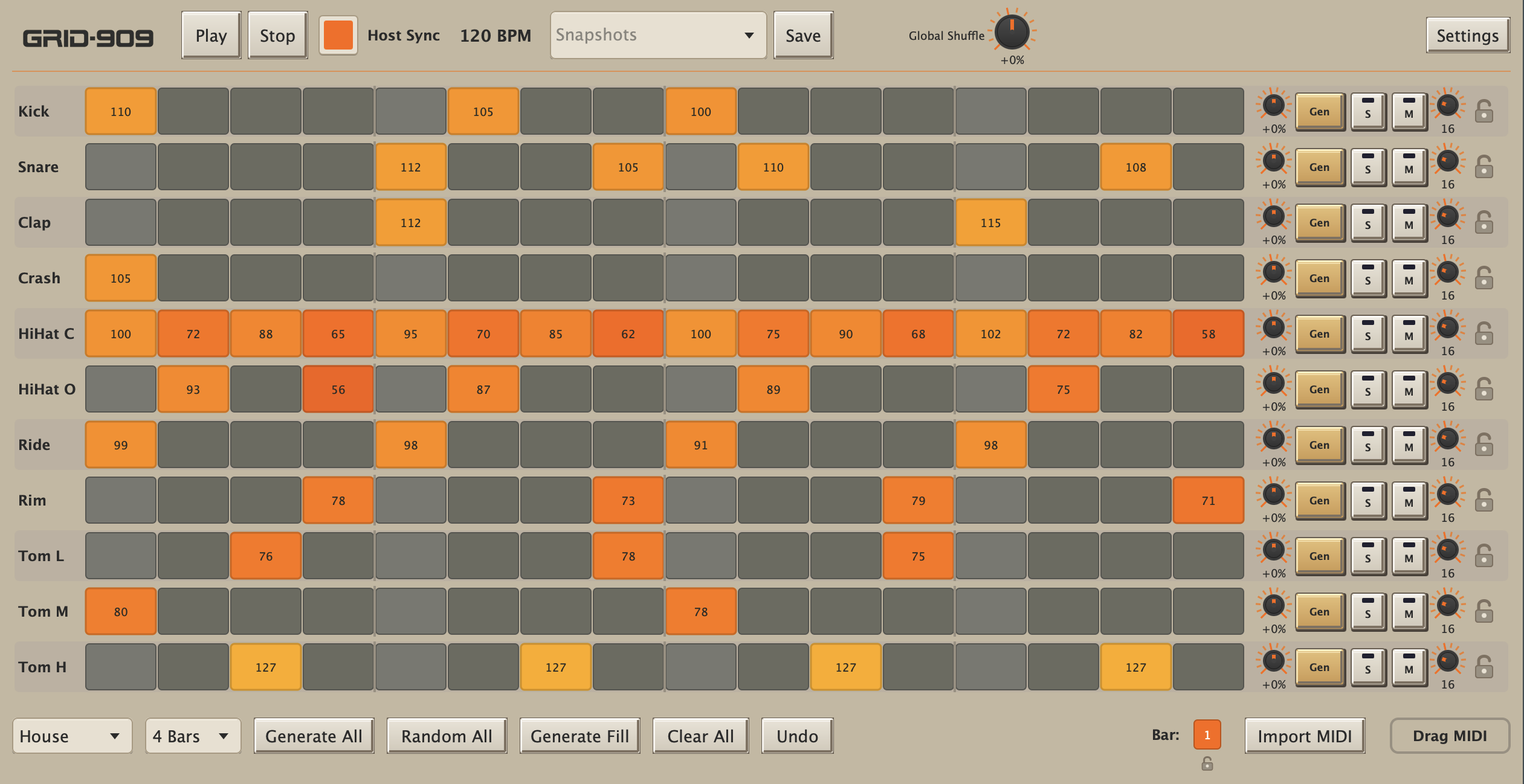
Grid-909 generates drum grooves as pure MIDI and drives any drum machine that understands it. The library holds 440 pattern sets across 22 genres, and each of the eleven tracks has its own generate button. Bipolar shuffle from -50 to +50 per cent and a per-track step length of 1 to 64 open up custom pockets and polyrhythms.
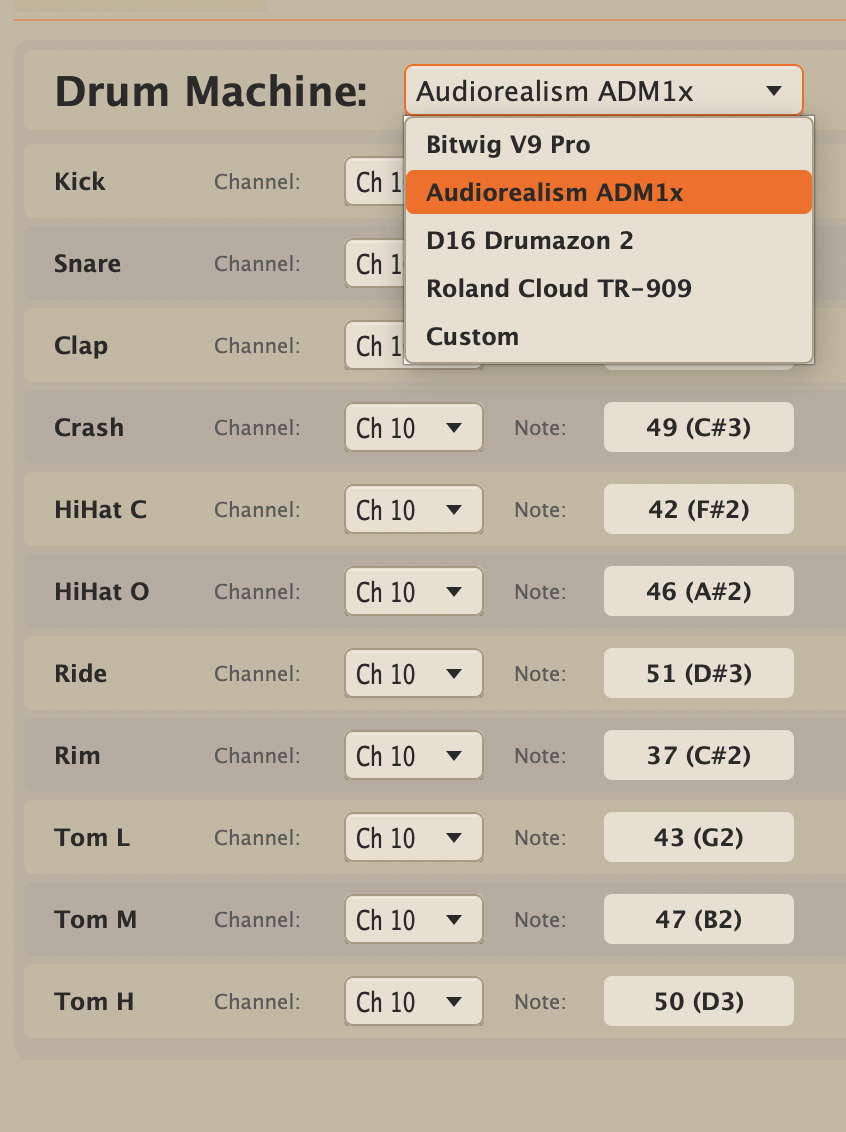
Grid-909 is a MIDI-only generator. The plugin produces no sound of its own, it drives any drum machine, sampler or drum plugin that understands MIDI. It ships with 440 ready-made pattern sets across 22 genres, from House and Techno through Electro, Trance and Breakbeat to Acid House, R&B and UK Garage. Each genre delivers 20 patterns per drum instrument, built by the rules that define that genre. Each of the eleven drum tracks has its own generate button. When the kick works but the closed hi-hat needs something different, only that track gets a new pattern from the library and everything else stays untouched. A lock system excludes individual tracks or entire pages from generation. Shuffle is bipolar, from -50 to +50 per cent, globally or per track, so the kick can sit behind the grid and the hi-hat ahead of it. Velocity is edited right in the grid with a drag, and a downbeat boost automatically gives steps on the one, the three and the quarters slightly more weight. Fill patterns per genre, a snapshot system and up to 64 undo steps are part of it. Every track also has its own LEN control, from 1 to 64 steps. Kick at 16, snare at 9 and closed hat at 3 produce a polyrhythmic constellation that drifts across several bars, with the playhead in each row following its own cycle length. A click on the control returns it to 16. The Settings tab exposes the full MIDI mapping, with assignments for Bitwig V9 Pro, Audiorealism ADM1x, D16 Drumazon 2 and Roland Cloud TR-909. Custom kits are stored as JSON, and patterns arrive by drag and drop as a .mid file and leave through the drag MIDI button.
- 440 pattern sets across 22 genres, 20 patterns per drum instrument and genre
- A separate generate button for each of the eleven drum tracks, plus a lock system for tracks and pages
- Bipolar shuffle from -50 to +50 per cent, globally or per track
- Per-track step length of 1 to 64, with the playhead following each row's own cycle length
- Velocity edited by dragging in the grid, downbeat boost on the one, the three and the quarters already applied
- MIDI only with no sound of its own, one MIDI channel per track, mappings for Bitwig V9 Pro, Audiorealism ADM1x, D16 Drumazon 2 and Roland Cloud TR-909
- MIDI import by drag and drop with automatic quantisation, export through the drag MIDI button including shuffle
- Demo with the full feature set: after three starts it expires
- Price: 49.00 euros
- Formats: VST3, AU, Standalone
- Systems: macOS 11.0 or later (Universal Binary, native on Apple Silicon), Windows 10 64-bit or later, Linux x86_64
- Version: 1.1.2
- Demo with full functionality, three starts
What was added recently
Version 1.1.0, 2026-04-24
- A polyrhythm engine: every drum row gets its own LEN control from 1 to 64 steps. Kick at 16, snare at 9, closed hat at 3, and the patterns drift across bars and only realign when the maths says so. Each row's playhead follows its own cycle, so what you see is exactly what you hear.
- Custom kits as presets. The MIDI note and channel mapping can be saved under a name straight from the Machine dropdown, renamed and deleted. That removes the need to remap on every project switch, and the kits persist across sessions.
- Universal binary for macOS, native on Apple Silicon without Rosetta. Plus a wider, cleaner layout with tighter row spacing and a real-time safe audio engine with no heap allocations in the audio callback.
Version 1.1.1, 2026-04-25
- Drums with a loop length that does not divide into the pattern length, a snare on 9 against a 16-step pattern for instance, now cross the pattern boundary cleanly at every tempo. Saving a custom kit always opens a dialog pre-filled with the current name: keep the name to overwrite, change it to store a variation as a new kit. And Clear All now leaves drum-locked rows alone the same way it leaves locked pages alone.
Version 1.1.2, 2026-06-17
- Grid-909 ships as an instrument instead of a MIDI effect and therefore loads in Ableton Live. Audio output, MIDI input and MIDI output are unchanged, verified with pluginval at strictness 10 and with auval. In Ableton the plugin belongs on a MIDI track whose MIDI output points at the target instrument. In Logic the AU type changes from MIDI FX to software instrument, so existing Logic projects need the plugin inserted once more, while VST3 projects still find it.
Video: Grid-909 overview
Video: Grid-909 polyrhythm update
Product page: German · English
OBERTON: Multiband saturator and parametric EQ
Six-band saturator that distorts only the EQ difference signal and leaves the rest clean.
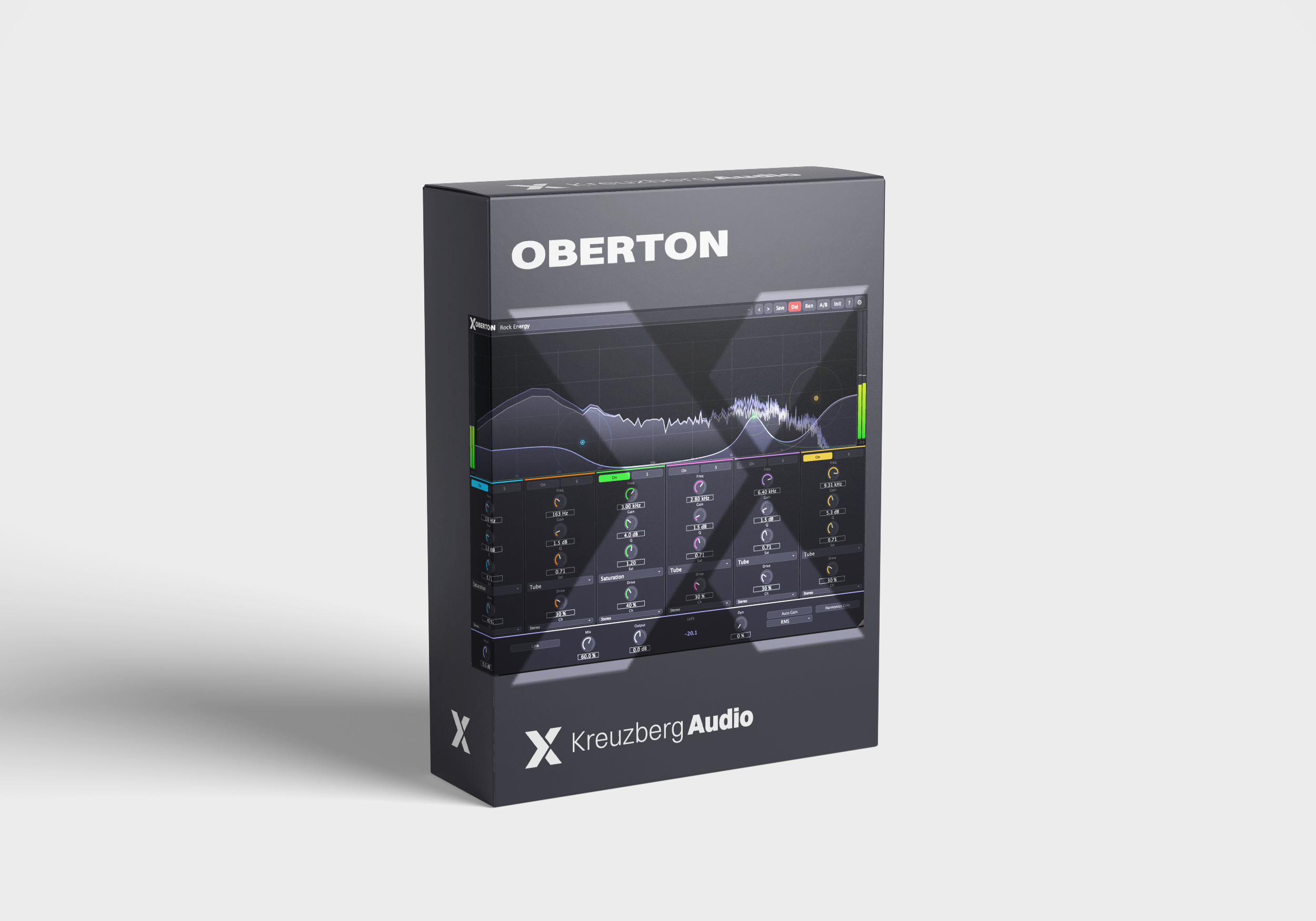
OBERTON 1.7.2 is a multiband saturator with six parametric bands and fifteen saturation algorithms. Each band extracts only its own EQ boost as a difference signal, sends it through the chosen algorithm and mixes only that result back onto the dry signal. Harmonics appear where EQ energy is added. The demo has the full feature set and runs for 30 starts.
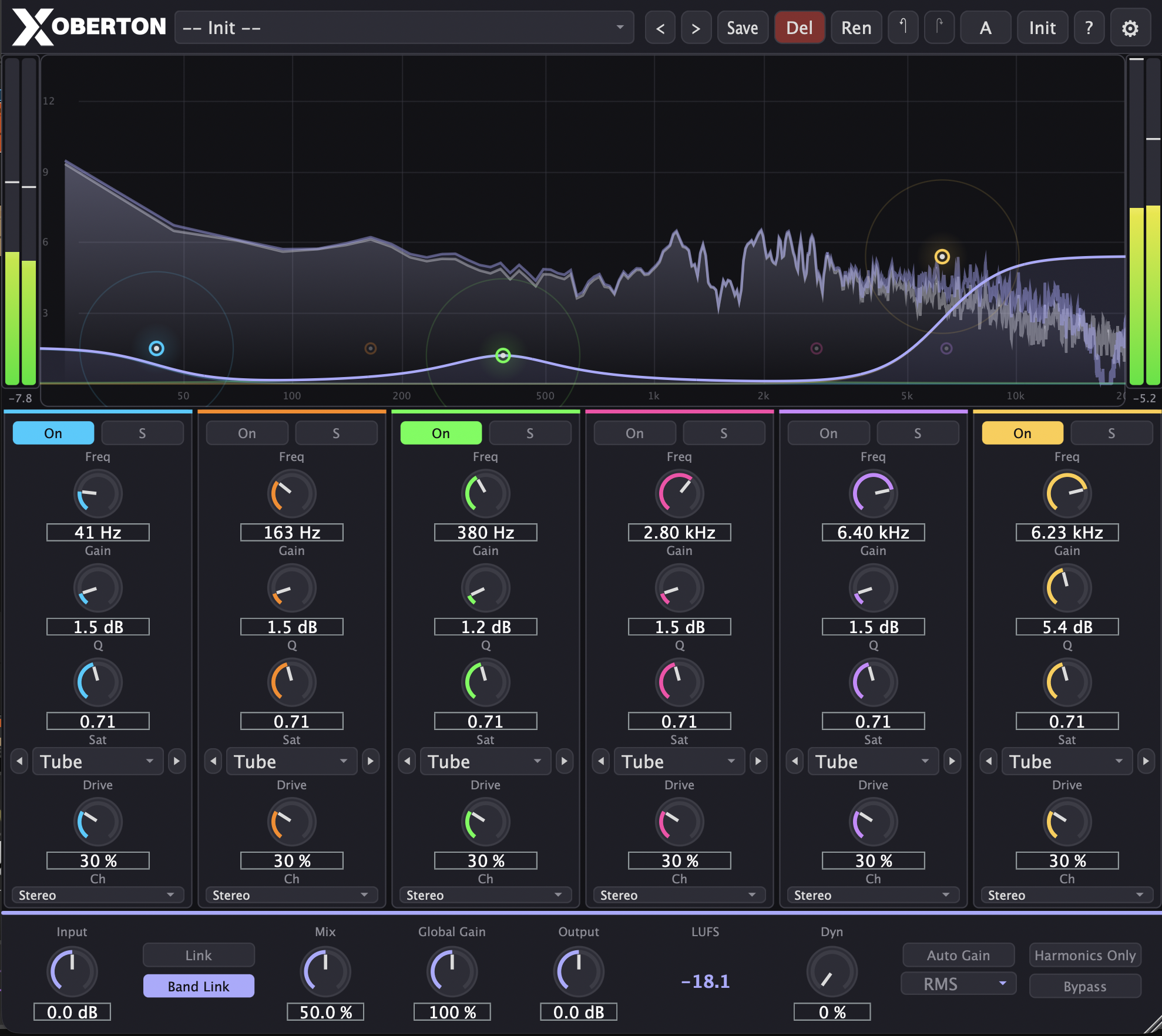
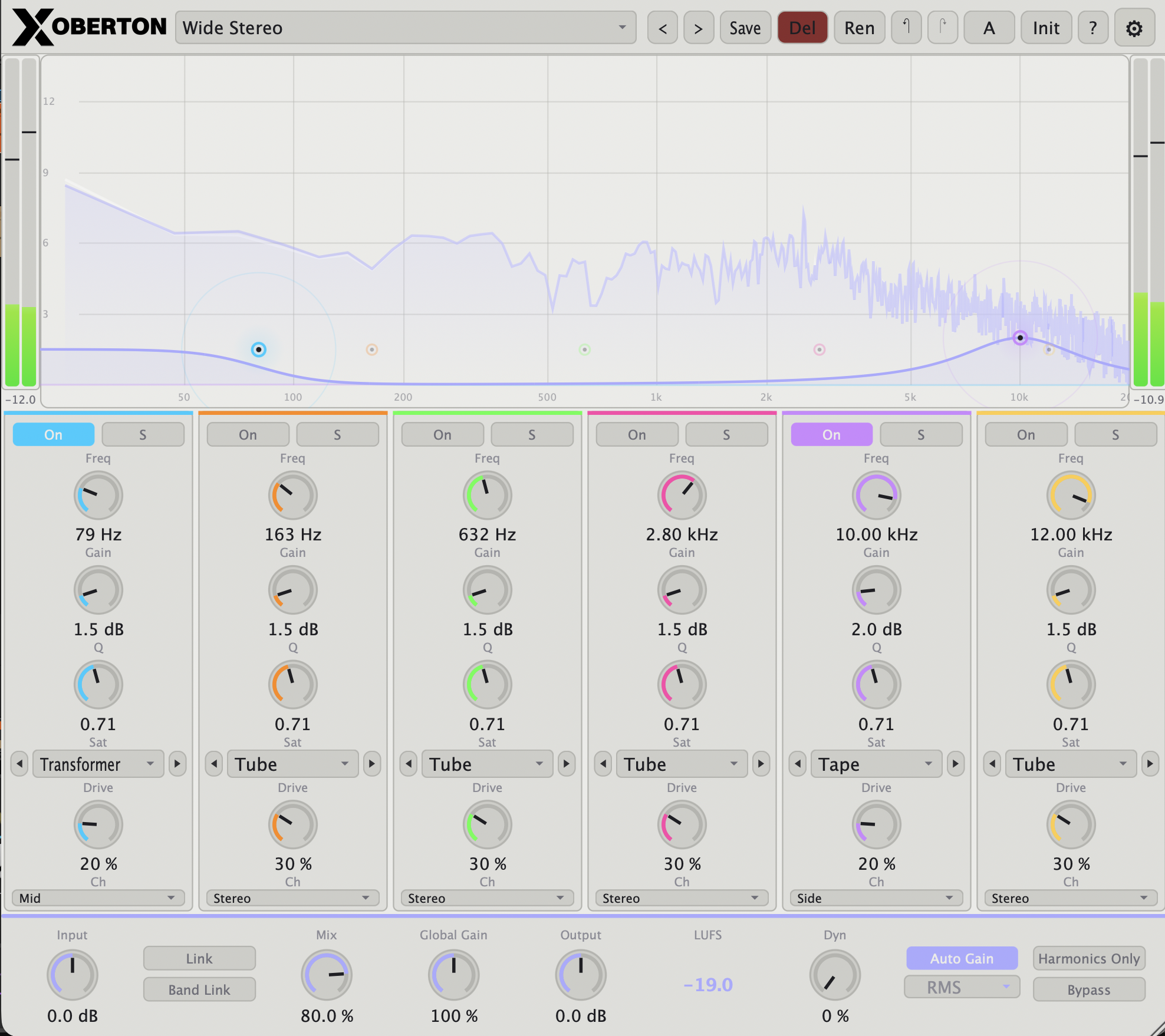
OBERTON reverses the usual order of EQ and saturation. Each of the six bands extracts only its own EQ boost as a difference signal, sends exactly that difference through one of fifteen algorithms and mixes only the result back onto the dry signal. The default frequencies are 42 Hz (low shelf), 164 Hz, 632 Hz, 2.8 kHz and 6.4 kHz (peak) plus 12 kHz (high shelf). Frequency from 20 Hz to 20 kHz, gain from 0 to 12 dB, Q from 0.1 to 10, drive, saturation type and channel routing are set per band, the routing to stereo, mid, side, left or right. Band Link addresses a measurable problem. Boost two bands in the same frequency range and their crossover points meet 130 to 170 degrees out of phase, losing 3 to 5 dB exactly where the punch was meant to sit. Concretely, 632 Hz plus 2.8 kHz at +12 dB each with Q 0.71 yields only +5.7 dB instead of the expected +10.4 dB. With Band Link enabled, each band extracts its residue against the sum of the previous bands, so the boosts add up as they would in a serial EQ, with no added latency and no pre-ringing. Harmonics-Only mode subtracts the EQ boost from the wet signal again, leaving the saturation harmonics on their own. Auto-Gain matches by RMS or by LUFS per ITU-R BS.1770 with K-weighting, and all fifteen modes are calibrated to the loudness of the Tube model to within 0.1 dB. New in 1.6.0 is the Pentode type, whose harmonic ladder opens up as the drive rises. Since 1.7.0 an AAX build for Pro Tools ships with it, PACE-signed and included in the installer for macOS and Windows. The interface switches between a dark and a light colour scheme.
- Six bands with defaults of 42 Hz low shelf, 164 Hz, 632 Hz, 2.8 kHz and 6.4 kHz peak plus 12 kHz high shelf
- Saturation acts only on each band's EQ difference signal, the rest of the signal is untouched
- Fifteen algorithms from Tube, Tape and Transformer to Wavefolder, Bitcrush and the surgical Pure H2 and Pure H3 types
- Band Link sums adjacent boosts phase-coherently, with no added latency and no pre-ringing, off by default
- Harmonics-Only mode delivers the saturation harmonics without the signature of the EQ curve
- Auto-Gain by RMS or LUFS per ITU-R BS.1770, all modes level-matched to within 0.1 dB
- Per-band routing to stereo, mid, side, left or right, with the M/S encoding wrapped around the saturation
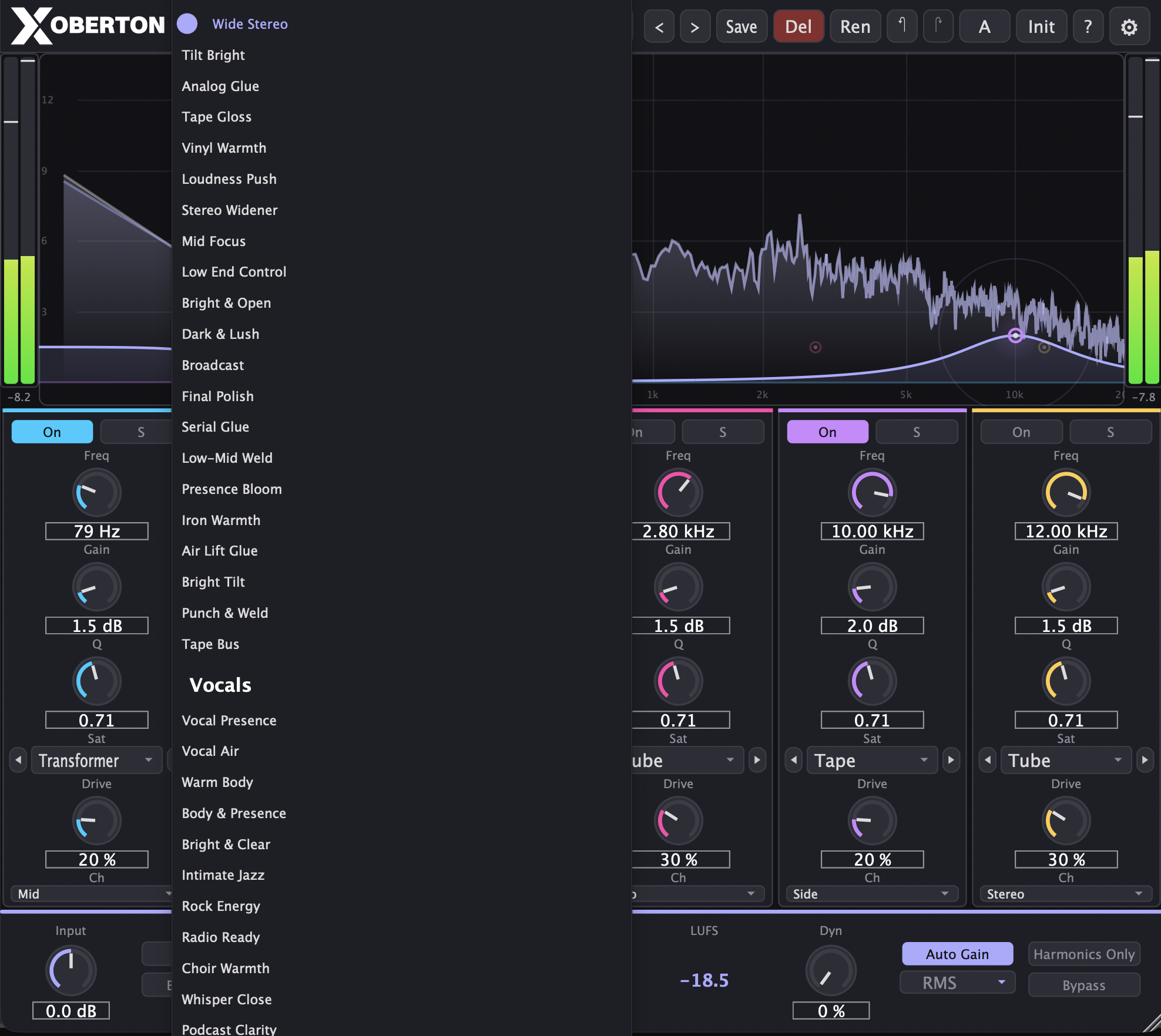
- 227 factory presets in nine categories, 57 of them with Band Link enabled, plus a light and a dark colour scheme
- AAX for Pro Tools alongside VST3, AU, CLAP and standalone, PACE-signed and included in the installer for macOS and Windows
- Price: 49.00 euros
- Formats: VST3, AU, AAX, CLAP, Standalone
- Systems: macOS 10.13 High Sierra or later on Intel, macOS 11 Big Sur or later on Apple Silicon (Universal Binary), Windows 10 64-bit or later, Linux from Ubuntu 22.04 (glibc 2.35), JACK or ALSA
- Version: 1.7.2
- Demo with full functionality, 30 starts
What was added recently
Version 1.7.2, 2026-09-20
- Solid with oversized audio blocks: some hosts hand over blocks considerably larger than the size they announced at startup. The seven oversamplers and the mono path now carry the same headroom as the rest of the buffers. Normal processing stays bit identical, verified against 229 reference renders. The Auto Gain tooltip also shows the right text again.
Version 1.7.1, 2026-09-20
- The dry path is now reset only on an actual mode change instead of on every audio block. That removes the broadband noise 1.7.0 produced around 20 dB below the signal with oversampling switched on. The analyzer picks its FFT size from the sample rate, 2048 points below 50 kHz, 4096 up to 100 kHz and 8192 above, so the bottom octave is drawn at 96 and 192 kHz as well.
Version 1.7.0, 2026-09-19
- AAX for Pro Tools, PACE-signed and included in the installer for macOS and Windows. It loads in any regular Pro Tools installation, with no wrapper and no developer build, and carries the same audio engine, the same 227 presets and the same six bands as VST3, AU and CLAP. The category in Pro Tools is Harmonic.
- Bypass now sits after the complete gain staging and outputs the pure original, without input and output volume. Match the processed sound with output, hit bypass, and you hear exactly what the saturation contributes instead of a level difference.
- The EQ display computes from the same coefficients as the audio processing and shows every curve accurate to 0.2 dB, including the characteristic overshoot at the shelves. Before that the display deviated from the real filter curve by up to 4.3 dB.
- Solo auditions a band that is switched off instead of leaving it silent, so you find the right spot before you activate it. Dry and wet also pass through the same oversampling chain and stay phase-aligned across the whole spectrum, which removes the notch around 17 kHz in the 2x, 4x and 16x modes.
- Activation is tied to a fixed machine ID (IOPlatformUUID, MachineGuid, /etc/machine-id) and stays in place across system and plugin updates, carried over silently on the first launch. The demo noise is half as loud, with a fade at both ends instead of a click.
Version 1.6.0, 2026-06-25
- CLAP format alongside VST3, AU and standalone, for Bitwig Studio, Reaper and Studio One 6.5 and up. It wraps the same audio engine rather than duplicating it, so the sound is bit-identical across formats and presets work either way.
Version 1.5.0, 2026-06-20
- Pentode as a new per-band saturation type: a drive-dependent ladder of purely odd harmonics, third before fifth before seventh, built from weighted Chebyshev polynomials. The ladder opens up as drive rises, with fifth and seventh growing relative to the third. It is the analog counterpart to Pure H3, which works in isolation and surgically.
Version 1.4.0, 2026-06-19
- Support back to macOS 10.13 High Sierra on Intel. The deployment target of the x86_64 slice was lowered from 11.0 to 10.13 while the arm64 slice stays at 11.0, since no Apple Silicon Mac predates it. The universal build therefore runs on Intel from 10.13 and on Apple Silicon from 11.0, enforced by a dedicated build gate.
Product page: German · English
RUMBLE FORGE: Rumble and sub bass generator for techno
RUMBLE FORGE analyses the kick and builds a rumble tuned to it.
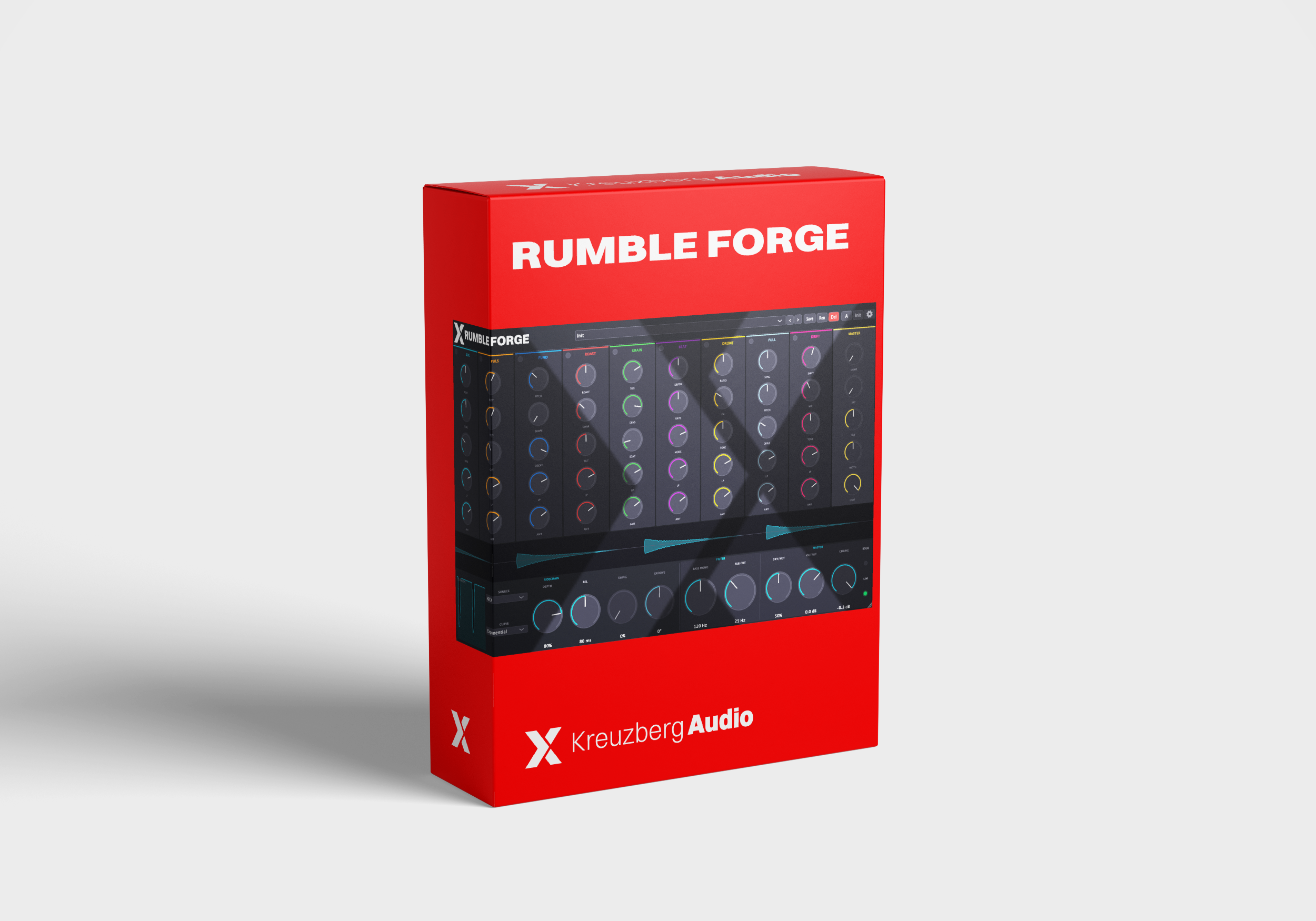
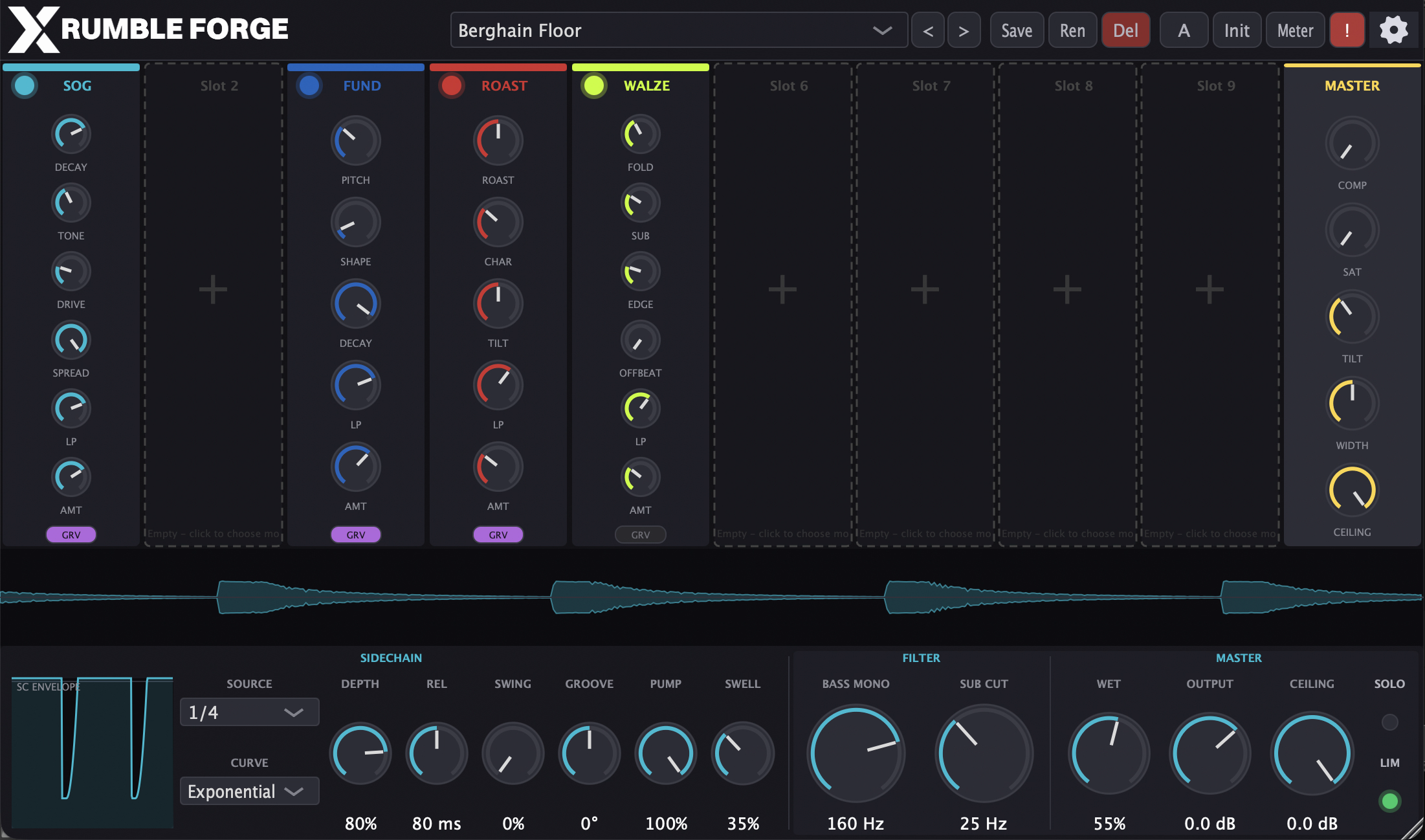
RUMBLE FORGE sits as an insert on the kick channel, detects the kick's transient and fundamental automatically and builds a rumble tuned to that exact kick. Eleven modules are freely assigned to nine parallel slots, joined by a per-slot groove pump, a rhythmic sidechain, bass mono below 120 Hz and a look-ahead limiter. 115 factory presets are included.
RUMBLE FORGE sits as an insert on the kick channel and generates the deep, sustained tail underneath it. The input runs down two paths: the dry kick passes through at unity gain, while two analysis modules work alongside it. The KickDetector catches every hit through the amplitude envelope, evaluates only energy below 200 Hz, adapts its threshold to the running level and locks out for 80 ms after each hit, which makes it robust against hats and bleed. The PitchDetector tracks the kick fundamental in parallel using a YIN algorithm, typically between 40 and 80 Hz. Both run automatically, so the same preset sits cleanly under a different kick without retuning. Eleven modules build on that analysis, assigned freely across nine slots, the same module several times over if needed. All run genuinely in parallel onto one shared rumble bus, each with its own amount control and output low pass. They include SOG (reverse swell from the kick's reverb tail), FUND (sub tuned to the tracked fundamental), GRAIN (150 ms of kick body sprayed back as up to 32 overlapping grains), DRONE (FM voice with carrier feedback), KESSEL (three tuned echo loops that self-oscillate past 100 per cent feedback) and WALZE (rectifier, wavefolder and octave sub). Every slot can be pumped in sync with the tempo through its GRV switch, with the bar position read from the host. A rhythmic sidechain ducks the whole rumble bus, triggered from the kick, from the grid (1/4, 1/8, 1/16 including triplets) or from an external input, while the dry kick stays untouched. The output offers bass mono below 120 Hz at 24 dB per octave, a sub cut, a channel strip and a look-ahead brick-wall limiter whose 2 ms of latency is reported to the DAW.
- Automatic kick detection: low-end energy below 200 Hz only, adaptive threshold, 80 ms lockout after each hit
- Pitch tracking of the kick fundamental via YIN algorithm, typically 40 to 80 Hz, with no manual retuning
- Eleven modules across nine freely assignable slots, genuinely parallel, multiple assignment possible
- Per-slot groove pump plus a rhythmic sidechain with kick, grid or external trigger
- The dry signal passes through at unity gain and is never ducked
- Master section with bass mono below 120 Hz (24 dB per octave), sub cut, solo and channel strip
- Look-ahead brick-wall limiter on the total output, 2 ms reported latency, gain of exactly 1.0 below threshold
- 115 factory presets in 23 categories, user presets as XML, RT-safe with no allocations on the audio thread
- Price: 49.00 euros
- Formats: VST3, AU (macOS), CLAP, Standalone
- Systems: macOS 11 Big Sur or later (Universal Binary, Intel and Apple Silicon), Windows 10 64-bit or later, Linux from Ubuntu 22.04
- Version: 1.3.4
- Demo with full functionality, 30 starts
What was added recently
Version 1.3.4, 2026-08-04
- Nine free slots instead of fixed pipelines. Every module fits in every slot, more than once if you want, and slots may stay empty. That is why a freshly loaded plugin is deliberately empty and makes no sound at first: you start from a factory preset or click an empty slot and pick a module.
- Two new modules for Schranz and hard techno. KESSEL is a feedback tunnel built from three tuned echo loops with saturation inside the loop, self-oscillating above 100 percent FEED, with a safety net that pulls it back down after about four seconds without input. WALZE is a crusher made of rectifier, wavefolder and an octave-down square whose intensity follows the kick envelope. Both have an OFFBEAT control that pushes their energy up to half a beat between the kicks.
- Groove Pump per slot. Every slot now has its own GRV switch: with transport running, that slot ducks on the beat and blooms toward the offbeat. PUMP and SWELL set depth and shape globally. It works independently of the master sidechain, so with both PUMP and DEPTH high you get double ducking.
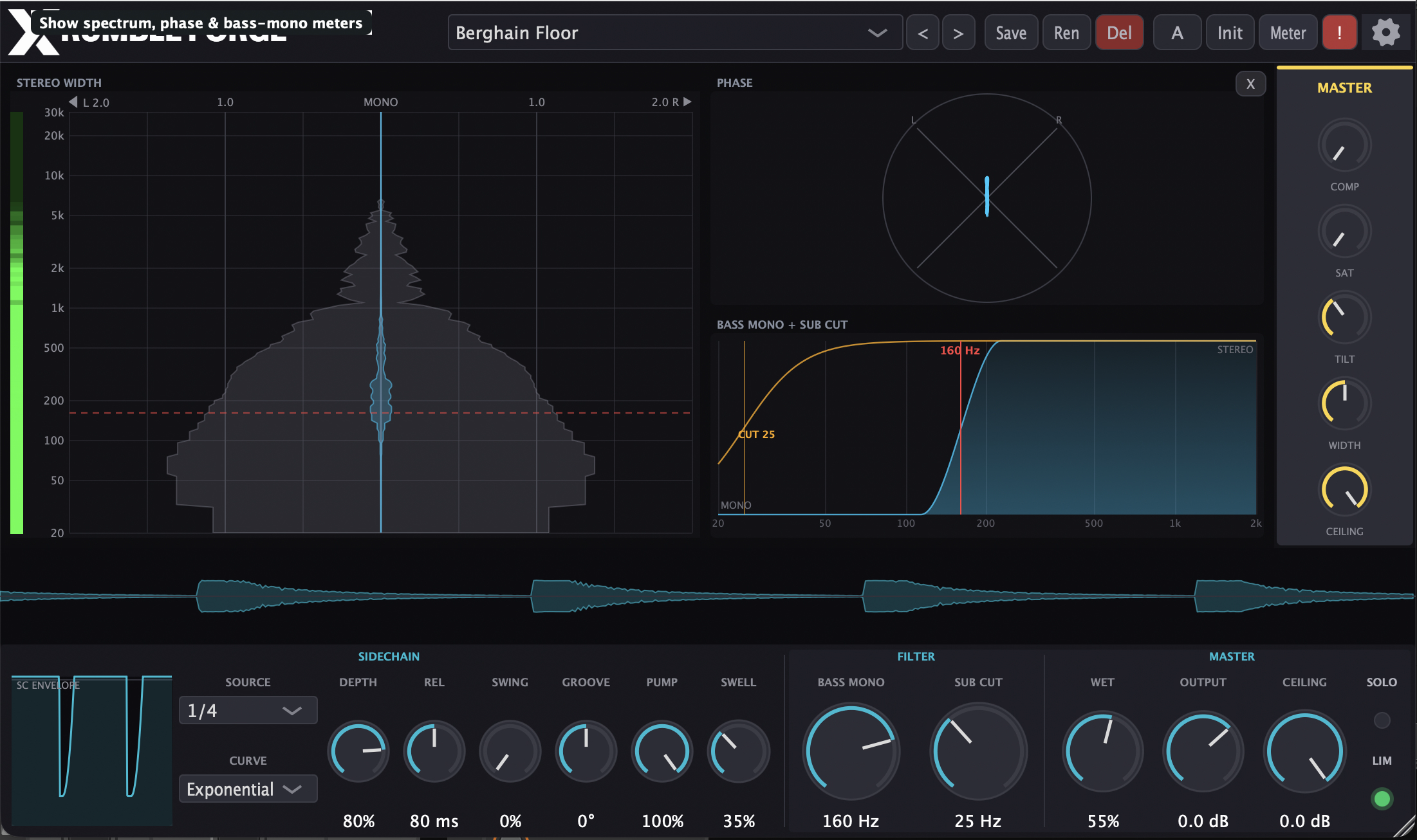
- A meter view: one click swaps the nine slots for a stereo width tree with per-band phase correlation, a goniometer and a curve for Bass Mono and Sub Cut. Analysis only runs while the view is open.
- 115 factory presets instead of 51, sorted into 23 categories including the new Walzwerk category with KESSEL and WALZE racks. Around 70 presets were revised, many of them after community feedback. CLAP format joins VST3, AU and standalone.
Product page: German · English
STAFFEL: Creative filter and IMPRINT resonator
STAFFEL hands the signal from one filter to a second one section by section and turns a captured sound into a filter.
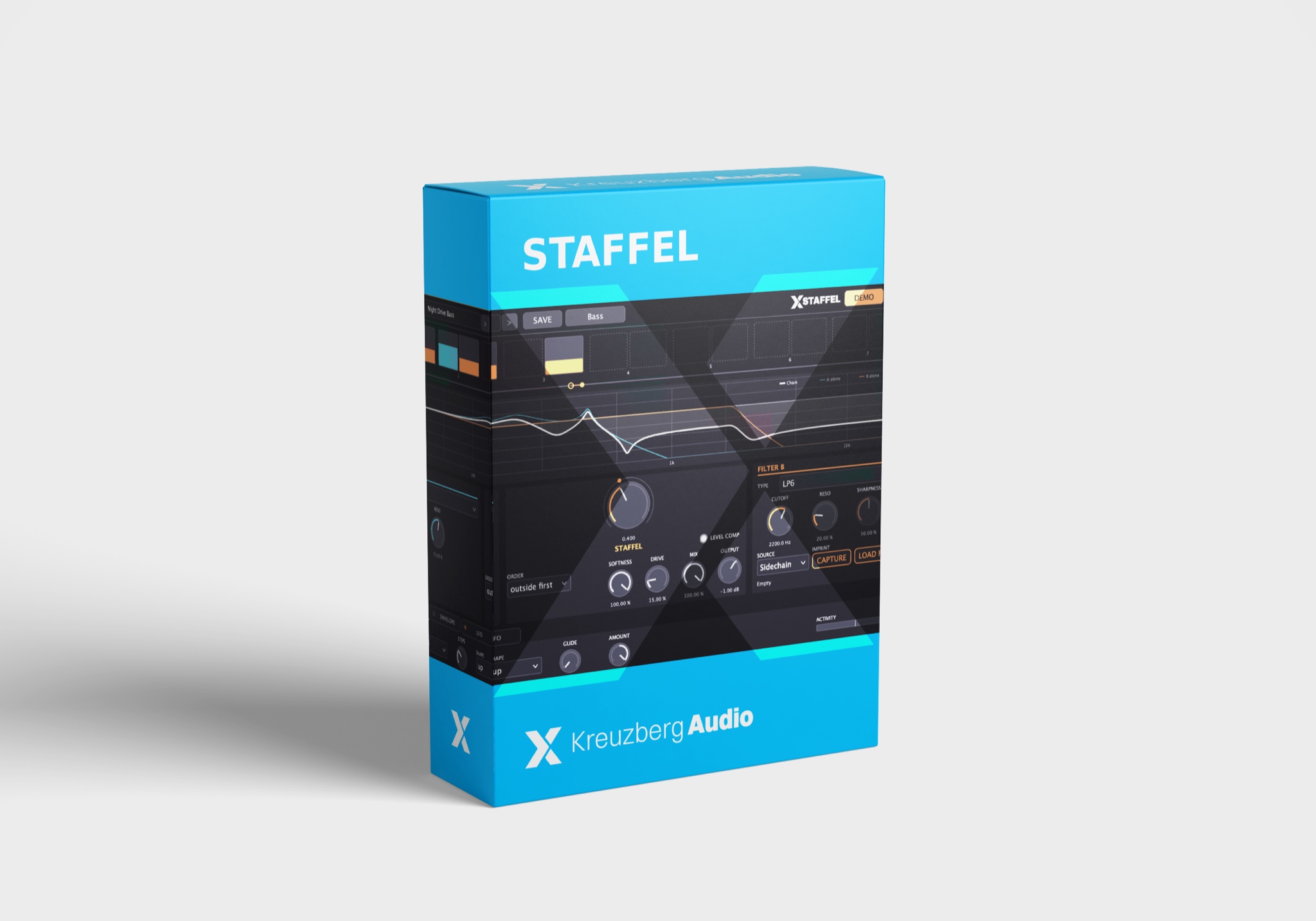
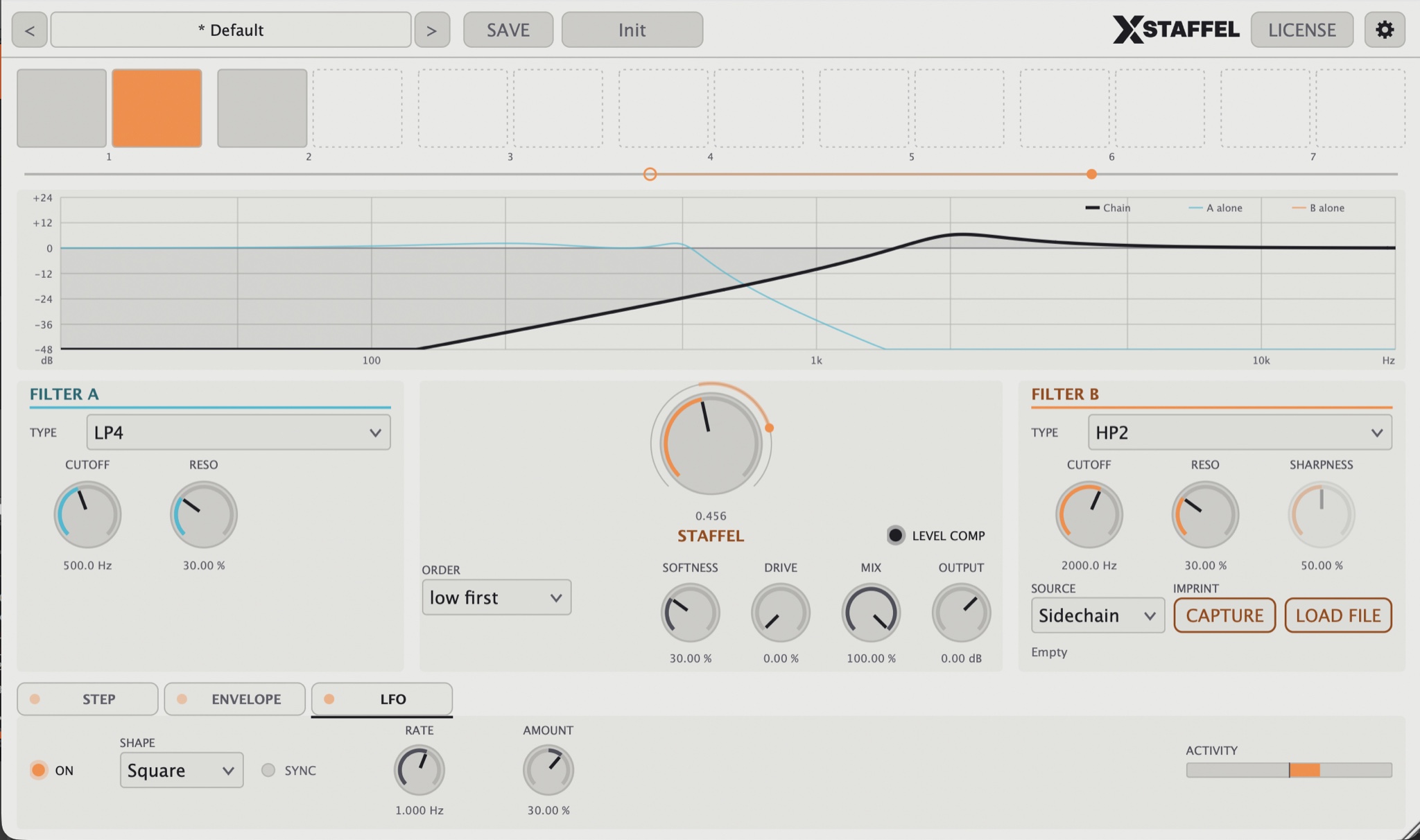
STAFFEL is a creative filter for basses and leads. Two complete filters with up to seven sections each sit left and right, and the STAFFEL knob in the middle hands the signal from A to B, not all at once but section by section. On the way, filters appear that are neither A nor B. IMPRINT derives filter B from a sound: from the sidechain, the input or a file. STEP, ENVELOPE and LFO move the handover in sync with the host, and 51 factory presets in six banks are included. Since version 1.1.0 the frequency response shows the spectrum and the pitch of the input.
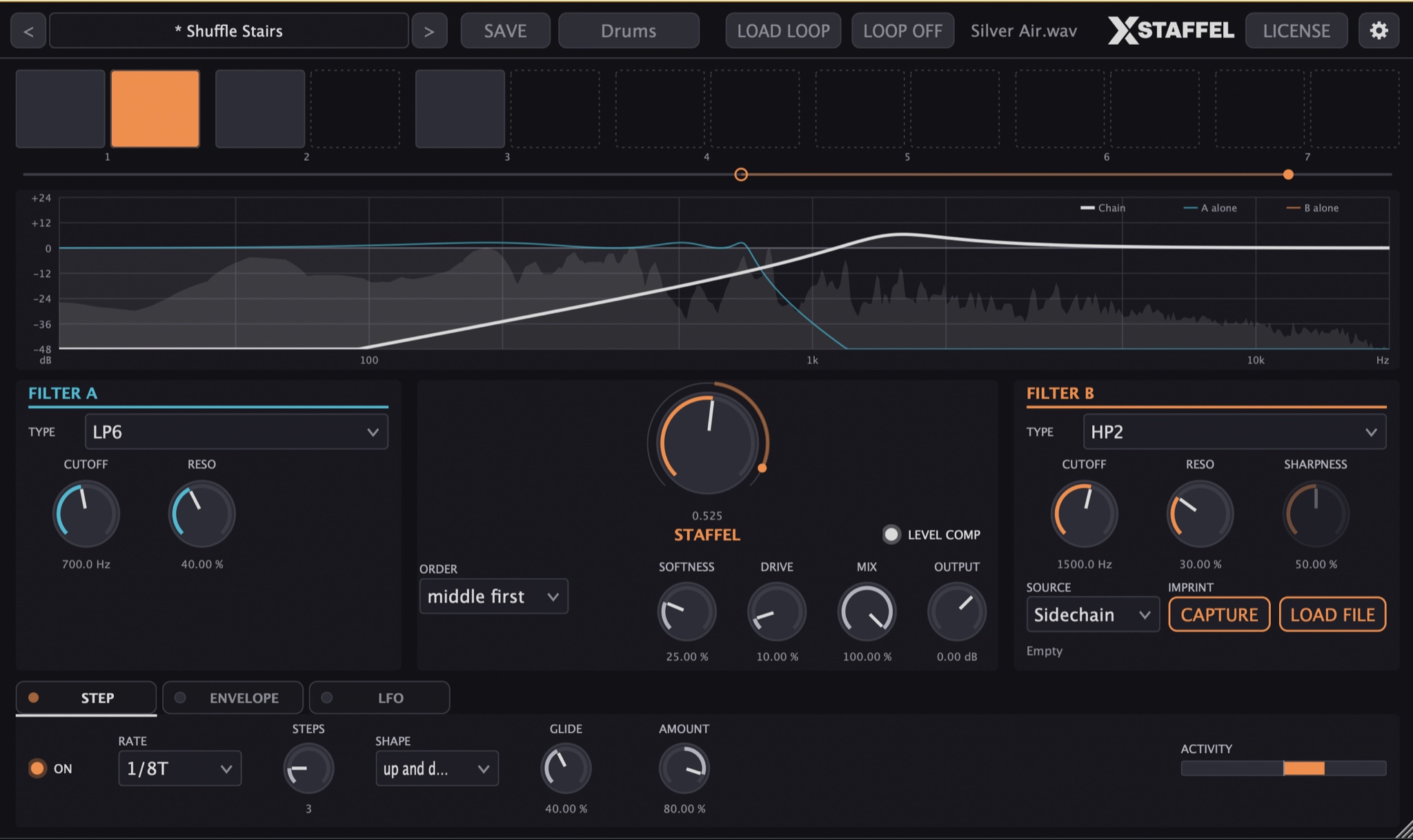
STAFFEL chains two complete filters in a way no other plugin does: filter A on the left, filter B on the right, each with its own type, CUTOFF and RESO. Eight types are available on either side, lowpass with two, four and six poles, highpass with two and four, a fourth-order bandpass, a harmonic comb with three peaks and a formant filter. Each filter consists of up to seven second-order sections that pair up by rank. The STAFFEL knob in the middle hands the signal from A to B, section by section, like a baton in a relay race. Halfway through, the chain is a hybrid of both: where a resonant section of A is half faded out and its counterpart from B half faded in, the two partly cancel, and these notches travel through the spectrum as you turn. Because the coefficients are never derived from in-between values, every position is stable, nothing clicks, and the endpoints are bit-identical to A and to B. Four knobs shape the handover. ORDER decides which sections change first, low first, high first, from the middle outwards, from the outside in, or random with a seed from 1 to 99. SOFTNESS decides whether each section snaps over on its own or all of them glide into each other. DRIVE saturates after every pair of sections, up to 18 dB, and LEVEL COMP holds the level along the whole way. IMPRINT derives filter B from a sound. CAPTURE searches the last two seconds of the sidechain for the loudest part, a 14th-order linear prediction over an 85 ms window pulls out seven resonances with frequency and decay time, and those become filter B. Without a sidechain, CAPTURE takes the input, and LOAD FILE reads a WAV, AIFF or FLAC. SHARPNESS lengthens the resonances, CUTOFF B shifts the imprint in octaves, RESO B makes it narrower or wider. The imprint is saved with the project and travels into user presets. Three modulation sources aim at the STAFFEL knob, each with its own bipolar amount. STEP is a sequencer with 2 to 8 stages on the host grid from 1/32 to 1 bar, triplets included, with GLIDE between stages. ENVELOPE follows the level of the input or the sidechain with attack from 0.1 to 100 ms and release from 5 to 2000 ms. The LFO swings as Sine, Triangle, Square or Sample and Hold, free from 0.01 to 20 Hz or synced from 1/32 to 8 bars. STEP and the synced LFO read the transport position from the host, so loops and jumps stay in phase. The modulation only moves the handover, never the filter designs themselves. Oversampling 2x and 4x with 49 and 61 samples of latency respectively, reported to the host. 51 factory presets in the banks Init, Bass, Drums, Acid, Voice and Chaos, each with a tooltip that states its intent. Interface 1100 x 650 px with six zoom steps, dark and light theme, standalone with loop player. Version 1.1.0 puts the spectrum of the input behind the curves of the frequency response as a grey veil, so CUTOFF and resonances land where the energy sits. When a clear note plays, a line shows its fundamental with note name and frequency, for example A2 110 Hz; with chords, drums and noise it stays away. Both can be switched off in the settings. On top comes the 90 percent zoom step. The sound stays bit-identical to 1.0.0.
- Two complete filters with up to seven second-order sections each, 14 slots in the chain, handover rank by rank on the signal level
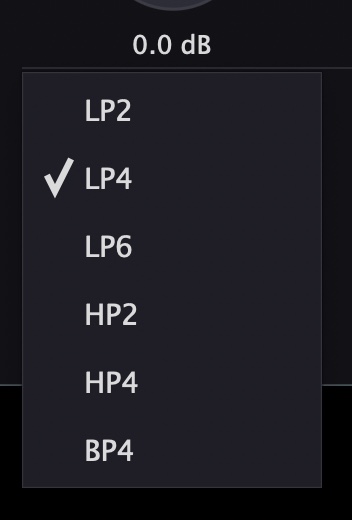
- Eight types per side: LP2, LP4, LP6, HP2, HP4, BP4, PEAK3 and FORMANT, each with its own CUTOFF from 20 Hz to 20 kHz and its own RESO
- Coefficients never derived from in-between values, endpoints bit-identical to A and B, stable and click-free in every position
- ORDER with five sequences including random with seed, SOFTNESS from hard to gliding, DRIVE after every pair of sections up to 18 dB, LEVEL COMP
- IMPRINT: filter B from sidechain, input or file, 14th-order linear prediction over 85 ms, seven resonators, SHARPNESS, shiftable in octaves
- STEP with 2 to 8 stages and GLIDE, ENVELOPE with attack 0.1 to 100 ms and release 5 to 2000 ms, LFO with four waveforms free or host-synced, all three bipolar on the handover
- Oversampling 2x and 4x, latency 49 and 61 samples respectively, reported to the host
- 51 factory presets in six banks with tooltips, user presets carry the imprint with them
- Input spectrum behind the frequency response and pitch of the input from 30 Hz to 2 kHz with note name, both switchable
- Interface 1100 x 650 px, six zoom steps, dark and light theme, standalone with loop player for WAV, AIFF and FLAC
- Price: 49.00 euros
- Formats: VST3, AU (macOS), CLAP, Standalone
- Systems: macOS 11 Big Sur or later (Universal Binary, Intel and Apple Silicon), Windows 10 and 11 (64-bit), Linux x86_64 from Ubuntu 22.04
- Version: 1.1.0
- Demo with full functionality, short noise burst every minute, 30 launches
What was added recently
Version 1.1.0, 2026-09-30
- The frequency response shows the spectrum of the input behind the curves, and a line shows the fundamental of a clear note with note name and frequency. Both can be switched off in the settings. New 90 percent zoom step, small texts stay legible below 100 percent. The sound is bit-identical to 1.0.0.
Version 1.0.0, 2026-09-27
- STAFFEL arrives. Two complete filters with up to seven second-order sections each, eight types per side, and one knob that hands the signal from A to B section by section. Coefficients are never derived from in-between values, the endpoints are bit-identical to A and B, every position is stable. ORDER, SOFTNESS, DRIVE and LEVEL COMP shape the handover.
- IMPRINT derives filter B from a sound: CAPTURE from sidechain or input, LOAD FILE from WAV, AIFF or FLAC, 14th-order linear prediction over 85 ms, seven resonators with SHARPNESS, shiftable in octaves. The imprint is saved with the project and travels into user presets.
- STEP, ENVELOPE and LFO modulate the handover with their own bipolar amounts, host-synced even across loops and jumps. Oversampling 2x and 4x with 49 and 61 samples of latency, 51 factory presets in six banks, dark and light theme, standalone with loop player. VST3, AU, CLAP and standalone for macOS, Windows and Linux.



Product page: German · English
UPLIFTER: Transition, riser and drop designer
UPLIFTER turns a single held MIDI note into a complete riser, build-up or drop.
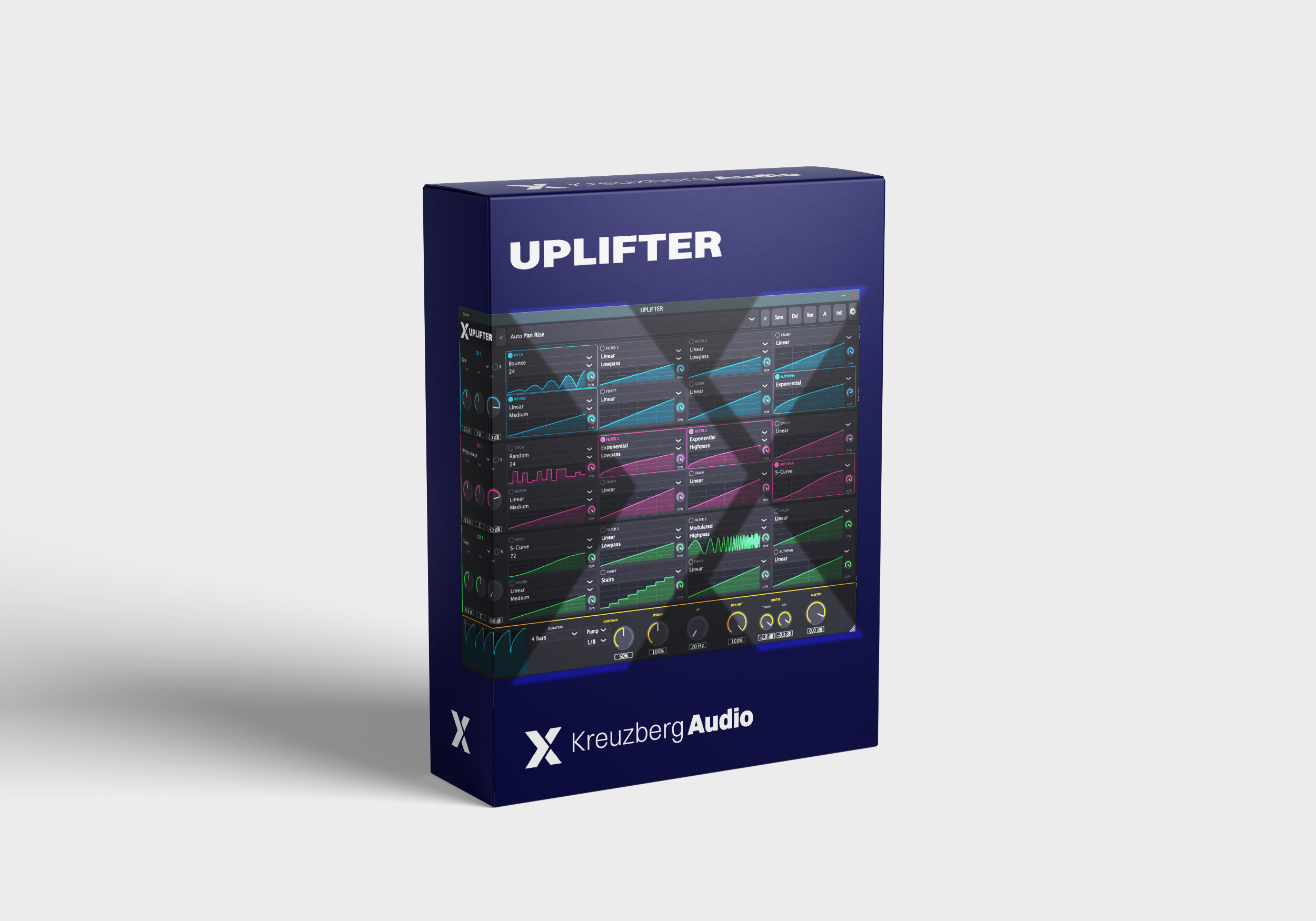
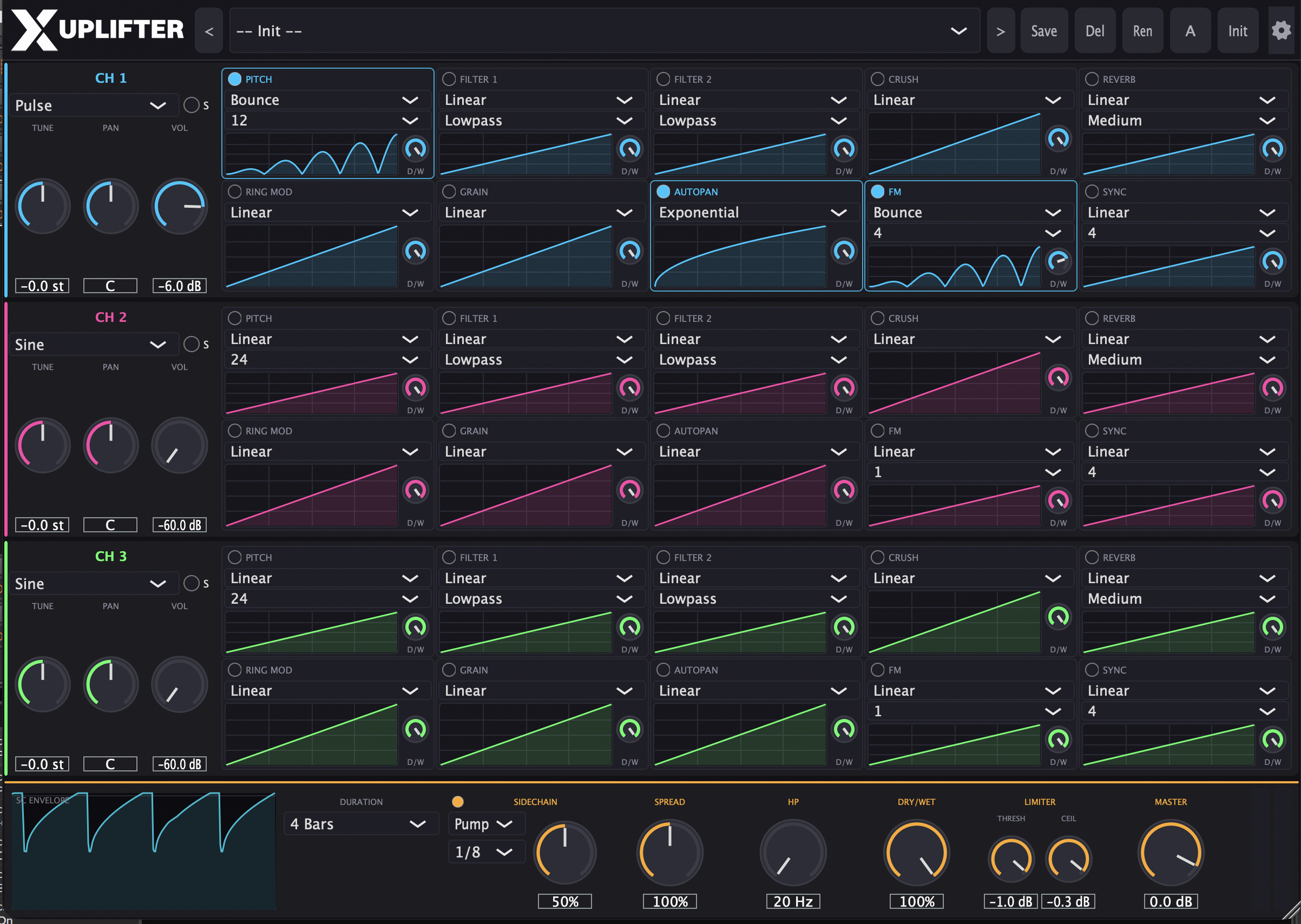
UPLIFTER builds transitions from a single held MIDI note, locked to host tempo. Three channels, each with 25 sound sources and ten effect slots, give 30 modulated effects per note, every one following its own curve from ten types or drawn with up to 32 breakpoints. 84 factory presets, durations from half a bar to 64 bars.
UPLIFTER builds transitions from a single MIDI note. The note is held for the configured duration and the plugin does the rest: riser, build-up, drop or sweep, locked to the host transport, with no automation drawn into the piano roll. The layout is three independent channels, each with its own sound source and a chain of ten effect slots. That adds up to 30 modulated effects per note, each with its own curve and dry/wet amount. Each channel offers 25 sources: seven oscillator types from sine through supersaw to Shepard tone, three noise colours, eight wavetables, a sample player for WAV and AIFF files, plus six evolving sweeps that travel across their spectrum over the full note length. The effect slots run in fixed order: pitch shifter with up to 84 semitones up or down, two independent TPT SVF filters (low pass, high pass, band pass), bit crusher, reverb, ring modulator, granular processor, auto pan plus FM and SYNC, the two slots added in 1.1.0. Modulation comes from curves that run across the note duration. Ten types are built in, among them Stairs, Tension, Bounce and Random. Where those fall short, the custom editor takes a hand-drawn curve with up to 32 breakpoints, each segment switchable between linear and Catmull-Rom interpolation. Durations run from half a bar to 64 bars, and the sidechain pump works at 1/4, 1/8 or 1/16 in three character modes: Constant Pump, Hard Duck and Soft Duck. The output stage carries a true peak limiter with 5 ms lookahead, M/S stereo spread, a tunable high pass against infrasonic content and a global dry/wet control. The 84 factory presets sit in eleven categories, and each preset name states its length in bars.
- A single held MIDI note produces the complete transition, locked to the host transport
- Three channels times ten effect slots, so 30 modulated effects per note, each with its own dry/wet
- 25 sound sources per channel, including six evolving sweeps and a sample player for WAV and AIFF
- Ten curve types plus a custom editor with up to 32 breakpoints, each segment linear or Catmull-Rom
- Durations from half a bar to 64 bars, sidechain pump at 1/4, 1/8 and 1/16 in three character modes
- Master section with true peak limiter (5 ms lookahead), M/S spread and tunable high pass
- 84 factory presets in eleven categories, user presets including hand-drawn curves
- Up to three activations per licence, seven day offline grace period
- Price: 49.00 euros
- Formats: VST3, AU, CLAP, Standalone
- Systems: macOS 11.0 or later (Universal Binary, native on Apple Silicon), Windows 10 64-bit or later, Linux x86_64
- Version: 1.2.0
- Demo with full functionality, three starts
What was added recently
Version 1.2.0, 2026-09-01
- CLAP format alongside VST3, AU and standalone, supported by Bitwig 5 and up, Reaper 7 and up and Studio One 6.5 and up. Same plugin, same presets, same DSP: a wrapper around the existing engine rather than a rewrite, so nothing about the sound changes.
- Ten more FM presets. The FM slot previously shipped with two examples, but the ratio between modulator and note is the actual instrument and two examples show none of it. FM Sub Growl and Reese FM Bass use ratio 0.5, the one setting that adds weight below the note you played.
Version 1.1.0, 2026-08-31
- FM on every channel, as a ninth effect slot: a sine modulator running at a ratio you pick against the note, 0.5 to 7, while the slot's curve sweeps the modulation index up from nothing across the length of the note. It starts clean and arrives as a scream, and the curve decides where along the way that happens.
- SYNC on every channel, as a tenth slot: hard oscillator sync, the effect the MS-20 is remembered for. A master runs at the note you played while the source runs faster, and every time the master comes round it snaps the waveform back to the start. The curve sweeps how much faster.
- SYNC and FM together, stacking rather than competing. Sync pins the pitch and tears the waveform, FM sprays inharmonic sidebands that the tear then chops up. Each has its own curve, so one can arrive early and the other late across the same eight bars, which is what keeps a long riser from sounding like a single gesture.
Product page: German · English
Amen Machine: Slice sampler, sequencer and FX rack for the Amen break
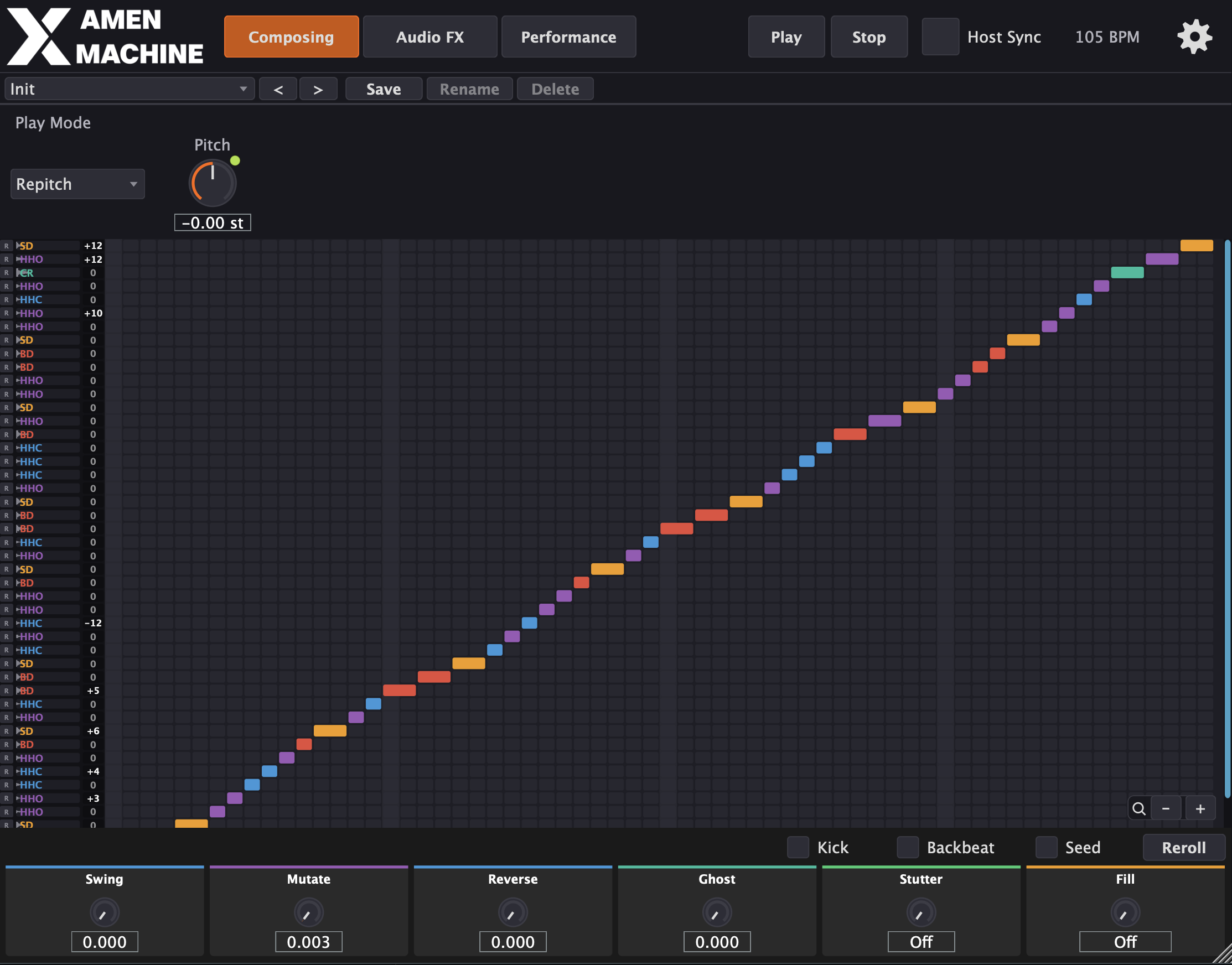
Slice sampler for the Amen break: 46 slices, 64-step sequencer, 19-slot FX rack.
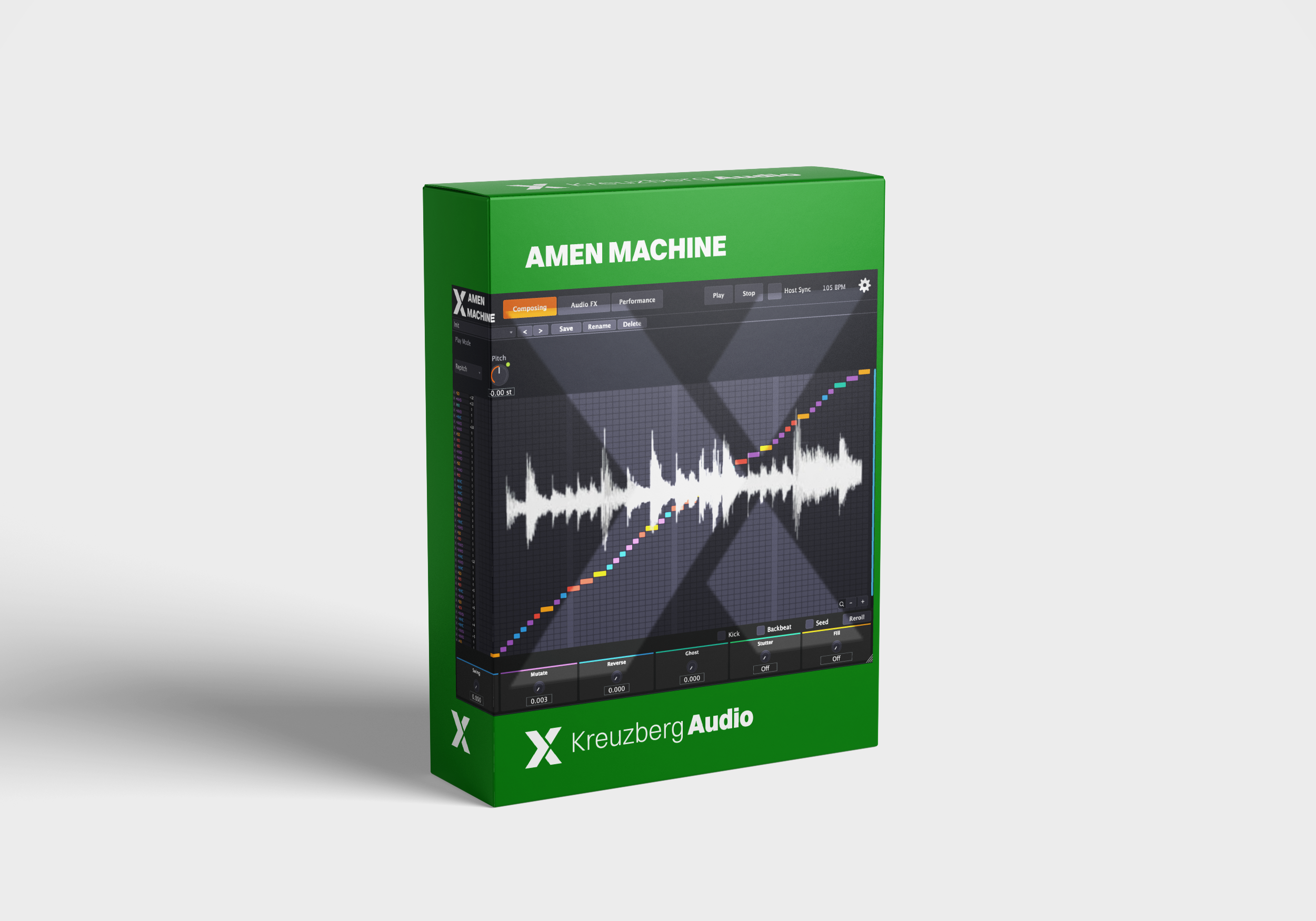
Amen Machine 1.3.0 chops the Amen break into 46 slices and rebuilds it on a 64-step sequencer across four bars. It adds three playback engines, a six-stage variation engine and a master FX rack of 19 slots and 23 swappable modules, usable on other material in FX Only mode. A demo with the full feature set is available.
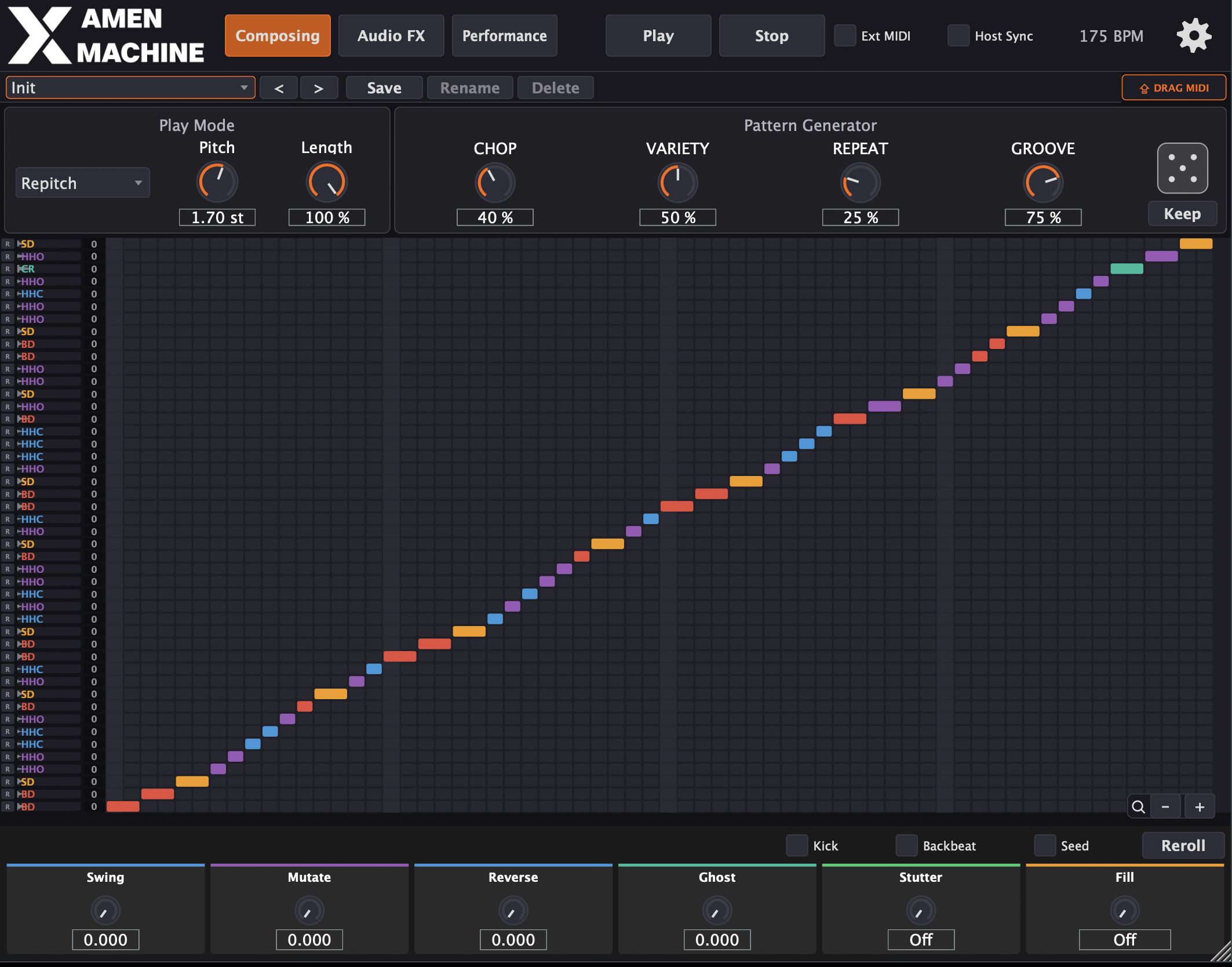
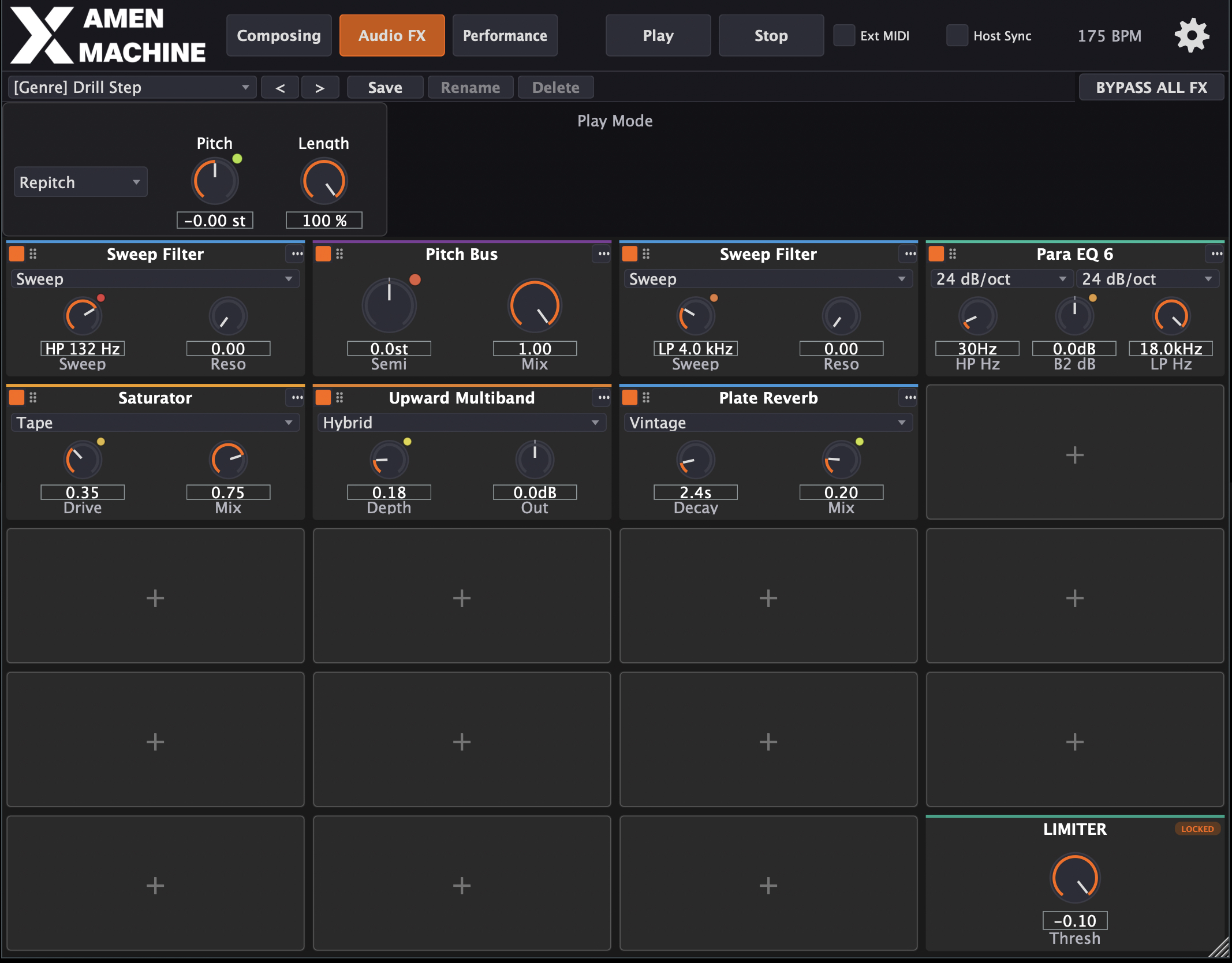
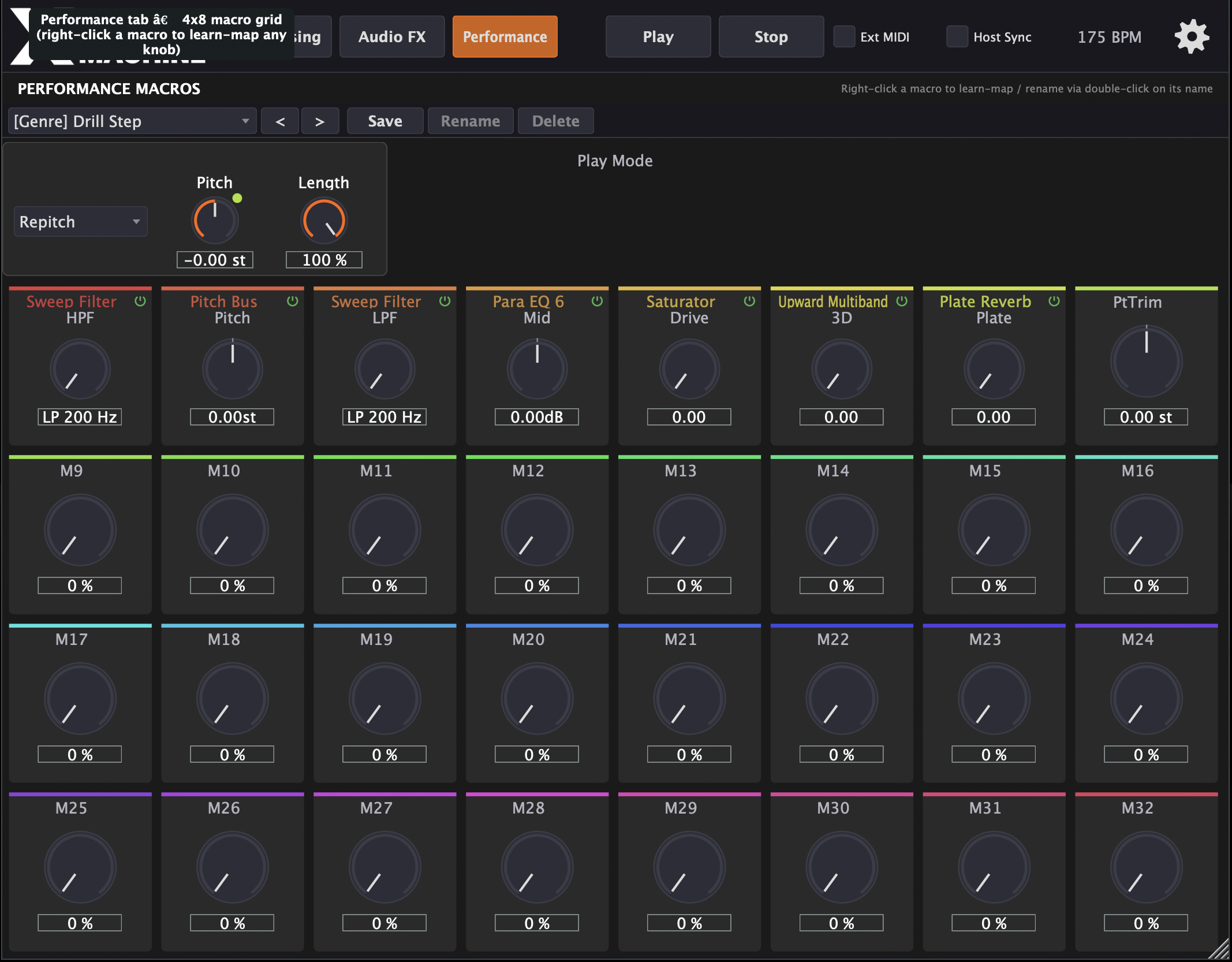
Amen Machine treats the Amen break as an instrument rather than a sample collection. The plugin chops the break into 46 slices and rebuilds it on a 64-step sequencer across four bars. Three playback engines are available: Repitch for the mid-nineties sampler sound, mono split aliasing included, Cycles as a clean granular path for half time and pitched drums, and Textures for spectral drift with decoupled pitch, speed and formant and grain sizes from 10 to 200 ms. A global length knob scales slice length down to one percent. The variation engine works in six stages: swing, mutate, reverse, ghost hits, stutter rolls and eleven hand-built fill patterns. Mutate swaps slices in a role-compatible way, so a kick stays a kick. Lock Kick on 1 and Lock Backbeat hold the skeleton in place even with all six controls at maximum. Seed Lock freezes a result reproducibly; without it every pass comes out differently. A pattern generator with CHOP, VARIETY, REPEAT and GROOVE controls sits next to it; results can be stored as user presets via Keep. Behind the sequencer sits a master FX rack with 19 freely orderable slots and 23 swappable modules, among them a FET 1176 compressor with all buttons, an OTT-style upward multiband, a wavefolder, convolution with five rooms, tape delay, a stutter gate and a Paulstretch-style spectral stretch up to 50x. In FX Only mode a sidechain signal runs through the rack while sequencer and variation engine stay idle. The Ext MIDI switch maps the slices onto notes 48 to 93, exactly as in the original Amen MIDI file. The break itself was played in 1969 by Gregory C. Coleman for The Winstons on Amen, Brother.
- 46 slices on a 64-step sequencer across four bars, MIDI export by drag and drop with the current tempo baked in
- Three playback engines: Repitch, Cycles and the pitch-stable Textures with grain sizes from 10 to 200 ms
- Six-stage variation engine with kick and backbeat anchors plus Seed Lock for reproducible results
- Pattern generator with CHOP, VARIETY, REPEAT and GROOVE controls, keepers stored as user presets via Keep
- Master FX rack with 19 freely orderable slots, 23 modules and a true peak limiter closing the chain
- Bypass / FX Only: a sidechain signal runs through the rack while sequencer and variation engine stay off
- Ext MIDI mode maps the 46 slices onto notes 48 to 93, matching the original Amen MIDI file
- 67 pattern presets, more than 80 sound presets and a 32-macro performance system with MIDI Learn
- Price: 19.00 euros
- Formats: VST3, AU, Standalone
- Systems: macOS Universal2 (Intel and Apple Silicon), Windows 10 64-bit or later, Linux x86_64
- Version: 1.3.0
- Demo available
What was added recently
Version 1.3.0, 2026-07-12
- A pattern generator in the composing tab: a dice roll drops a fresh Amen variation straight into the grid, shaped by the CHOP, VARIETY, REPEAT and GROOVE controls. VARIETY changes the beat structure itself, from a re-gridded roll at low settings through a hypnotic looped fragment in the middle to a programmed anchor fill.
- 50 factory patterns rebuilt. Variations 15 to 64 were previously all segment recombination and sounded too alike. They are now spread across three structural archetypes distilled from the hand-made variations 1 to 14, plus halftime, breakcore and syncopated flavours.
- MIDI preview files for every factory pattern, one standard MIDI file each following the Ext MIDI convention: note 48 plus slice, channel 10, 960 ticks per quarter. That makes every pattern auditionable in a DAW without loading the plugin.
Version 1.2.0, 2026-06-07
- DRAG MIDI in the preset row: pull the finished 64-step pattern onto a DAW MIDI track or onto the desktop. Format 1, 960 ticks per quarter, exactly four bars. The slice to MIDI note mapping matches external MIDI mode, note 48 plus slice number.
Version 1.1.0, 2026-06-02
- Ext MIDI mode as a global switch in the header. With it on, the internal sequencer goes quiet and incoming host notes drive the sample voices directly. Notes 48 to 93 map to slices 0 to 45, matching the original Amen MIDI file. All slice settings and the full FX chain stay active.
Product page: German · English
Acid Distortion Pro Suite: One-knob distortion with nine distortion types
One-knob distortion with nine distortion types for the TB-303 and other bassline synths.
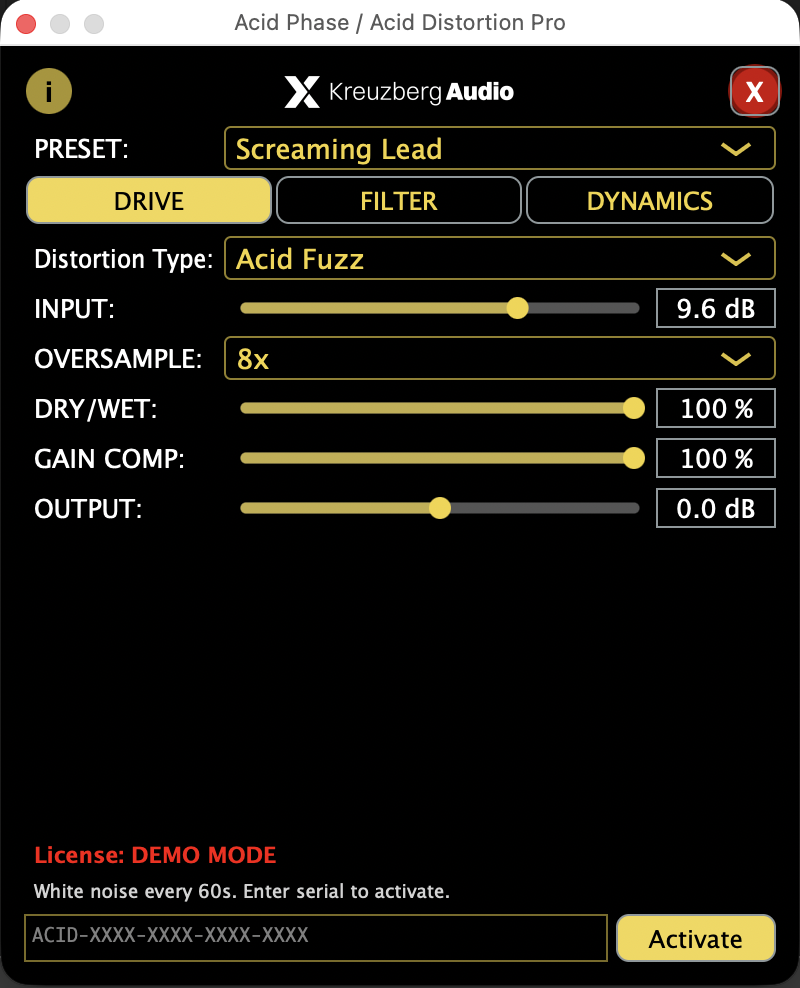
The Acid Distortion Pro Suite is a distortion plugin for the TB-303 and other bassline synths, driven by a single dry/wet control. Underneath sit nine switchable distortion types, a pre-highpass with adjustable slope, an envelope follower, a crossover that routes the sub bass around the distortion, and an audio-triggered accent engine. Ten factory presets are included.
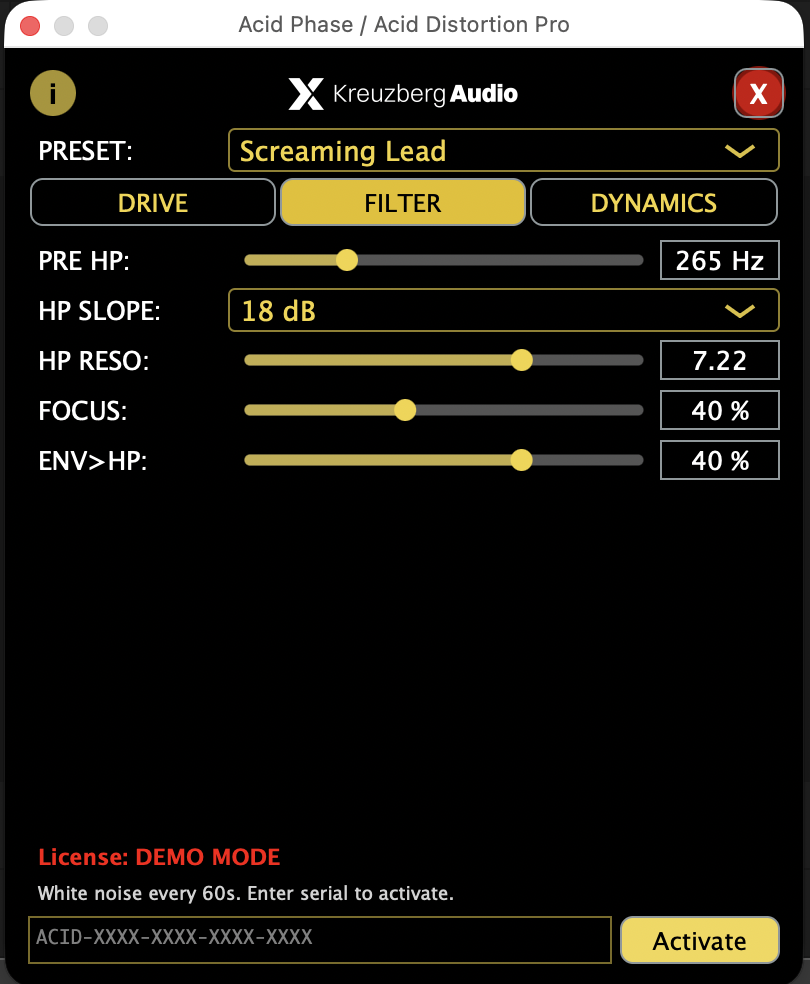
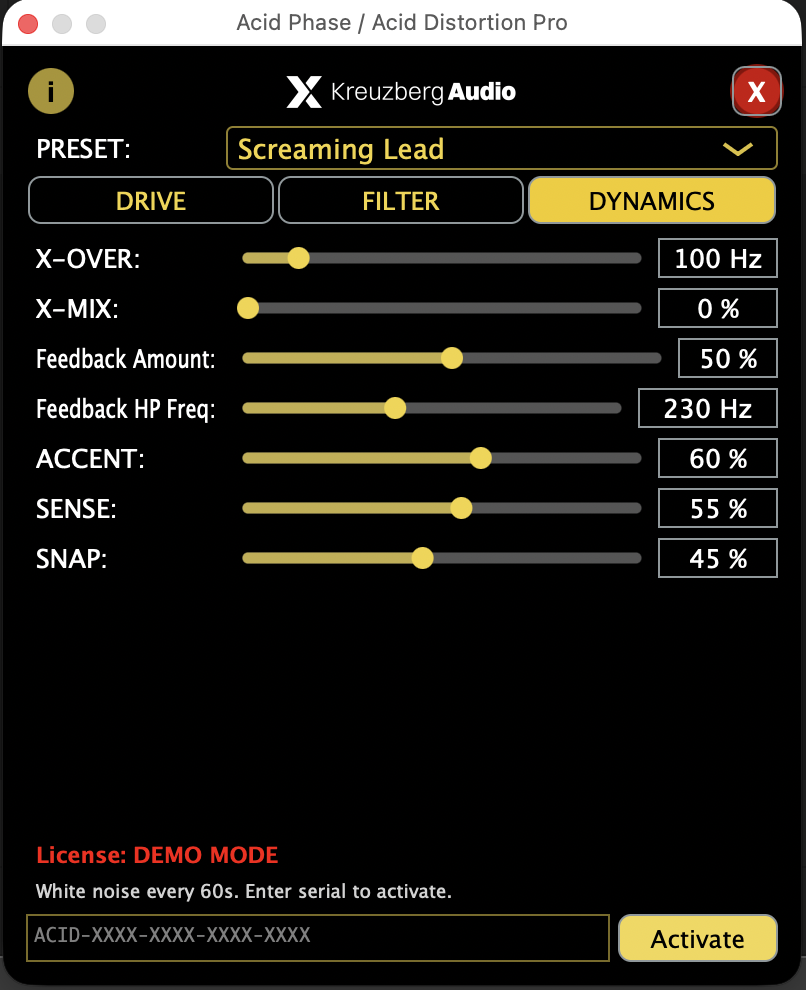
The Acid Distortion Pro Suite is a specialised distortion plugin for the TB-303 and other bassline synths, aimed at the acid sound shaped by producers such as Hardfloor, Josh Wink or Emanuel Top. At its simplest it is operated with one control: the acid smiley on the interface morphs across 14 frames at 60 frames per second from a friendly smile to a distorted grimace, and it is the dry/wet parameter itself. Where the free version carries a single algorithm, the Pro version offers nine switchable distortion types: Classic Hardfloor, Acid Fuzz, Tape Saturator, Diode Clipper, Wavefolder, Rectifier, Bitcrusher, Valve Screamer and Hard Clip. The controls are spread across three tabs. DRIVE pushes the incoming signal into saturation by up to 24 dB in either direction and adds True Drive oversampling at 2x, 4x and 8x, linear phase and latency compensated, plus a post-highpass from 30 to 500 Hz. FILTER holds a pre-highpass from 20 to 1000 Hz with a slope of 6 to 24 dB per octave and resonance up to Q 10, which removes sub bass before it can muddy the distortion. Acid Focus narrows the bandwidth from above, and an envelope follower modulates the pre-highpass frequency: with a positive value the filter opens on the attack, with a negative value it closes. DYNAMICS carries the crossover mix, which routes the sub bass cleanly around the distortion, an AC-coupled feedback loop with a highpass at 150 Hz and soft clipping, and the accent engine: a transient in the input signal triggers a jump in drive and cutoff, shaped by ACCENT, SENSE and SNAP, fully audio triggered with no MIDI routing. Automatic gain compensation keeps the output level consistent.
- Nine switchable distortion types, from tape saturator and diode clipper to wavefolder and bitcrusher
- Operated through a single dry/wet control, drawn as an acid smiley across 14 frames at 60 frames per second
- Pre-highpass from 20 to 1000 Hz with 6 to 24 dB per octave and resonance up to Q 10
- Envelope follower on the pre-highpass frequency, opening or closing on the attack
- Crossover mix routes the sub bass around the distortion, only mids and highs are processed
- AC-coupled feedback loop with a highpass at 150 Hz and soft clipping against runaway resonance
- Accent engine with ACCENT, SENSE and SNAP, audio triggered with no MIDI routing
- Input trim of up to 24 dB in either direction, automatic gain compensation, oversampling at 2x, 4x and 8x
- Price: 9.99 euros
- Formats: VST3, AU, Standalone
- Systems: macOS (Universal Binary, Intel and Apple Silicon), Windows 10/11, Linux (x86_64 and ARM64)
- Version: 1.1.0
- Free version available
What was added recently
Version 1.1.0, 2026-06-16
- An accent engine that turns the insert effect into a playable acid voice: the 303-style accent is triggered from the audio itself, with no MIDI routing, in any DAW.
- True-Drive oversampling at two, four and eight times. It clears the recursive intermodulation on hot 303 lines, with a latency-matched dry path and no comb filtering. In its off state the plugin is bit-exact with the previous version.
- Hard Clip as the ninth distortion type, a brutal asymmetric brick-wall clip with rich highs. Plus an input trim of plus or minus 24 dB, to push harder into saturation and hold the level afterwards through gain compensation.
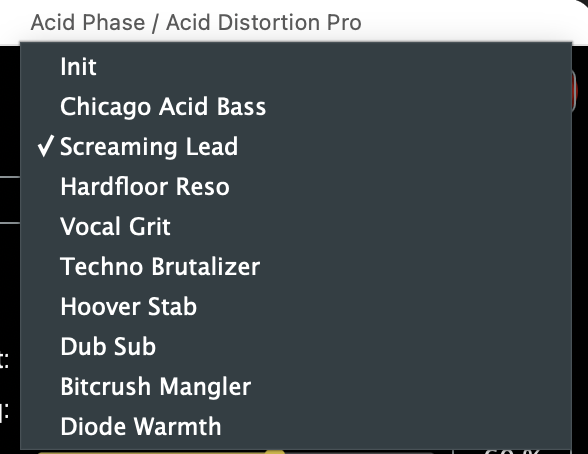
- Ten factory presets from Chicago Acid Bass to Techno Brutalizer, plus a cleaner interface with three tabs: DRIVE, FILTER and DYNAMICS. Existing projects and presets sound unchanged.
Product page: German · English
RASPEL: Saturating filter and wavefolder, free
RASPEL saturates inside every stage of a resonant filter and keeps the resonance when the distortion bites. Free.
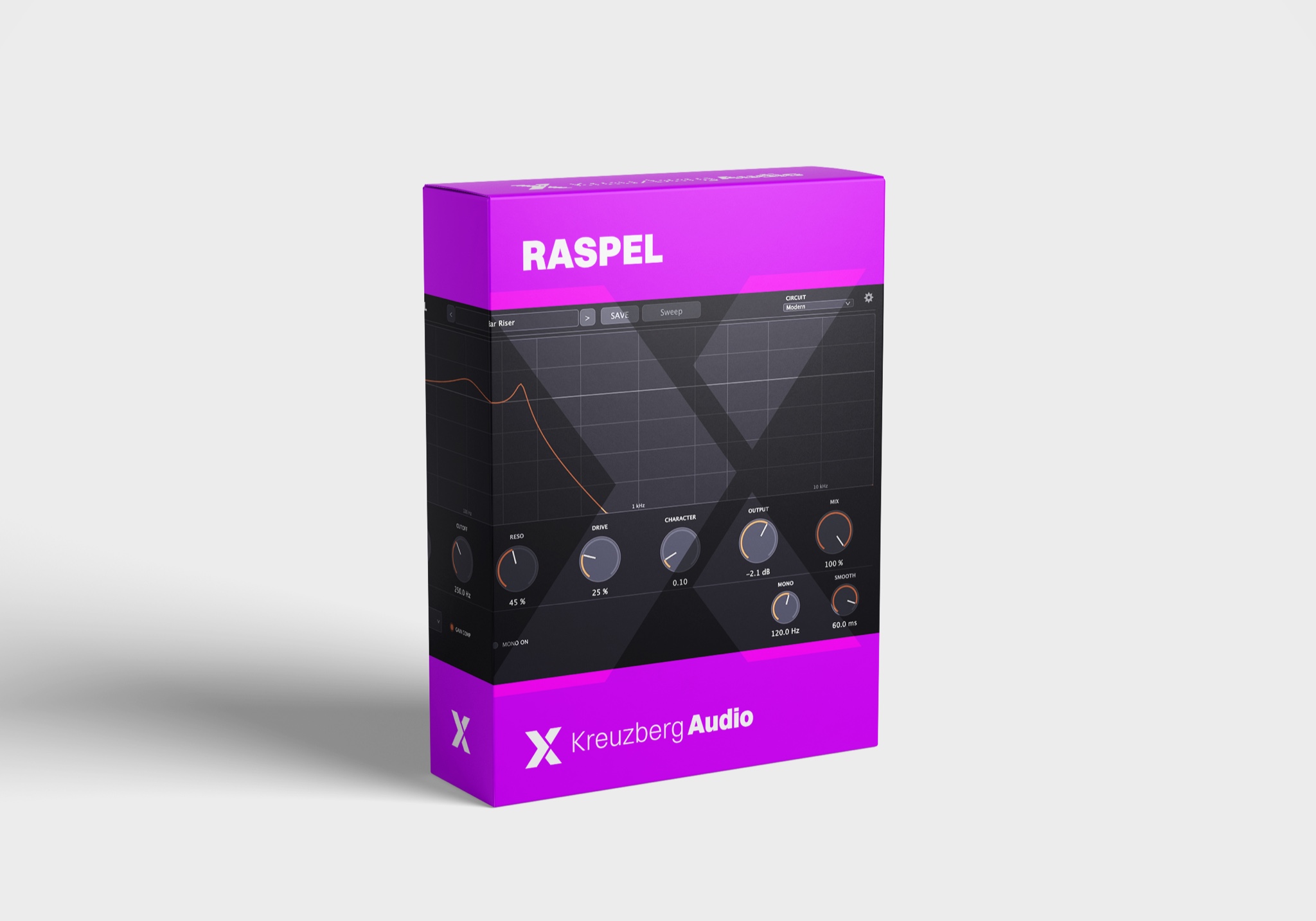
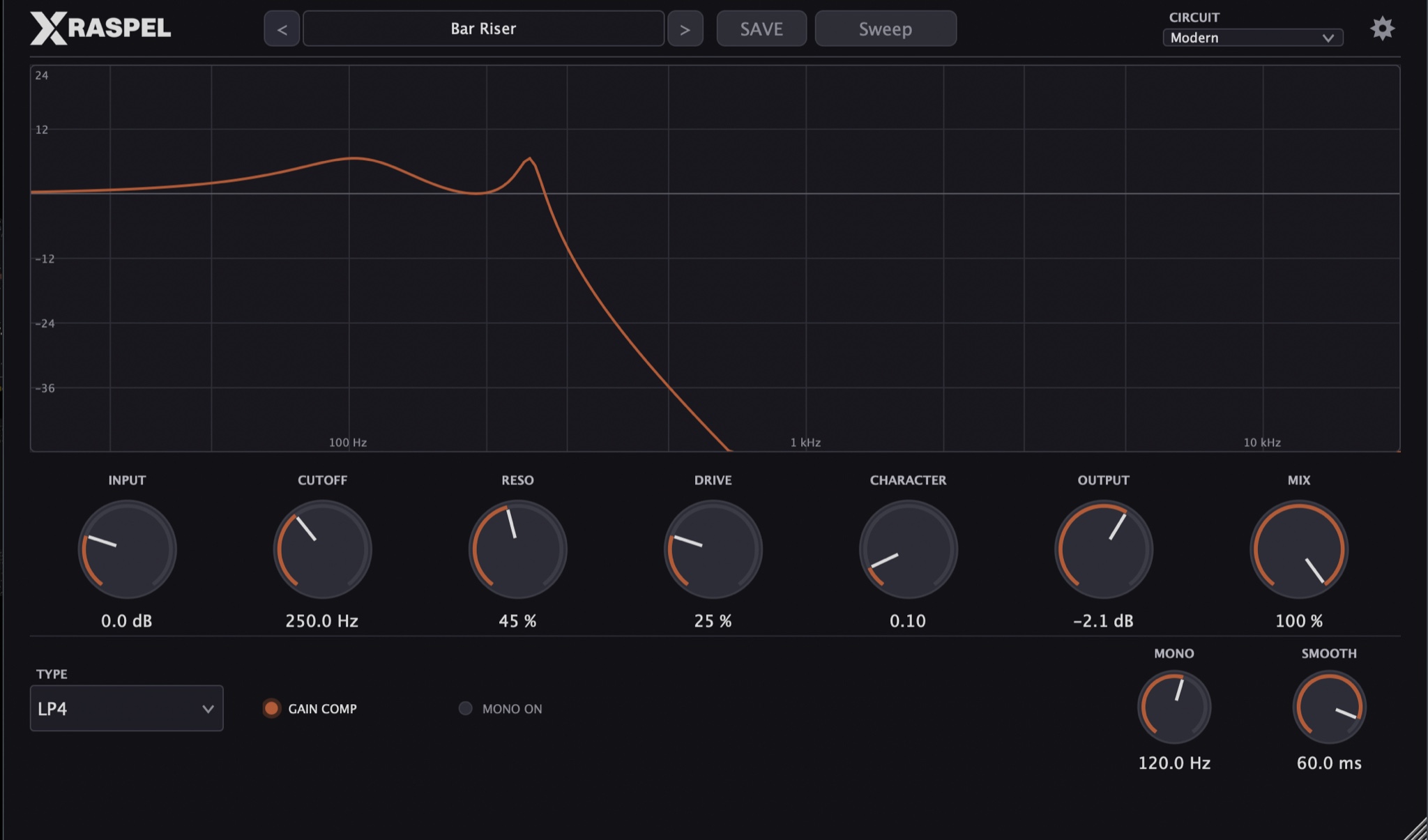
RASPEL is a free resonant filter with saturation inside every filter stage. Six filter types from LP2 to BP4, DRIVE at the input of every stage with linear feedback, and the CHARACTER wavefolder after the filter. CIRCUIT Vintage snaps the filter like an old digital system, and a zero-latency mono maker keeps the sub in the center. 50 factory presets in four banks, all level matched within 1 dB. No serial number, no activation.
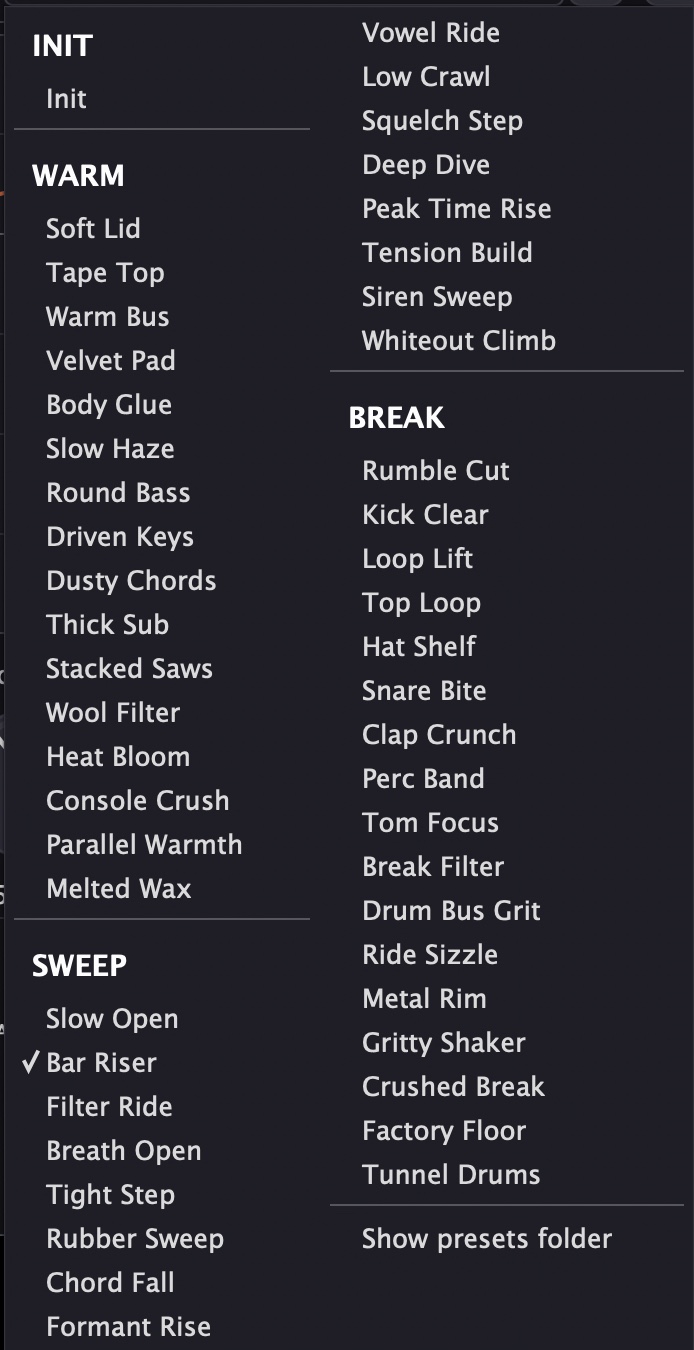
A filter and a saturator in a row always lose something: before the filter, the distortion lands where the filter is about to cut it away, after it the resonant peak gets flattened. RASPEL puts the saturation inside the filter. DRIVE boosts the level in front of the filter by up to 30 dB, saturates the input of every single filter stage and takes the boost back out afterwards. The feedback stays linear, so the resonance gets thicker under saturation instead of unstable, even with DRIVE all the way up. Automatic gain compensation runs all the time, and GAIN COMP keeps every stage at 0 dB in its passband. Six filter types are available: lowpass with two, four and six poles, highpass with two and four, and a fourth-order bandpass. Switching crossfades over 20 ms. After the filter sits CHARACTER, a sine wavefolder that is bit-transparent at 0 and turns a round bass into a metallic lead when pushed. Filter, DRIVE and CHARACTER run with 1x to 8x oversampling. CIRCUIT Vintage snaps the frequency of the filter poles to third-octave steps and the damping to coarser steps, plus a soft limit inside the filter. In the bass a slow sweep moves in steps. MIX is time-aligned parallel without comb filtering, and the mono maker works with zero latency and phase compensation from 20 to 500 Hz. SMOOTH from 1 to 100 ms decides how the filter follows automation, from stepped sixteenths to a soft build over many bars. 50 factory presets in the banks Init, Warm, Sweep and Break, level matched within 1 dB measured at -18 dBFS. Reported latency at 48 kHz is 59 to 124 samples depending on oversampling. RASPEL is free, with no serial number and no activation.
- Six filter types: LP2, LP4, LP6, HP2, HP4 and BP4, CUTOFF 20 Hz to 20 kHz, 20 ms crossfade when switching
- DRIVE at the input of every filter stage with up to 30 dB of boost, linear feedback, automatic gain compensation, GAIN COMP
- CHARACTER: sine wavefolder after the filter, bit-transparent at 0
- CIRCUIT Modern and Vintage, Vintage with a third-octave grid and a soft limit inside the filter
- Oversampling 1x, 2x, 4x and 8x, latency at 48 kHz 59, 108, 120 and 124 samples, reported to the host
- Time-aligned parallel MIX, zero-latency mono maker from 20 to 500 Hz
- SMOOTH from 1 to 100 ms, 14 automatable parameters
- 50 factory presets in four banks, level matched within 1 dB
- Free, no serial number and no activation
- Price: free
- Formats: VST3, AU (macOS), CLAP, Standalone
- Systems: macOS 11 Big Sur or newer (Universal Binary, Intel and Apple Silicon), Windows (64 bit), Linux x86_64 from Ubuntu 22.04
- Version: 1.0.2
What was added recently
Version 1.0.2, 2026-10-05
- Maintenance update, includes 1.0.1. A fast DRIVE move, a preset change or an automation jump in CUTOFF or RESO no longer causes a short volume burst. The curve display no longer cuts off the resonance peak and no longer jumps while a knob sweeps through the resonance. On Linux, install.sh installs the CLAP again.
Version 1.0.0, 2026-10-01
- RASPEL arrives as a free plugin. A resonant filter with six types, saturation at the input of every filter stage with linear feedback, the CHARACTER wavefolder and CIRCUIT Vintage. Zero-latency mono maker, oversampling up to 8x, 50 factory presets in four banks. VST3, AU, CLAP and standalone for macOS, Windows and Linux, no serial number.