
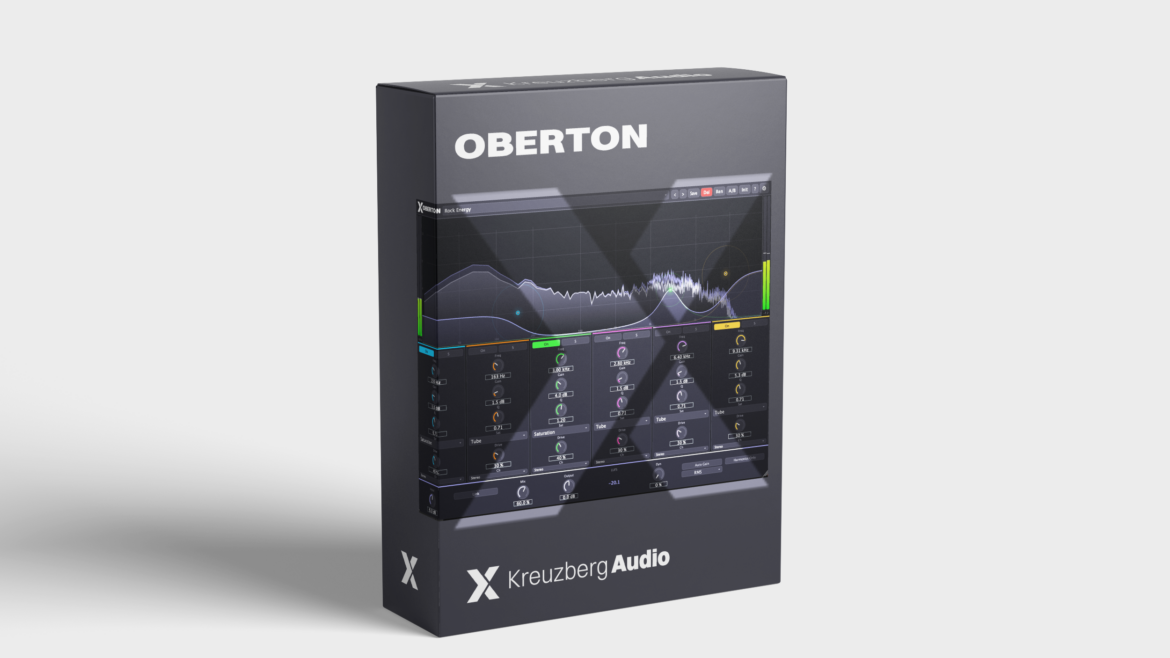
Six bands. Fifteen saturation algorithms. Saturation exactly where your mix needs it.
Now in Pro Tools too
Pro Tools users have had to sit this one out so far. Version 1.7.0 changes that: OBERTON runs as an AAX plugin in Pro Tools, on macOS and Windows. The plugin is PACE-signed and ships right in the installer, you simply tick the AAX component. No wrapper, no developer build of Pro Tools, OBERTON loads in any regular installation.
For mastering, mixing and post in Pro Tools you get the same OBERTON as in VST3, AU and CLAP: the same audio engine, the same 227 presets, the same six bands. The Pro Tools master bypass runs through the same click-free bypass as the button in the plugin.
The problem with global saturation
Tape on the master. Tube over everything. One drive knob for the whole mix. It sounds fat at first, but a global saturator colors the entire signal the same way. The harmonics also land where you don't want them at all. You wanted shine in the highs and get a muddy bass with it. You wanted punch in the low end and get harsh, distorted highs on top. One decision for the whole spectrum, and most of the time it only sits right in half the places.
The idea: saturation follows your EQ
OBERTON flips the principle around. Each of the six bands extracts only its EQ boost as a difference signal, sends exactly that difference through the saturator you choose and mixes only the result back onto your dry signal. You hear harmonics where you add EQ energy, and nowhere else. Which band turns warm, which bites, which goes metallic, which only breathes subtly, you decide that per band. The rest stays clean.
No drive stage building up on itself, no muddy master. Pure layering of character, placed exactly on the frequency range you boost in the display.
Who OBERTON Is Built For
OBERTON is built for two worlds that share the same workflow.
Mastering engineers get phase-coherent glue across two or three wide bands, honest level matching via LUFS, a Harmonics-Only mode for transparent polishing without an EQ signature, and Mid saturation that thickens the center without polluting the stereo field. Tape and Tube for subtle glue, Rectify for the 808 sub trick, Transformer for Neve-style iron warmth.
Sound designers and producers who want to color their sound get a separate character on every band, from gentle tube warmth all the way to total destruction. Wavefolder and Bitcrush generate metallic and digital textures, Diode delivers fuzz and drum crush, Side saturation brings stereo sparkle to hihats and cymbals without raising the mono center. From subtle coloration to sound-design brutality, it is all in there, and you pick it per band.
What makes OBERTON different
Continuous Saturation, Not Three Fixed Steps
A lot of saturators give you subtle, medium and aggressive, and that is it. OBERTON gives you a continuous drive from 0 to 100 percent on every band. No thinking in steps, no jumping between intensity presets. You dial in the exact point where it sits, different on every band. And with Dynamic Drive the saturation even follows the level: loud passages push the saturator harder, quiet passages less, transient-aware. At 30 percent the bass breathes subtly, at 50 percent it turns into compression-meets-saturation, at 100 percent extreme dynamic pumping for creative use.
Band Link for phase-coherent boost summing
When you boost two or more bands in the same frequency range, they do not sum 1:1. Their crossover points meet 130 to 170 degrees out of phase, and you lose 3 to 5 dB exactly where you wanted the most punch. Concretely: 632 Hz plus 2.8 kHz at +12 dB each with Q 0.71 gives only +5.7 dB instead of the expected +10.4 dB.
With Band Link enabled, each band extracts its residue against the sum of the previous bands. The boosts add up cleanly like in a serial EQ, but each band still saturates only its own difference signal. The result: denser welding between adjacent bands, rich mastering glue, closed vocal cohesion from body through presence to air, stacked rhythm guitars without phasing dips. No added latency, no pre-ringing, none of the baggage of a linear-phase EQ. Off by default, so your existing projects and presets sound bit-identical.
Harmonics-Only mode
Maybe the most honest feature in the plugin. Switch Harmonics-Only on and OBERTON subtracts the EQ boost from the wet signal. What remains is only the nonlinear saturation harmonics. You get air and presence without the typical EQ curve signature. Clean, perceptually honest, ideal for mastering when you want character but no tonal shift.
Pentode, the new tube character
Pentode is a new per-band saturation type that delivers an authentic tube and pentode tone. It generates a pure odd harmonic series with a dominant 3rd harmonic, with the 5th and 7th sitting below it. Unlike a static distortion unit, the harmonic ladder opens up with the drive: the harder you push, the more the 5th and 7th rise relative to the 3rd. The result is a living, dynamic analog feel instead of a frozen distortion sound.
Pentode is the full, musical counterpart to the surgical single-harmonic types that place only one individual harmonic on purpose. On hot material, combine it with 4x or 16x oversampling for a clean spectrum. Your existing sessions and presets stay untouched, Pentode was added purely additively.
The new in-plugin help now also documents every saturation type and explains when each one fits: from the surgical single-harmonic tools for targeted spectral work to the full analog saturators like Pentode, Tape and Transformer.
Auto-Gain in two modes
Louder always sounds better at first. That exact bit of self-deception kills honest decisions. Auto-Gain subtracts the EQ boost from the wet signal so only the harmonics remain, and holds the output at dry level, either classic RMS match or modern LUFS match per ITU-R BS.1770 with K-weighting. The latter follows perceptual equal-loudness and is the more honest choice. You hear the real character of your saturation, not the level. That is how you compare A against B the way it should be.
Mode Level Normalization
Click through the fifteen algorithms without the loudness jumping. Tube, Tape, Diode, Wavefolder, Bitcrush, Rectify, everything is calibrated to Tube's K-weighted loudness, accurate to 0.1 dB. You cycle through the modes and compare pure character, with no level matching by hand. Clean stays deliberately neutral so the band gain knob honestly shows what it does.
Global Gain Scaler
One knob in the master section scales all active bands proportionally. You built your saturation chain, the ratio between the bands is right, now you want the whole thing harder or softer without destroying the balance. That is exactly what this is for. 0 to 200 percent, default 100. At 200 all band gains double in dB, at 50 they halve, and the ratios between bands stay untouched.
Mid/Side and Left/Right per Band
Every band can be routed to Stereo, Left only, Right only, Mid only or Side only. The M/S encoding sits around the saturation, so harmonics are generated on the chosen channel exclusively. Mid saturation on the mastering bus for the fattest center without polluting the stereo field. Side saturation on hihats for more sparkle without raising the mono center. Isolated L or R for one-sided coloration, for example a solo guitar on the right only.
A Workflow That Stays Out of Your Way
Soloing a band that is switched off auditions it before you commit, with a click-free 50 ms crossfade. Solo-Sweep on the right mouse button solos a band momentarily and lets you drag through the spectrum to hunt down trouble spots. Double-click on an empty area drops the next free band exactly there, automatically Low Shelf below 50 Hz, High Shelf above 10 kHz, otherwise Peak. Double-click on an existing point toggles the band on or off. Saturation skip arrows step through the fifteen algorithms per band strip without opening the dropdown. Undo and Redo sit right in the top bar, wired into the parameter tree. Click-free bypass that outputs the untouched original and also routes the host's native bypass shortcut cleanly through the crossfade. Mono bus support for bass DI, mono guitar, vocal lead and drum mics. Continuous GUI zoom from 50 to 150 percent via corner drag, plus a Light and a Dark theme.
The six bands
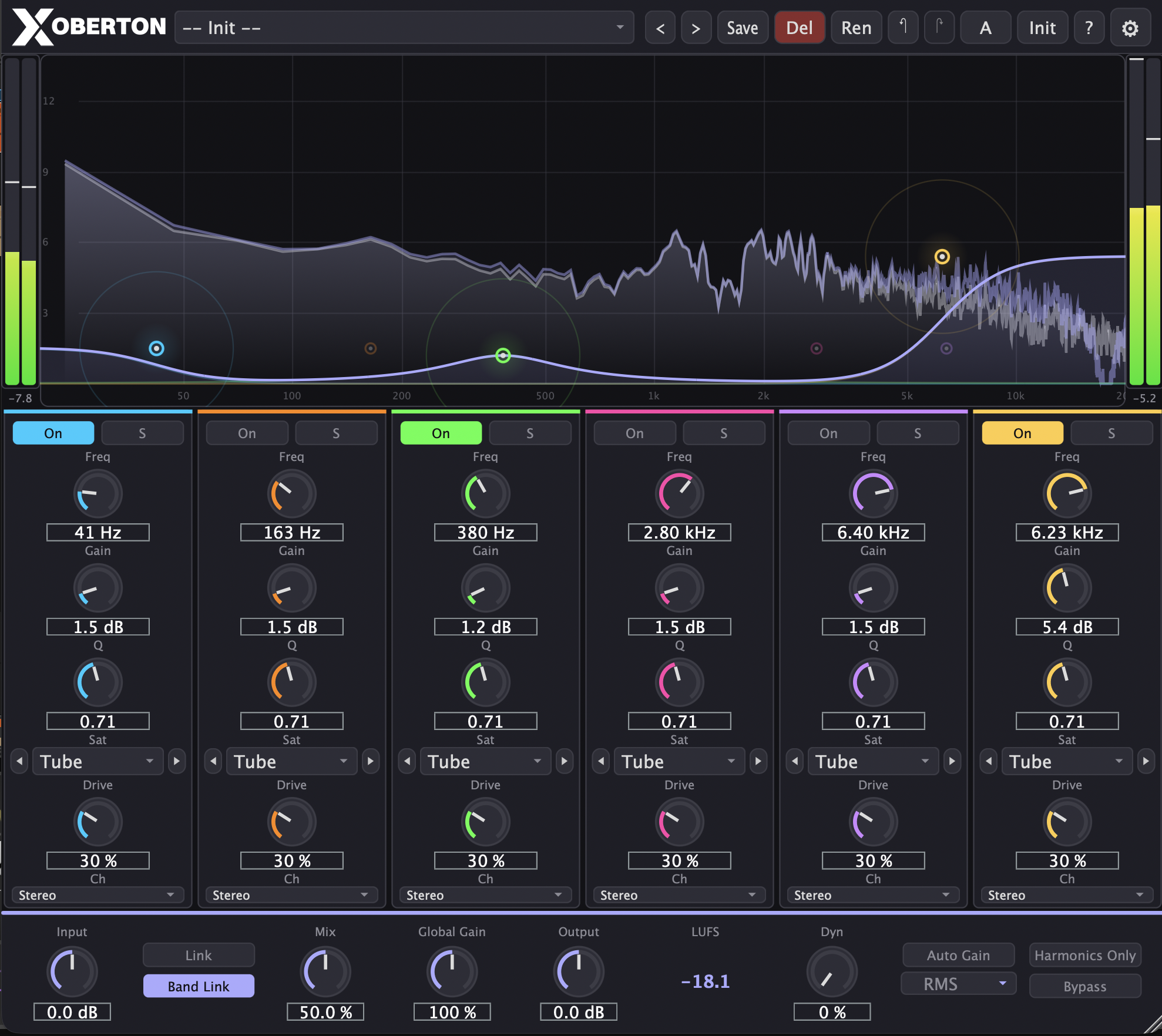
| Band | Default Frequency | Filter Type |
|---|---|---|
| 1 | 42 Hz | Low Shelf |
| 2 | 164 Hz | Peak |
| 3 | 632 Hz | Peak |
| 4 | 2.8 kHz | Peak |
| 5 | 6.4 kHz | Peak |
| 6 | 12 kHz | High Shelf |
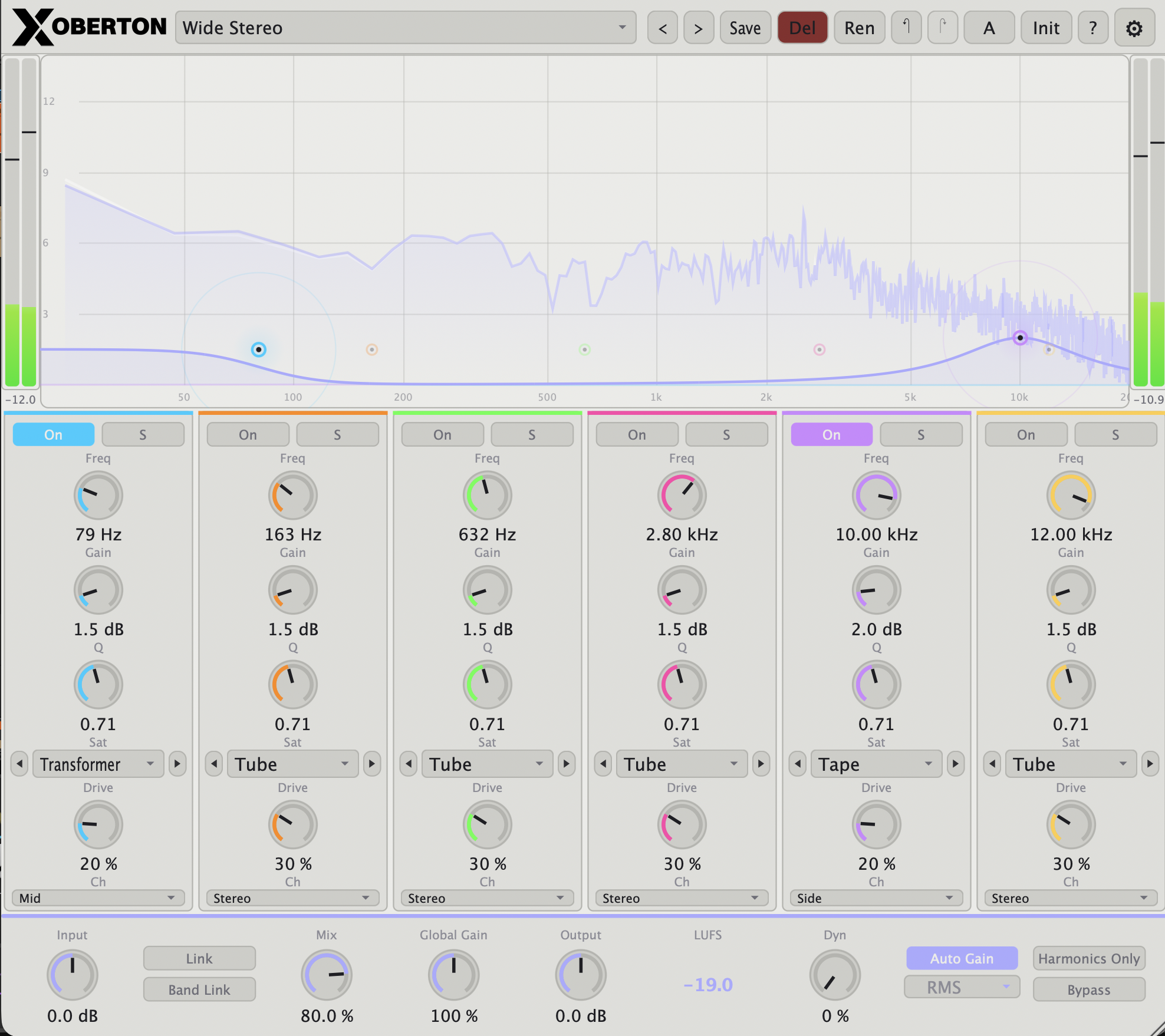
Frequency (20 Hz to 20 kHz), Gain (0 to 12 dB), Q (0.1 to 10), Drive, Sat-Type and Channel-Routing are freely adjustable per band. Every band has a solo switch. Out of the box all bands are disabled, so a fresh plugin is bypass first. Enable a band and its saturation path kicks in immediately.
Fifteen Saturation Algorithms, Each With Its Own DNA
Every algorithm has a distinct harmonic fingerprint, all written from scratch, no third-party IP, no samples.
- Tube: classic warm, asymmetric, 12AX7 triode character. Vocal bus, bass warmth, master glue.
- Warm Tube: Class-A power tube with a dominant 2nd harmonic, fat and much more aggressive.
- Tape: gentle, low-THD, cassette and 15ips vibe. Subtle mastering glue, drum bus, anywhere you want tape character without audible distortion.
- Diode: Shockley-equation smooth clip, fuzz-pedal style. Aggressive coloration and drum crush.
- Saturation: pure x/(1+|x|), symmetric, odd-only, a neutral reference and transparent drive.
- Rectify: pure even harmonics, the 808 sub-bass booster trick, emphasizing the octave and the fifth.
- Harmonic: even and odd blended, rich and musical.
- Cubic: pure 3rd harmonic, transparent asymmetric drive, ideal for vocals.
- Transformer: iron-core B-H curve, Neve-style iron warmth, saturates low frequencies first.
- Clean: bypasses the nonlinearity, pure EQ mode, for when you want a band as a parametric EQ stage only.
- Wavefolder: sine-based folding in the style of Buchla and Serge, complex metallic overtones. Best (16x) oversampling recommended above 50 percent drive.
- Bitcrush: true integer bit reduction from 3 to 14 bits, lo-fi, 8-bit retro, glitch.
- Pure H2: surgical single-harmonic generator (Chebyshev T2) that places only the 2nd harmonic on purpose. A clean tool for targeted spectral work and parallel blends, not an analog saturator.
- Pure H3: surgical single-harmonic generator (Chebyshev T3) that places only the 3rd harmonic on purpose. For precise harmonic work, the surgical counterpart to the full Pentode.
- Pentode: warm, analog, tube-style, with a dominant 3rd harmonic plus the 5th and 7th below it. The twist: the harmonic ladder opens up with the drive, the harder you push, the more the 5th and 7th rise relative to the 3rd. A living, dynamic analog feel instead of static distortion, ideal for master glue, bass warmth and anything with real tube character.
From subtle glue on the master bus to full sound-design destruction, it is all in there. You choose per band.
227 factory presets in nine categories
Every preset is designed to work in the mix right away, not to sound crazy on YouTube. Drive and mix values are realistic, not spectacular. 57 of them are Band Link cascade variants with Band Link enabled for denser welding.
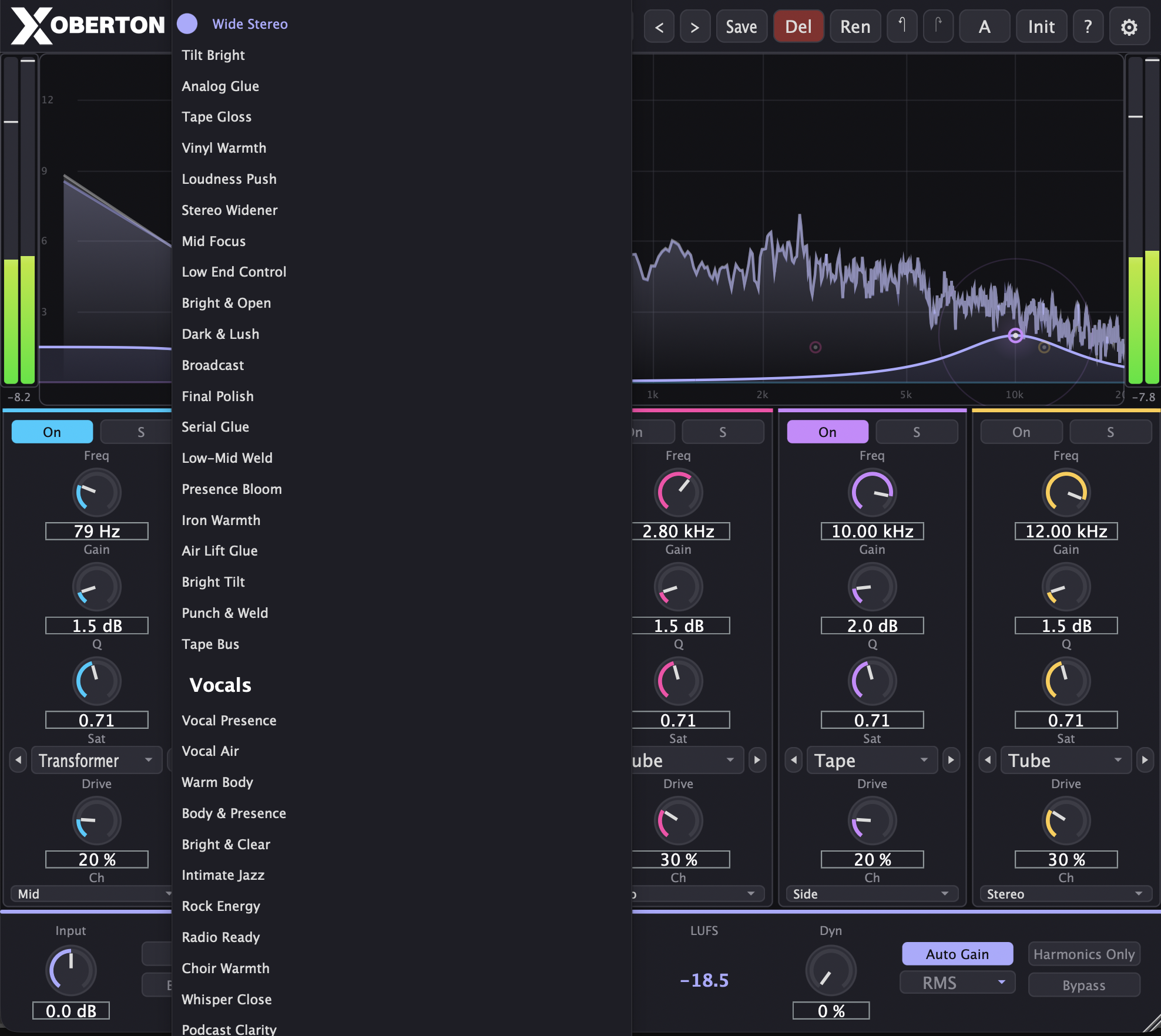
- Mastering (28): Air Lift, Pultec Vibe, Analog Glue, Final Polish, Cohesion Glue (Band Link)
- Vocals (28): Vocal Presence, Radio Ready, Whisper Close, Rap Aggression, Body→Air Welding (Band Link)
- Drums (28): Kick Punch, Snare Crack, 808 Sub, Parallel Crush, Bus Weld (Band Link)
- Bass (28): Sub Fundament, Acid Character, 808 Enhancement, Cut Through Mix, Fundamental→Harmonic Link (Band Link)
- Guitar (28): Guitar Bite, Cabinet Warmth, Metal Crunch, Lead Sustain, Stacked Rhythm (Band Link)
- Keys & Piano (28): Rhodes Warmth, Hammond Drive, Mellotron Tape, Pad Evolve, Layered Keys Welding (Band Link)
- Genre (29): Techno Drive, Trap 808, DnB Amen, Synthwave Retro, Psytrance Acid, Wall-of-Sound Cohesion (Band Link)
- Experimental (20): Folded Bass, Robot Voice, Glitch Pop, Industrial Bass
- Creative (10): Mid Crunch, Lo-Fi Vinyl, Mid Bloom, 8-Bit Retro
User presets land under Documents/Kreuzberg Audio/OBERTON/Presets, and factory names are protected against overwriting.
Technical highlights
- Oversampling: Off, 2x (Light), 4x (Good) or 16x (Best), via IIR half-band polyphase, with plugin delay compensation. Dry and wet pass through the same chain and stay phase-aligned.
- Spectrum analyzer: live pre/post overlay right in the EQ display with the exactly computed filter curves, bands editable by drag, switchable off to save CPU (audio stays bit-identical).
- LUFS meter: ITU-R BS.1770 K-weighted, 400 ms momentary, plus input/output peak meters with peak hold.
- Dynamics modulation: drive follows the level envelope, transient-aware, globally adjustable.
- A/B compare: two slots in the preset bar with copy A to B and copy B to A.
- MIDI CC Learn: right-click any knob, turn a hardware controller, done. Lock-free on the audio thread.
- Realtime-safe: no heap allocation in the audio path, smooth parameter ramps, no zipper or click artifacts.
New in version 1.7.0
- AAX for Pro Tools: PACE-signed, in the installer for macOS and Windows, loads in any regular Pro Tools installation.
- Honest A/B comparison: Bypass now sits after the complete gain staging and outputs the pure original. Match the level with output, hit bypass, and you hear exactly what OBERTON adds.
- Precise filter curves: The EQ display computes from the same coefficients as the audio processing and shows every curve accurate to 0.2 dB, right down to the characteristic overshoot at the shelves.
- Solo to audition: Solo lets you hear a band even while it is still switched off, so you find the right spot before you activate it. Compare several bands directly in solo.
- Phase-aligned oversampling: Dry and wet pass through the same oversampling chain and stay phase-aligned across the whole spectrum. Boosted high shelves sound open right up into the top octaves, exactly the way the curve in the display shows.
- Auto gain explained: Tooltips and an expanded help section show right in the plugin what auto gain does and how RMS and LUFS differ.
- Update-proof license: Activation is tied to a fixed machine ID and stays in place across system and plugin updates.
- Subtler demo marker: The noise in the demo is quieter and fades in and out smoothly.
Formats and Systems
Formats: VST3, AU, AAX, CLAP, Standalone.
macOS 10.13 High Sierra or later on Intel, macOS 11 Big Sur or later on Apple Silicon, Universal Binary, signed and notarised. Windows 10 64-bit or later. Linux Ubuntu 22.04 or later (glibc 2.35), JACK or ALSA.
Sample Rates: 44.1, 48, 88.2, 96, 176.4 and 192 kHz. GUI: 900 x 800 px, continuously resizable from 50 to 150 percent (9:8 aspect ratio, persistent), Light and Dark theme.
Made in Berlin
OBERTON was developed entirely in Berlin. The DSP is built on JUCE, the saturation algorithms are written from scratch, every filter coefficient is sample-rate correct. No white label, no generic toolkit saturator. Our secret weapon is the love of detail.
Tools by producers, for producers.
License
Online activation with a 3-machine limit per license. 14-day refund guarantee. Free v1.x updates. Automatic license delivery by email within minutes of purchase. Customer portal for license management. Demo version without a license: 30 plugin starts with a discreet demo marker (3 seconds of noise every 2 minutes), then sound off. Educational and NFR licenses on request.
Demo: 0.00 EUR
Full version: 49.00 EUR (incl. 19% VAT)
CLAP format
OBERTON now runs as CLAP too. The modern, open plugin format is natively supported by Bitwig Studio, Reaper and Studio One 6.5 and up, among others. It is sonically identical to VST3 and AU because it runs the same audio engine, so there is no difference in sound, just one more format to choose from. The CLAP build is installed automatically, just rescan your plugins once in your DAW and you are set.
License Information
This product includes a professional license system with the following features:
- Online activation with hardware fingerprinting
- Up to 3 device activations included
- Automatic license delivery via email
- Customer portal for license management
After purchase, you will receive your license serial number via email within minutes.