
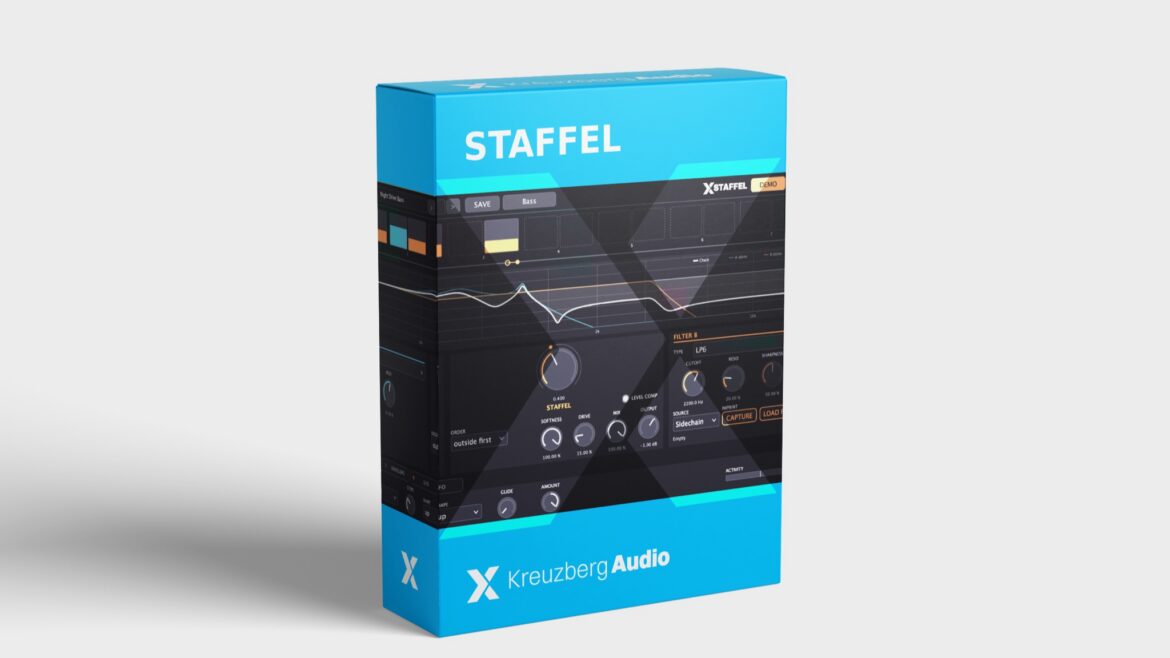
Two filters, fourteen handovers. Modulation for basses and leads that did not exist before.
The road between two filters
The filter sweep into the drop. The highpass that takes the bass away in the breakdown and gives it back on the drop. The acid line whose cutoff opens up over eight bars. Every club track has it, and every producer can do it. Which is exactly why it sounds the same everywhere by now: one filter, one cutoff, up and back down.
If you want more, you build yourself a monster. Two filters in parallel, a crossfade automated, and in the end two finished sounds just add up. Or a filter with a morph knob whose in-between positions sound like nothing, plus clicks and level jumps on every change. Then automation lanes for cutoff, resonance and type, an envelope follower from the rack, an LFO from another plugin. An hour later you have a build that sounds okay, and on the next track you start from zero again.
STAFFEL turns that into one knob. You set up filter A on the left, filter B on the right, and the big STAFFEL knob in the middle hands the signal from A to B. Not all at once, but section by section, like a baton in a relay race. The sweep into the drop no longer just pushes a cutoff up, it transforms the filter itself on the way. A lead that travels from a bandpass into a formant across the break arrives at the drop as a different instrument. A bassline that gets a different filter on every step has motion that no LFO on the cutoff can deliver. And in between, the thing happens that we developed this plugin for: filters that are neither A nor B, that did not exist before, and that stand out on a big system right away.
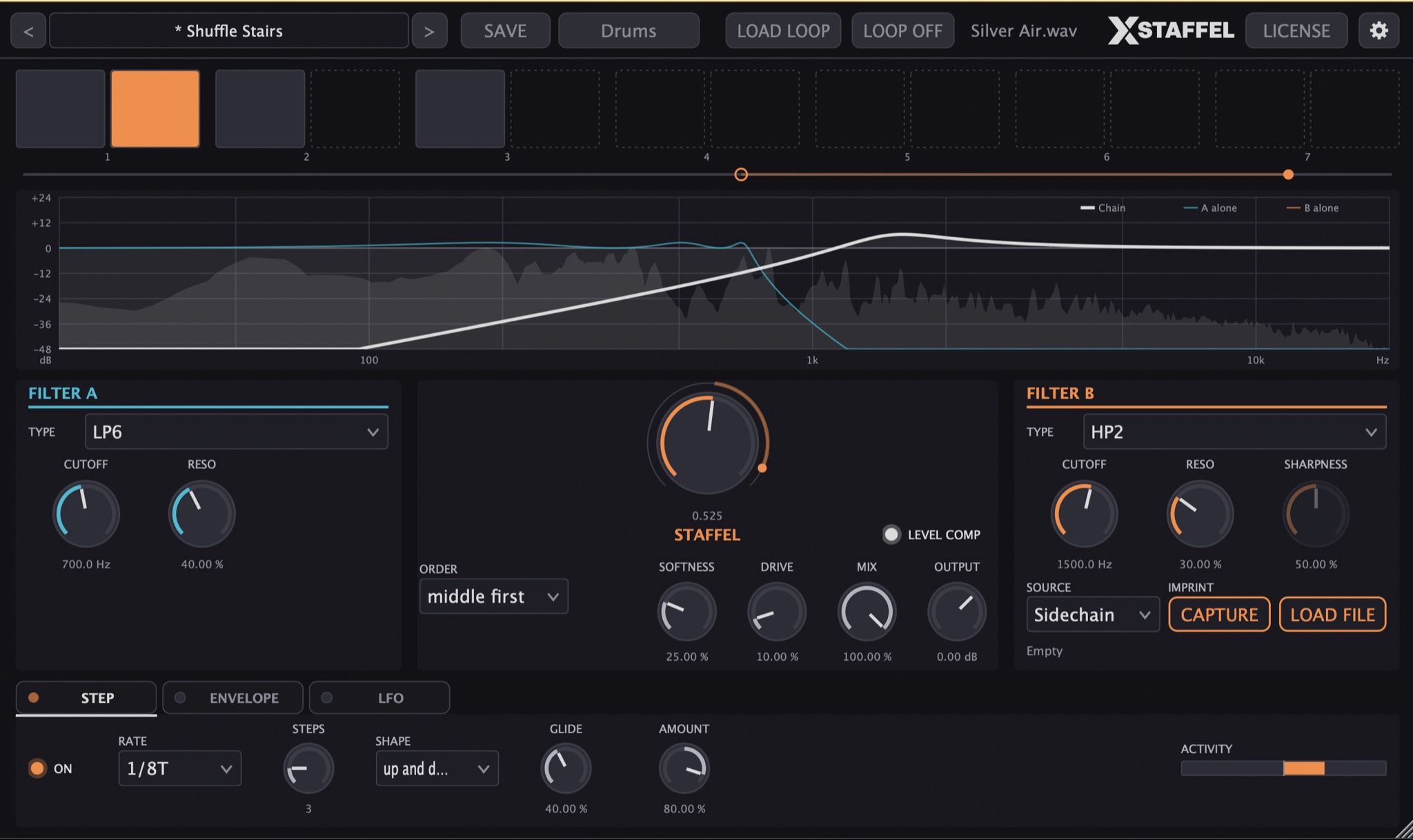
FILTER A on the left, FILTER B with IMPRINT on the right, the STAFFEL knob in the middle. The teeth row above shows which of the 14 sections currently sit with A and which with B.
What you hear
Turn STAFFEL slowly from left to right. First the lowest section lets go of A and travels to B, then the next, then the next. Halfway through, the chain is a hybrid of both, and that is exactly where it gets interesting: where a resonant section of A is half faded out and its counterpart from B half faded in, the two partly cancel each other. Those cancellations travel through the spectrum as notches while you turn. A lowpass on its way to becoming a highpass does not sound like both in the middle, it sounds like a third thing: hollow, vowel-like, comb-like, depending on what you set up on either side. Put that on a 16-bar build, and the drop arrives out of a sound the floor has not heard yet.
And because these are two complete filters rather than one with a morph knob, every position is stable, nothing clicks, and at the far left and far right you get exactly the filter you dialed in. So go ahead and swing between a six-pole lowpass and a formant in the drop, between bandpass and comb in the bassline, between recipe and imprint in the breakdown. It holds, even when you run it on sixteenths.
Four knobs shape the handover. ORDER decides which sections change first: the low ones, the high ones, from the middle outwards, from the outside in, or random with a seed from 1 to 99 so a sweep you found today is still the same tomorrow. SOFTNESS decides whether each section snaps over on its own or all seven glide into each other. DRIVE saturates not once at the end but after every pair of sections, spread along the chain, up to 18 dB. And LEVEL COMP holds the level so you compare sound, not loudness.
Eight types on either side
A and B choose their type independently, each with its own CUTOFF from 20 Hz to 20 kHz and its own RESO:
- LP2, LP4, LP6: lowpass at 12, 24 and 36 dB per octave. Six poles for the scream, two for the gentle roll-off.
- HP2, HP4: highpass at 12 and 24 dB per octave. For breaks, hats and anything that needs to make room.
- BP4: fourth-order bandpass. Telephone, radio, isolated mids.
- PEAK3: three peaks at one, two and three times the cutoff frequency, 12 dB each. A harmonic comb that travels with CUTOFF.
- FORMANT: three peaks in the ratio 1 to 2.7 to 4.2. Vowels without tuning them one by one.
A six-pole lowpass against a formant, a bandpass against a PEAK3 two octaves up: because both sides are free, the combination decides how the handover sounds. And because sections pair up by rank, every combination fits every other.
IMPRINT: filter B from a sound
Up to here, the filters come from recipes. With IMPRINT, filter B comes from your own material, from an imprint. You hit CAPTURE, and STAFFEL searches the last two seconds of the sidechain for the loudest bit, pulls out its resonances, seven of them, each with frequency and decay time, and turns them into filter B. Without a sidechain, CAPTURE takes the input. LOAD FILE goes the other way: load a WAV, AIFF or FLAC, STAFFEL finds the loudest window in the first ten minutes and captures from it right away.
After that the imprint is a filter like any other, and you are allowed to bend it. SHARPNESS lengthens the resonances, from wide and soft to a standing ring. CUTOFF B shifts the whole imprint in octaves, at 1 kHz it sounds as captured. RESO B makes the resonances narrower or wider. And then you hand over with STAFFEL from an LP4 to the vowels of a voice, to the body of a snare or to the ring of a cymbal, section by section. A bassline that starts sounding like your vocal chop halfway through. A break that takes on the body of the snare sitting on the sidechain.
The imprint is saved with the project and travels into your own presets. A new imprint fades in softly instead of switching hard.
Modulation: three sources on one knob
The STAFFEL knob is where everything comes together, and that is exactly where three modulation sources aim. Each has its own switch and its own amount, positive or negative, and all three add up on the knob. So you can park the knob at a third, run STEP over it, pull the ENVELOPE against it and let the LFO drift slowly underneath. The ring around the knob shows you at any moment where the handover currently sits, and ACTIVITY shows per source how hard it is pushing.
- STEP is the sequencer. 2 to 8 stages on the host grid from 1/32 to 1 bar, triplets included, up, down or up and down, with GLIDE between the stages. An acid line does not get a different cutoff per sixteenth, it gets a different filter per sixteenth. Four stages on quarter notes with an LP4 against a formant, and the bassline talks. Eight stages upwards on 1/2 with GLIDE, and you have a four-bar build that lands exactly on B at the drop.
- ENVELOPE follows the level of the input or the sidechain, attack 0.1 to 100 ms, release 5 to 2000 ms. The handover breathes with the material: every hit pushes it towards B, in the gap it falls back to A. With a negative amount it goes the other way. Put the kick on the sidechain and a pad or a rolling bass switches between two filters in time with the kick, without automating a single note. It is sidechain, except the filter pumps instead of the volume.
- LFO swings as Sine, Triangle, Square or Sample and Hold, free from 0.01 to 20 Hz or synced from 1/32 to 8 bars. Sample and Hold on eighths with ORDER set to random: a different hybrid on every beat, the glitch fill before the drop without any chopping. A sine over 8 bars on a techno loop: the slow movement that can carry a track for twelve minutes.
STEP and the synced LFO read the transport position straight from the host. Loops, jumps, scrubbing, everything stays in phase. And on top of that comes what your host can do anyway: every knob in STAFFEL is automatable, CUTOFF A and B just like ORDER, SOFTNESS or the amount of each source. The modulation only ever moves the handover, never the design of the filters themselves. That is why it stays clean at any tempo, no matter how wildly you stack it.

STEP: 2 to 8 stages on the host grid, with GLIDE in between.

ENVELOPE: follows the input or the sidechain, attack and release free.

LFO: Sine, Triangle, Square or Sample and Hold, free or host-synced.
Who it is for
For producers looking for modulation on basses and leads that does not sound like cutoff automation, and who want what they make in the studio to work in the club. Techno and acid: basslines that get a different filter on every step, and builds that let the drop arrive out of a new sound. Drum and bass and breaks: a break whose hats wander across the highpass while the snare keeps its imprint, neuro basses that switch between two mouths. House and dub: vocal chops and pads whose vowels the envelope follower moves along the phrase. Dubstep and bass music: growls from FORMANT against an imprint, stepped on a halftime grid. And for anyone in sound design looking for something nobody has in their set yet: the Chaos bank is there for exactly that.
Anyone who has ever tried to make a build sound more exciting in the middle than at the drop knows what that is worth.
51 factory presets in six banks
Every preset has a tooltip in the preset bar that states its intent in one sentence. Presets with IMPRINT sound with the imprint currently loaded, and tell you if there is none yet.
- Init (1): the starting position
- Bass (10): Twin Saw Drift, Rolling Sixteenths, Dub Growl, Neuro Stepper, Mouth Bass, Kick Carve
- Drums (10): Break Shifter, Hat Shimmer, Dusty Crate, Imprint Room, Glitch Scatter, Tuned Hits
- Acid (10): Squelch Ladder, Rubber Accent, Six Pole Scream, Four Bar Squeeze, Vowel Drop, Triplet Slide
- Voice (10): Vowel Shift, Phone Chop, Breath Follow, Imprint Vowel, Imprint Choir Drift, Robot Syllables
- Chaos (10): Rank Storm, Imprint Shatter, Imprint Undertow, Flutter Engine, Three Hands, Ghost Trigger
You can save your own presets without limit, they carry the imprint with them and survive any uninstall.
New in version 1.1.0
Behind the curves in the frequency response you now see the spectrum of your input. You see where the energy of the bassline sits before you put CUTOFF or a resonance there.
When a clear note plays, a line shows its fundamental with note name and frequency, for example A2 110 Hz. That lets you put a formant or PEAK3 right on the pitch of the lead. With chords, drums and noise the line stays away instead of claiming a wrong note. Spectrum and pitch display can be switched off in the settings.
On top of that comes the 90 percent zoom step, and below 100 percent small texts stay legible. The sound does not change: the output is bit identical to 1.0.0, your projects and presets sound exactly as before.
Technical highlights
- Two complete filters with up to seven second-order sections each, 14 slots in the chain, handover rank by rank on the signal level
- Coefficients never derived from in-between values, endpoints bit-identical to A and to B, stable in every position
- Notch report from development: LP4 at 500 Hz against HP2 at 2 kHz measured in 100 steps
- Five orders including random with seed, SOFTNESS from hard to gliding
- DRIVE after every pair of sections, up to 18 dB, with measured level compensation
- IMPRINT: 14th-order linear prediction over an 85 ms window from sidechain, input or file, seven resonators, shiftable in octaves, fades in over 25 ms
- STEP, ENVELOPE and LFO with their own bipolar amounts on the handover, host-synced even across loops and jumps
- Oversampling 2x and 4x, latency 49 samples at 2x and 61 at 4x, reported to the host, dry path delayed to match
- Knobs smoothed on a 16-sample control grid, preset and type changes during playback without clicks
- Teeth row showing the 14 faders plus the frequency response of the chain, of A and of B, at 60 frames per second
- Input spectrum behind the curves and pitch of the input from 30 Hz to 2 kHz with note name, both switchable
- Interface 1100 x 650 px, six zoom steps from 50 to 150 percent, dark and light theme
- Standalone with loop player for WAV, AIFF and FLAC
- RT-safe, no allocations on the audio thread
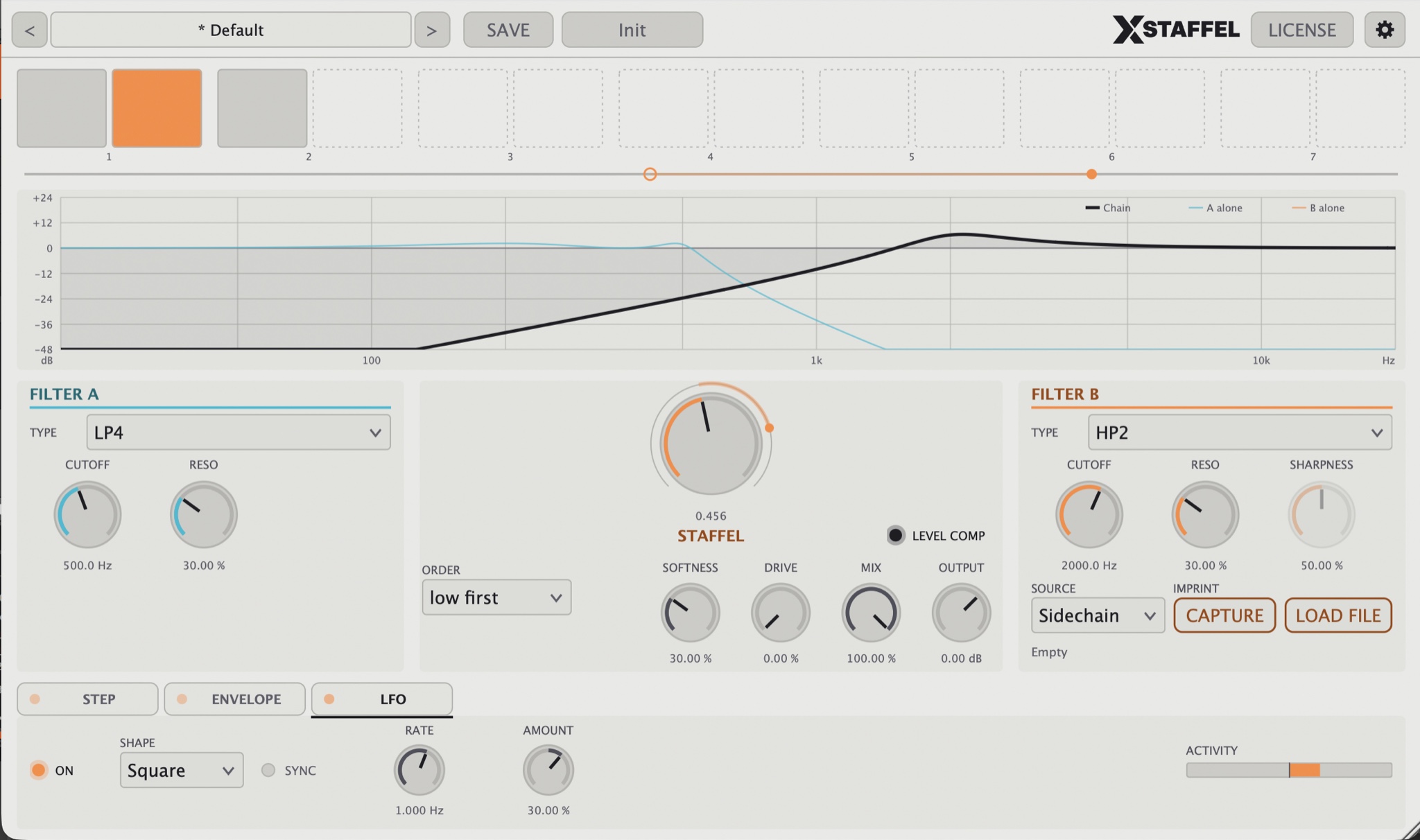
The same plugin in the light theme.
Formats & Systems
Formats: VST3, AU (macOS), CLAP, standalone
Systems: macOS 11 Big Sur or later (universal binary, Intel and Apple Silicon), Windows 10+ (64-bit), Linux from Ubuntu 22.04
Made in Berlin
STAFFEL was developed entirely in Berlin. The DSP is based on JUCE, the filter designs, the relay chain and the imprint analysis are written from scratch, every coefficient is sample-rate aware. No white label, no generic toolkit filter. Our secret weapon is the joy of detail.
Tools by producers, for producers.
License and demo
The demo runs with the full feature set, nothing is locked. Once a minute, quiet white noise mixes in for three seconds, faded in and out softly so you don't blame it on the filter. The demo allows 30 launches, after that it stays silent until you enter a serial number.
Activation contacts the license server exactly once. After that the plug-in starts with no network access at all, it never phones home. Your serial allows three concurrent activations. The only data transmitted is the serial number, an anonymous hardware fingerprint and the product name, never audio, project data or analytics.
Demo: 0.00 EUR
Full version: 49.00 EUR (incl. 19% VAT)
License Information
This product includes a professional license system with the following features:
- Online activation with hardware fingerprinting
- Up to 3 device activations included
- Automatic license delivery via email
- Customer portal for license management
After purchase, you will receive your license serial number via email within minutes.