
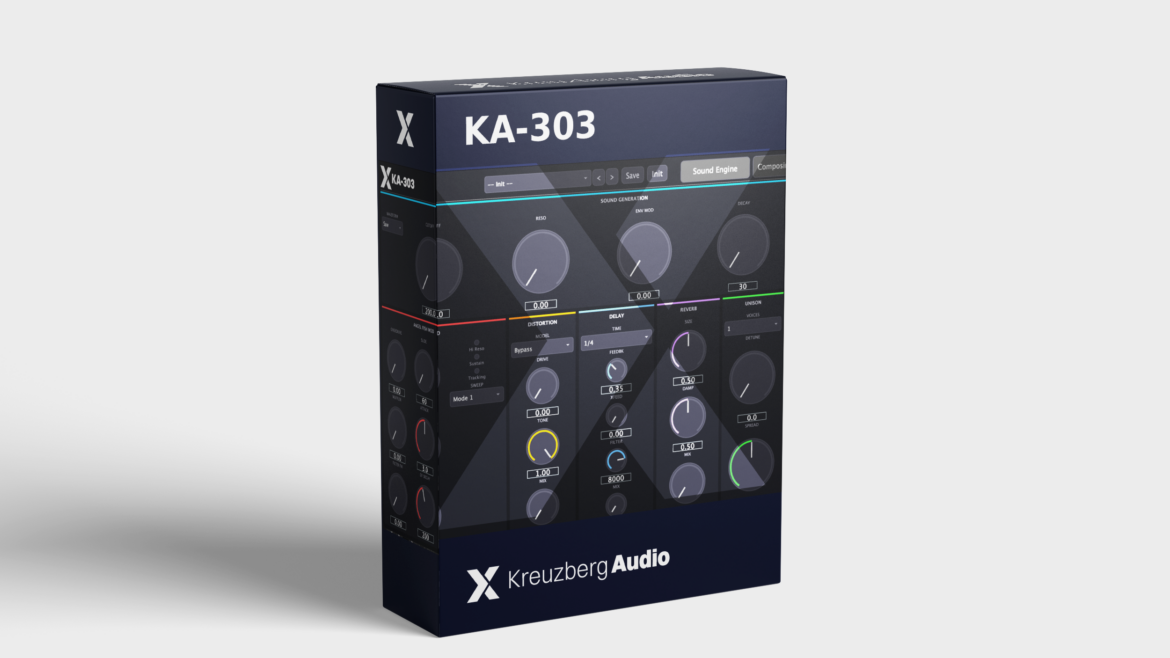
The KA-303 is a software synthesizer for the sound that invented Acid House, Acid Techno and Hard Acid. Squelchy, resonant, driving basslines that have moved dancefloors around the world since the late 80s. Made for producers who want exactly that sound in their DAW. No compromises, no detours, no hardware.
Read the full review → · Original at Loop Rituals
Read the full review → · Original at AMAZONA.de
Read the full review → · Original at bonedo
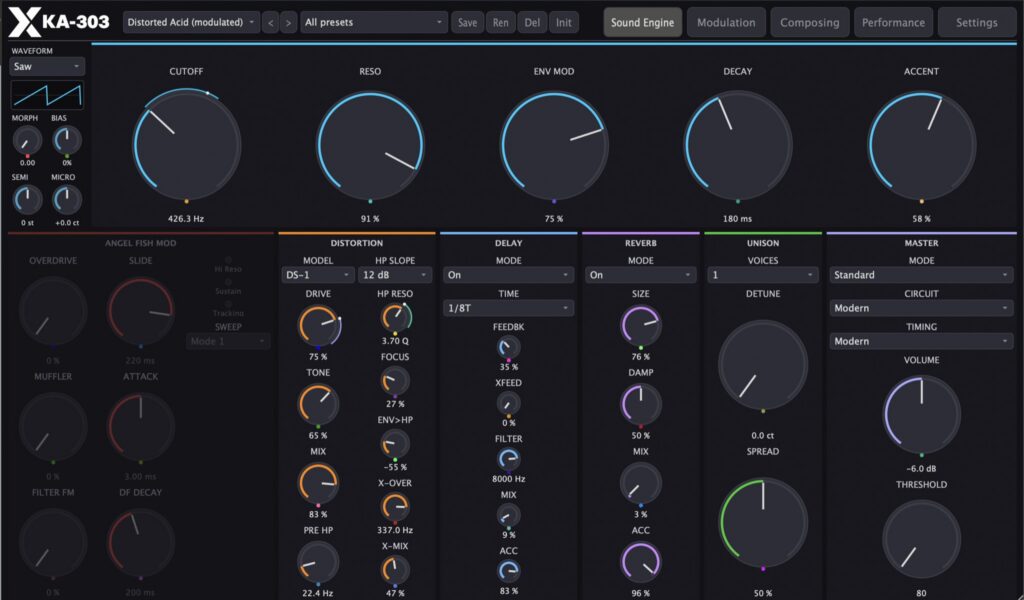
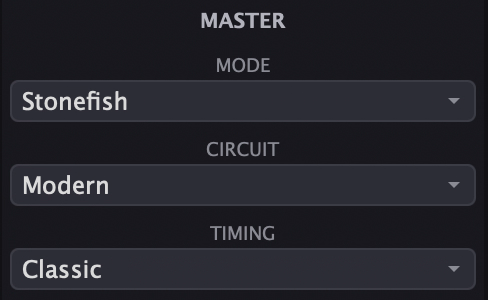
The KA-303 takes the sound of the legendary 303 as its starting point and goes far beyond it. A complete Composing Engine for acid patterns, a full modulation system with 64 macros, a Performance tab with eight pad modes, four distortion models, a Unison Engine with up to seven voices, the CIRCUIT and TIMING switches between modern and original envelope wiring, and the Flavor Palette with eight hard-wired character engines make the KA-303 not a clone but an instrument of its own with its own character.
The Flavor Palette: One Synth, Eight Instruments
Eight DSP engines hardwired into the voice's signal path, from the dry 303 to a screaming sync wall. The MODE selector is not an effects carousel and not a preset list. Each mode is its own engine, and they escalate: every higher mode keeps the character below it and stacks exactly one new signature engine on top. You don't pick a sound, you pick a character.
Standard, the pure 303
One oscillator, the 18 dB diode ladder filter, envelope and accent. Dry squelch, growling basslines, fat sub. The foundation every other mode builds on.
Angel Fish, inspired by Robin Whittle's Devil Fish
Pre-filter overdrive, audio-rate filter FM for metallic screams on the accents, and Hi Reso, a resonance that tips over into self-oscillation. This is aggressive acid: screaming leads, hard-hitting accents, long expressive slides.
Stonefish, saturation with teeth
An asymmetric tanh saturator, Venom as drive in front of it, Howl behind it. From warm grit to a brutal saturation wall, with fat even harmonics. Howl pushes the filter into singing, so self-oscillating screamers and inferno leads.
Sea Devil, depth and motion
Cavern opens a tuned resonant space, Abyss pulls downward with a sub-dive, and Tide lays a slowly breathing modulation on top, up to two bars long and tempo-synced. It sounds hollow, cathedral-sized and bottomless. Made for dub basses, underwater pads and evolving ambient acid textures.
Lionfish, the talking 303
Three parallel formant filters over a vowel table. Spines sets the sharpness, Vowel morphs from Ooo through Aaa to Eee, Motion moves the mouth on every note or only on the accents. Talking leads, wah sweeps, choir-like pads.
Dragonfish, the Scream Machine
A hard-synced slave oscillator that resets on every note and fires off the classic tearing sync overtones, clean via PolyBLEP and oversampling. Sweep drags the ratio across the note, Bite adds aggression. Tearing hard-sync leads and industrial stabs.
Torpedo Ray, the harmonic fan
Three pitch-tracked resonators ringing on the fifth, octave and twelfth above the fundamental. Fan blends the upper partials in, Bloom raises the resonance for a blooming ring. Harmonically rich stacked leads, organ- and choir-like tones that fill the whole mix.
Eight real instruments in one voice. Dial one in and start tweaking.
Angel Fish II: The Angel Fish at the Limit
The star is Angel Fish II: the Angel Fish, but with every mod pushed to the limit. Same knobs, same preset compatibility, only now the engine reads every value far more brutally.
- Overdrive now pushes up to roughly 41x gain with a biting wavefold character, from grindy to full-on roaring, and it never gets quieter as you turn it up.
- Hi Reso plus Resonance tips into tonal, singing screams: the Reso knob turns into a scream control.
- Filter FM opens the filter at audio rate: metallic shriek plus brightness, up to about +1.3 octaves.
- Accent barks harder: a faster sweep kick and a much hotter punch.
You’ll find it in the MODE menu right after “Angel Fish”. The panel turns orange and reads “ANGEL FISH II MOD”. The fastest way to hear the difference is to toggle between Angel Fish and Angel Fish II at the same knob positions.
There’s a fresh batch of sounds to go with it, each one with a “(modulated)” twin: Hellfire Bass · Volcanic Scream · Rabid Fish · Molten Lead · Inferno Squelch · Savage Stab · Napalm Groove · Apex Predator.
Modulation: When the Acid Line Comes Alive
The MOD tab turns every static patch into a moving soundscape. Assign almost any source to almost any knob and the sound starts to breathe. Three LFOs handle the classic cyclic movement, from slow filter sweeps to wobble and tremolo. Two modulation envelopes shape the contour per note, including a true one-shot AD mode that shapes single notes percussively. Two freely drawn curves let you sketch your own modulation shape by hand. A step sequencer with 1 to 16 steps lays rhythmic, pattern-bound movement on top. 64 macros in the Performance tab gather whole parameter groups under one knob. And performance sources such as velocity, accent, note pitch, modwheel, random and, since 2.4, aftertouch let the synth respond to how you play.
Assignment is a right-click directly on the destination knob. The ring around the knob then shows the modulation depth and can be dragged open with the mouse without opening the MOD tab. Since 2.0 an assignment bar above the tab content shows on every tab that you are assigning, a click on it or Escape ends the mode.
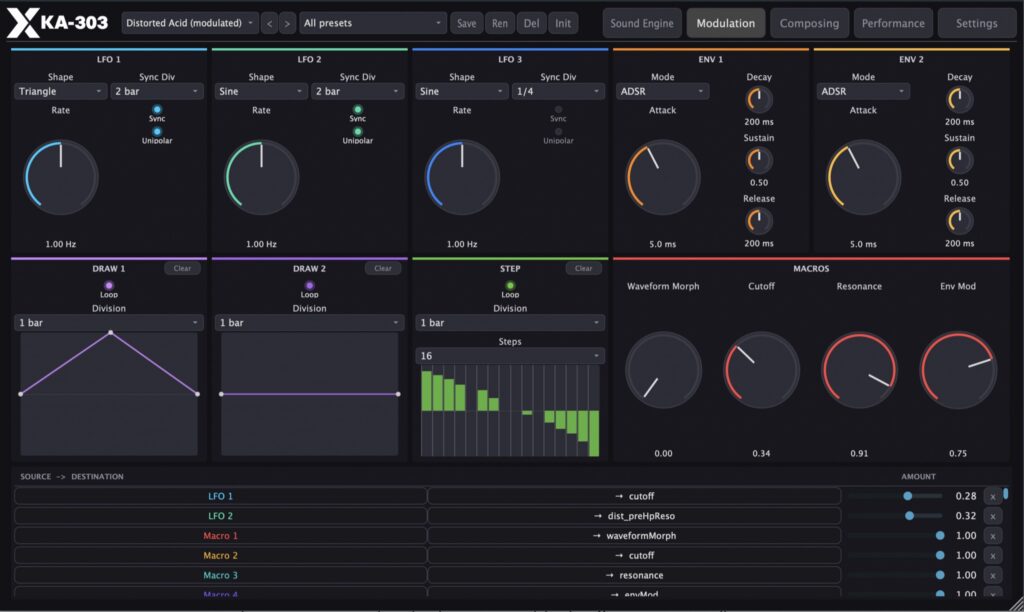
Assigning is deliberately simple: right-click any control, pick a source, done. A colored ring shows the modulation depth right on the knob, and a moving dot tracks it in real time, so you always see what is happening. Every routing is saved with your preset and your project.
And no worries about your existing library: modulation only moves what you assign to it. All existing patches sound exactly as before; the update changes nothing about your sounds.
Performance tab: 64 pads, eight modes at once
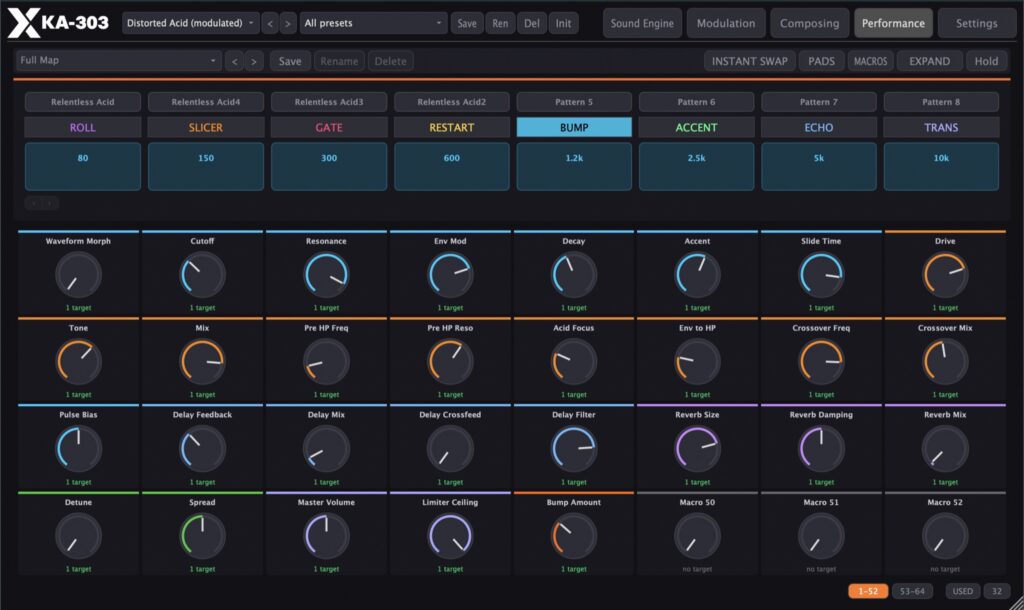
The Performance tab is the tab for playing with your hands, built after the pad modes of a DJ player. Eight modes, eight fixed values each: eight targets side by side instead of a menu you would have to open in the middle of a bar. Since 2.1, EXPAND puts all eight modes on screen at the same time as a matrix of 64 pads, and they play together: GATE cuts while ROLL repeats while TRANS transposes. COLLAPSE folds the matrix back up. A held pad overrides the value, it does not write it. Let go and every control sits where it sat before, and ROLL, SLICER and RESTART let the pattern carry on sample-accurately where it would have been without you. SHIFT-click latches a pad, at most one per row, and a held pad takes priority for as long as you hold it. Each of the 64 tiles has its own parameter and its own MIDI learn, so one controller covers the whole matrix in one go instead of only the row that happens to be selected. A button on the controller selects a row directly, eight buttons on eight CCs are eight fixed rows. A pad mapping from 2.0 still applies and follows the row you select, as before, and all 274 factory presets and saved projects sound unchanged.
- ROLL: beat repeat. Eight window lengths from 1/2 to 1/64T, shiftable with the arrows. Held and walked to the right gives the build-up before the drop.
- SLICER: the phrase in eight slices, a press jumps there. A second click on the selector turns it into Slicer Loop. ROLL and SLICER nest: a roll shorter than the slice repeats its start, a longer one widens it into a loop across the neighbouring slices.
- GATE: eight gate rates from 1/4 to 1/64 on the final mix, behind delay and reverb. The only mode that also cuts echo and reverb tails, and the only one that works with the sequencer stopped.
- RESTART: pattern to step 1, immediately or quantised to 1/4 up to 16 beats.
- BUMP: eight absolute cutoff values from 80 Hz to 10 kHz.
- ACCENT: eight accent patterns (every note, 1/8, 1/4, 1/2, 1/1, every third step, offbeats, random), eight strengths via the arrows.
- ECHO: the DJ throw. Eight delay divisions from 1/2 to 1/32, audible even on a preset without delay.
- TRANS: the sequencer notes shifted by -12, -7, -5, -3, +3, +5, +7 or +12 semitones while you hold.
Since 2.4 a row of eight pattern pads sits above the action pads. In the Composing tab, PAD puts the loaded pattern preset on one of them; in the Performance tab a press switches the bassline at the end of the current pass, and the pad blinks until then. With INSTANT SWAP it switches right away at the playhead position, for example exactly on the snare hit. The switch is automatable and saved with the project. MIDI Learn now accepts notes as well, so every pad can sit directly on the pads of a controller.
Below the pads sit 64 macros as a grid, 32 per page or all 64 at once. A macro is a second knob for the same thing, not a modulator: its position is the value of its destinations, and it follows along when you touch the destination itself. Since 2.3 every assignment carries its own range with a sign. When you create it, the destination stays where it is, and the macro travels from there to the farther end stop. In the MOD view you set the range, negative too, and so build a knob that opens the cutoff while pulling the resonance back. Click the name, then the destination knobs in any tab, done. The mapping belongs to the sound and knows the mode, an Angel Fish preset shows the Angel Fish destinations. HOLD freezes the layout while you browse sounds, and you save your own layouts as performance presets. USED hides every macro that has no assignment. With the factory mapping in Standard mode that is 32 cells instead of 44.
Circuit-Modeled at Component Level, not emulated
The heart of the KA-303 is no generic filter model. It is a detailed recreation of the original diode ladder filter with zero-delay feedback architecture, modeled down to component level. Four cascaded integrator stages with asymmetric coefficients, soft-clipping saturation after 1S2473 silicon diodes, the original 150 Hz highpass in the feedback path. The result is the fat, signal-dependent squelch that transistor ladder designs simply cannot replicate.
Slide, accent and the gimmick circuit are modeled at component level too, including the capacitor-based accent sweep that accumulates across consecutive accented notes. Just like the hardware.
CIRCUIT: Modern or Vintage
In the MASTER section, right below MODE, sits a second selector: CIRCUIT. It decides which wiring the envelope and the accent follow. Modern is the sound you know and stays the default. Vintage switches over to the documented behaviour of the original circuit.
- The filter envelope shapes the volume on accented notes only. In Modern it bleeds into every note.
- An accent shortens the filter sweep instead of stretching it. Accented notes snap shut, the unaccented ones keep the long arc.
- The note stops when you let go of it. Nothing rings on after note-off.
This is not a different preset, this is a different instrument. With a sequencer in front of it the accent suddenly does half the work: it no longer just places emphasis, it shapes the rhythm of the filter sweep along with it.
CIRCUIT applies in all eight modes and is stored with the preset and with the project. The fastest way in: load “303 Basic”, then “303 Basic Vintage”. They are identical apart from the switch, so everything you hear comes from CIRCUIT.
On top of that, 50 new presets, and the bank grows from 175 to 225. Ground delivers eleven basses with a heavy foundation, built around the highpass in front of the distortion and the waveform shaping. Vintage brings 22 squelch, lead and stab sounds that differ in the shape of the filter sweep rather than in cutoff alone. Fossil puts the new circuit under the character engines with eleven patches, where it had never been demonstrated before. The remaining six are exact counterparts of existing sounds, there to A/B Modern against Vintage at identical settings.
And as with the modulation system: Init resets CIRCUIT to Modern, and all new presets are appended at the end. No existing preset and no saved project sounds any different than before.
TIMING: Modern or Classic
Since 2.0 a third switch sits directly below CIRCUIT: TIMING. CIRCUIT says how envelope and accent are wired, TIMING says how fast they run. Modern is the shipping sound and the default. Since 2.4 the eleven Ground basses and the eleven Fossil presets load on Classic themselves, 44 of the 274 factory presets counting their modulated twins. Classic follows the reference measurement of the original circuit: the accent charges with a tenth of the time constant, the peak stands after 47 instead of 141 ms, and the swing is 2.9 instead of 1.2 octaves. On a 16th note the peak used to sit exactly at the moment of note-off, so the hit came once the note was already over. In Vintage a note also holds its level for 8 ms before it falls, instead of being 30 dB down after 8 ms. Both switches combine freely, TIMING is saved in the preset and is automatable.
Waveform Morph: The Sweet Spot Between Saw and Square
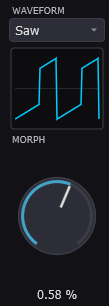
Every other 303 plugin forces you to choose: saw or square. The KA-303 doesn't. With the dedicated MORPH knob you blend continuously between both waveforms. At 30 percent with high resonance you get timbres that neither saw nor square reach on their own. Automated via MIDI CC, basslines start to breathe and evolve in real time.
Pulse Bias and Analog Drift: Authentic Square Like the Hardware
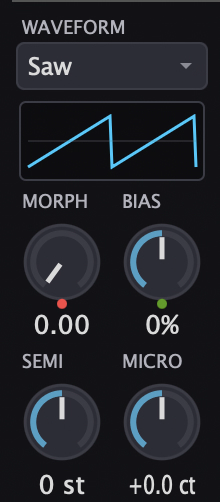
The original 303 has no dedicated square oscillator. The sawtooth is clipped through a single transistor whose Vbe bias and component tolerances produce a systematically asymmetric square wave. The duty cycle typically sits between 46/54 and 48/52, the transitions are soft rather than sharp, and even harmonics appear that an ideal square lacks and that interact audibly differently with the filter resonance. That is exactly what gives the 303 its character, and almost every other emulation skips it.
With Pulse Bias you shift the square's switching point bipolar. To the left the pulse gets wider, the sound fatter and more hollow. To the right narrower, more nasal, thinner. Analog Drift switches between a hard-clip comparator for the clean, modern square and a BJT soft-clip with deterministic per-voice bias variation. Every unison voice gets a slightly different switching point, which comes very close to a small collection of slightly differently calibrated 303s. For the classic nineties acid character: Drift on, resonance high, tube distortion on.
SEMI, MICRO and a cutoff down to 60 Hz
Two new knobs in the waveform column tune the oscillator: SEMI in whole semitones from -24 to +24, MICRO continuously in cents up to plus or minus 50. SEMI is deliberately stepped, sweeping continuously across four octaves you never hit the fifth. Both belong to the sound and are saved in the preset, unlike Master Tune, the concert pitch of the machine in the settings. Both also act on externally played MIDI. And MORPH, BIAS, SEMI and MICRO now show their value as a number below the knob.
CUTOFF now reaches down to 60 Hz instead of 200 Hz, as far as the filter has always been able to go. Three factory presets asked for values below that and were silently clamped to 200 Hz until now: Deep Sub, Venom Sub and Abyss Sub now sound as deep as their names promise.
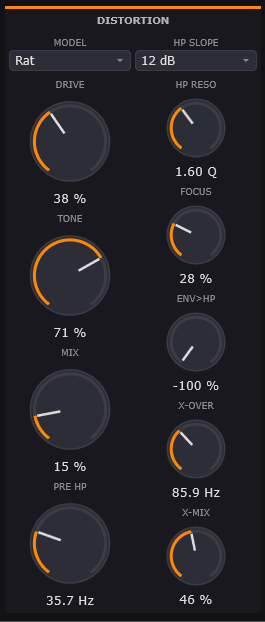
Four Distortion Models with Intelligent Crossover Logic
DS-1, Tube, Rat, Fuzz. Four models, each with its own character. But the crucial part happens before that: a pre-distortion crossover splits the signal. The sub-bass stays clean, only the mid range runs through the distortion. HP resonance creates the characteristic nasal growl, and ENV>HP links velocity to the high-pass frequency for dynamically responsive distortion. From light crunch to aggressive acid growl, without the bass collapsing.
Composing Engine: Acid Basslines in Seconds
The built-in pattern editor was developed specifically for acid basslines. A smart note grid keeps your input in the chosen scale for as long as you want it to, because the SNAP switch frees pitch and time whenever you like, and the grid button frees the horizontal axis alone, in triplets or not at all: 1/8, 1/8T, 1/16, 1/16T, 1/32 and OFF. There are 22 scales to choose from, from two to twelve notes. On top of the eight existing ones come Minor Pentatonic, Blues, Harmonic Minor, Phrygian Dominant, Major Pentatonic, Lydian Dominant, Melodic Minor, Whole Tone, Half-Whole Dim., Hungarian Minor, Hirajoshi, Double Harmonic, In-Sen and Fifth. The new scales are appended at the end, so an older pattern stays on its scale, and not a single note moves in the existing eight. A keyboard with white and black keys down the left edge tells you which row is which note. Slides and accents are visible right in the piano roll, with no hidden menus. 98 factory patterns from Chicago Deep through Berlin Basement to Final Boss provide instant inspiration. On top of that, Scramble, Mutate, Octave Jumps, Groove and Density as creative tools. A completely new pattern takes a few clicks, and MIDI drag and drop puts it straight into your DAW.
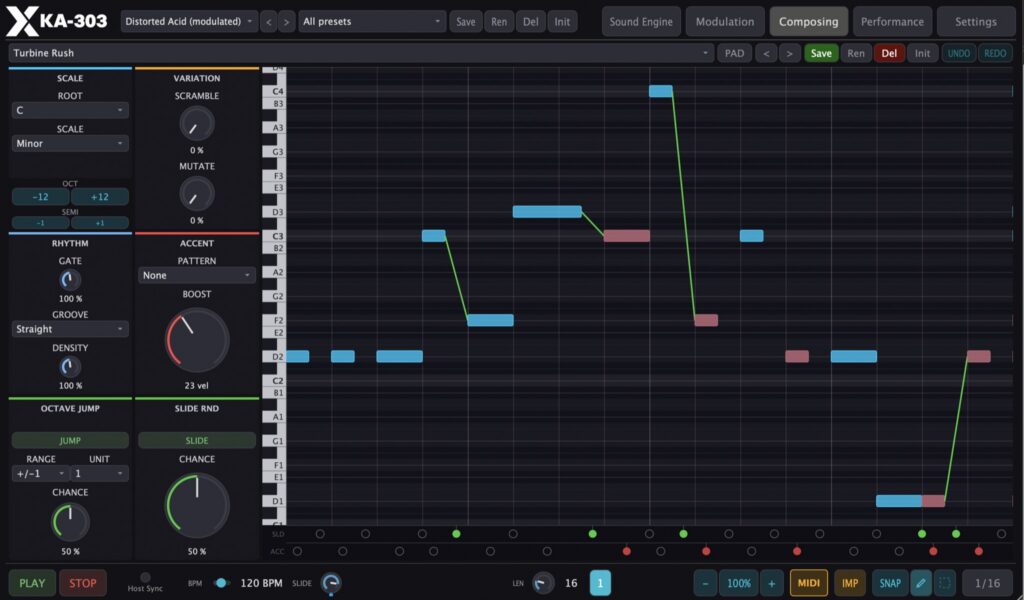
Dynamic Pattern Grid: As Flexible as the Idea
The Dynamic Pattern Grid allows pattern lengths from 1 to 64 steps, freely adjustable per pattern. The key trick: patterns with odd lengths, so 3, 5, 7 or 11 steps, run against the DAW's 4/4 grid and create natural shifts that build up over bars and resolve again. That is exactly the hypnotic effect the early acid producers made their sound. Classic 16-step basslines work just as well, but once you know that living, constantly realigning groove, you won't want to go without it.
Page System: More Than One Bassline
One pattern, several pages. The Page System creates and chains multiple independent step pages inside a single pattern. That builds longer structures with internal variation without needing several pattern slots. Verse, fill, chorus, all organized in one pattern.
MIDI Import: Your Material, the Power of the KA-303
Sketched a bassline in the DAW, or an old MIDI file on your drive? Just drag it into the KA-303. The notes land in the acid grid immediately, and from there the composing engine takes over. Scramble shuffles the pattern, Mutate evolves it, slides and accents go in directly, Groove brings it to life. What would mean editing note by note in the DAW becomes a squelching acid pattern in seconds in the KA-303.
Editor Workflow: Resolution, Lasso, Groove
The pattern editor works at 1/8, 1/16 or 1/32 resolution, from short staccato notes through dense triplet feels to the classic acid timing grid. You select, move, copy and delete notes with lasso selection, using the same gestures you know from any piano roll. And the groove choice goes beyond simple swing: 8th Triplet and 16th Triplet put the notes on a triplet grid, 8th Shuffle and 16th Shuffle push every second note back, and Hard Swing moves it all the way to a dotted feel. Straight leaves the timing as it is. Combined with Density and Mutate, basslines feel alive. MINUS at 100 percent zoom switches to FIT and shows the whole pattern at once, across all pages. Since 2.3 LEN can be mapped to a controller.
Whether the scale leads is up to you. The SNAP toggle next to the pencil and selection rectangle tools decides whether drawn notes snap to the selected scale or stay exactly where you put them. With SNAP off, the highlighted rows become an orientation aid instead of a fence, and semitone steps are available everywhere. Hold Alt to invert the setting for a single edit, in both directions. The SEMI buttons follow the same rule: one scale degree with SNAP on, exactly one semitone with SNAP off. And switching scales transposes your melody into the new mode instead of detuning it.
SLIDE Straight From the Pattern
Between BPM and LEN sits a bipolar slide knob that controls the glide character right in the composing view. The 60 ms default matches the original, fully left 20 ms for fast, accented slides, fully right 360 ms for long, drawn-out glides. It works in every mode and is the same parameter as SLIDE in the Angel Fish tab, so composing needs no tab change.
Two Separate Preset Worlds
Sound presets and pattern presets are completely independent. 274 factory sounds across all eight modes, from a clean sub to an inferno lead, meet 98 pattern presets, 372 presets out of the box. Every one of the original sounds has a “(modulated)” twin: the same foundation, but in motion. Slow filter sweeps, breathing character parameters, living spaces, each one tuned by ear, slow, smooth, never nervous. In practice that means letting a pattern run and clicking through the sounds, hearing the same bassline in completely different timbres. No rebuild, no loss. Sound and notes live in two separate worlds and combine freely. The sounds are grouped by mode into eight sections, and a filter narrows the list by mode, circuit, timing and modulation, together with the name search: with the search word acid, 274 entries become 20.
Unison Engine: When It Needs to Be Fat
Up to seven full synthesizer voices, each with its own filter, its own envelopes and its own slide processor. Continuous detune and stereo spread. From subtle thickening with two voices to a massive wall of sound with seven voices and 30+ cents of detune. Automatic gain compensation keeps the level consistent across all voice counts.
Everything On Board
Tempo-synced stereo delay with crossfeed and darkening filter. Reverb based on the Signalsmith algorithm with room sizes from 0.3 to 5 seconds. Both with ACCENT ONLY: the ACC knob decides whether only accented notes go into the echo and the reverb while the quiet ones pass through dry, at zero everything is as before. Since 2.2 delay and reverb have a bypass that lets a running tail ring out instead of cutting it off. A master limiter as a brick-wall peak limiter at the output protects against clipping no matter how far resonance and distortion are pushed. Up to 8x oversampling for the highest sound quality, full MIDI CC mapping via right-click and MIDI Learn with soft takeover, so a hardware knob does not throw the sound off, plus an overview of all assigned CCs in every MIDI menu, dark and light theme, switchable in the settings. Multi-level undo/redo in the composing view (Cmd+Z / Cmd+Shift+Z), five new modulation destinations in the pre-distortion filter, tooltips on every knob and a tidy tab order (Sound, Modulation, Composing, Performance, Settings). If you always work at 432 Hz or always set the limiter to minus 1 dB, save Master Tune and Ceiling as your own default with one click: every new instance then starts with those values while saved projects keep their own.
Now Also as CLAP
Alongside VST3, AU and Standalone, the KA-303 now runs as CLAP, the open plugin format. For everyone working in Bitwig, Reaper or Studio One it is on board with no detours. Same engine, same sound, one more option.
Who Is the KA-303 For?
For everyone who takes acid seriously. Whether Acid House, Acid Techno, Hard Acid, Trance or Hardtechno. The KA-303 delivers the authentic sound with modern tools. If you build basslines that should squelch, scream and move the dancefloor, this is for you.
Try Before You Buy
Not sure? No problem. Download the free demo and test the KA-303 in your DAW, with all features. The demo has two limits: once a minute a three second burst of white noise fades in, and after 30 launches it goes silent. So you can try the sound, the Flavor Palette and all distortion models in peace before you decide. Once the KA-303 wins you over, you just activate your license key and both limits are gone.
Formats and Systems
Formats: VST3, AU, CLAP, Standalone
Systems:
- macOS 11.0 or newer, Intel and Apple Silicon
- Windows 10 64-bit or newer
- Linux x86_64
The macOS version is signed and notarized, the Windows installer is signed.
Demo free. Full version 69.00 EUR including 19 percent VAT.
- Formats
- VST3, AU, CLAP, Standalone
- Systems
- macOS 11.0 or newer, Intel and Apple Silicon
- Windows 10 64-bit or newer
- Linux x86_64
- Demo
- Every feature. Three seconds of noise once a minute, silent after 30 launches.
- License
- One serial number for up to three computers.
License Information
This product includes a professional license system with the following features:
- Online activation with hardware fingerprinting
- Up to 3 device activations included
- Automatic license delivery via email
- Customer portal for license management
After purchase, you will receive your license serial number via email within minutes.