
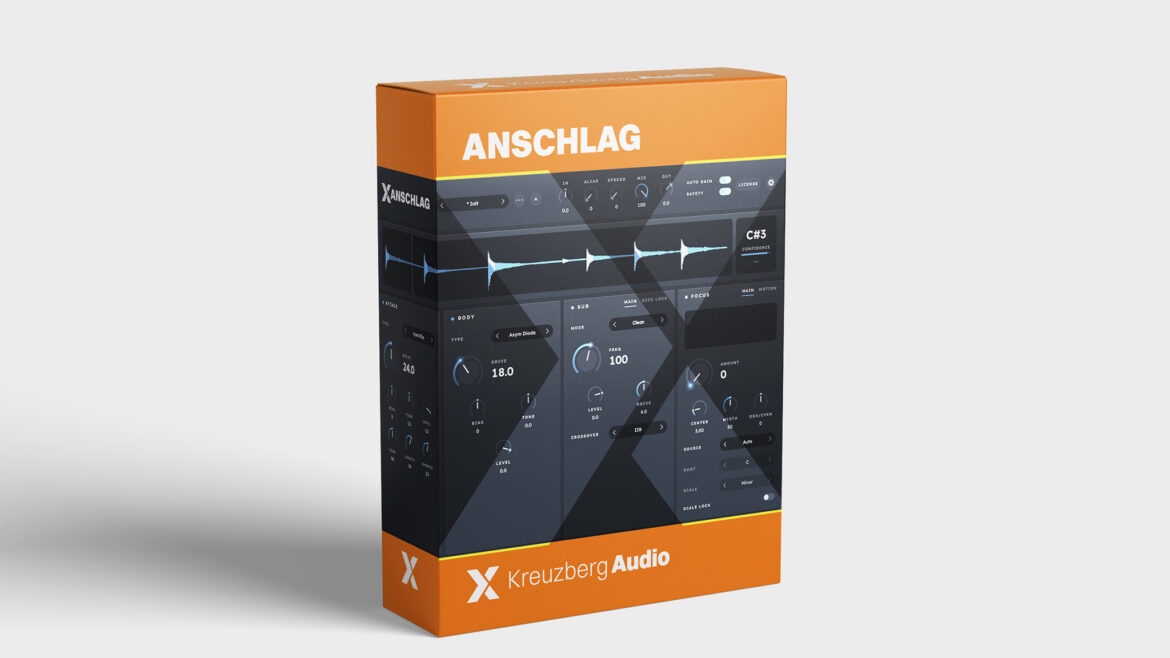
Distortion that knows where the note starts.
There are plenty of distortions, and almost all of them work the same way
There are hundreds of distortion plugins, and at their core they work in one of two ways. Some send the whole signal through one curve, across the full frequency range. The others split the signal into frequency bands first and distort each band on its own. One is coarse, the other finer, but both ask the same question: which frequency gets distorted how much?
A bassline is not just frequencies, though. It is made of notes, and every note has a start and a rest. The start is the attack, the first milliseconds where the punch lives. The rest is the body, where warmth, density and length live. To a distortion that works by frequency, the two are the same thing. Even in a multiband, the attack gets the same curve and the same drive in every band as the body does.
That is why you know the compromise. Turn up the drive until the body is dense and loud, and the attack gets flattened, so the bassline loses its punch. Back the drive off and the attack survives, but the body stays thin. And down in the sub, distortion unsettles exactly the part that has to carry the club.
So you build workarounds. Duplicate the track, one copy with a transient shaper and a clipper for the attack, one with a saturator for the body, split off the sub with an EQ and sum it to mono, and put a sidechain compressor from the kick on top. Half an hour later you have a rack of half a dozen devices that works for exactly this one bassline. On the next track you start from zero again.
The new approach: split by time, not by frequency
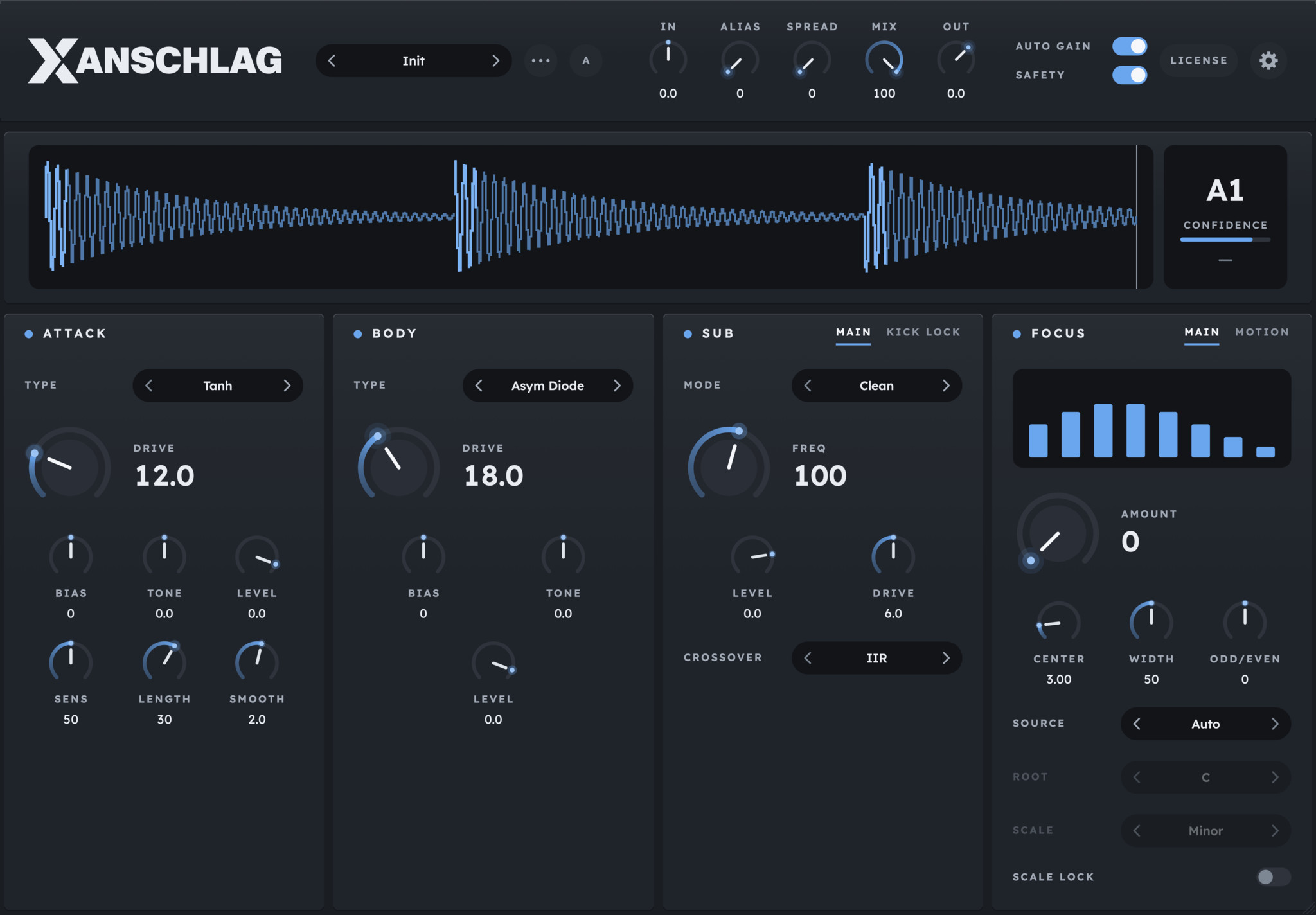
ANSCHLAG asks a different question: not which frequency, but which part of the note. Anschlag is the German word for the attack of a note. It is not a multiband distortion and not a transient shaper with a drive behind it. The event splitter listens to the audio signal, finds every attack by itself, without MIDI, and separates the first milliseconds from the rest of the note. One track becomes two signals, attack and body, and each gets its own distortion. Then the two are joined again.
You do not hear the split itself. Attack and body add up to exactly the input signal again, with no gap and no doubling. What you hear is only what you do with the two parts.
And that is the point: punch and density are no longer one knob, they are two. You can push the body as far as the track needs, and the attack still stands. Or you make only the attack hard and bright, and the body stays round.
- Sixteenth-note techno bassline: The attack hard clipped, the body warmly saturated. Every note clicks through on the system without the line getting harsh overall.
- Reese and neuro: The attack almost clean, the body folded. The bass growls, and you still hear where every note starts.
- 808s and long subs: Bite at the start of the note, a long, clean tone underneath.
- Small speakers: A bright attack keeps the bassline readable even where the sub never arrives.
How the signal runs through ANSCHLAG
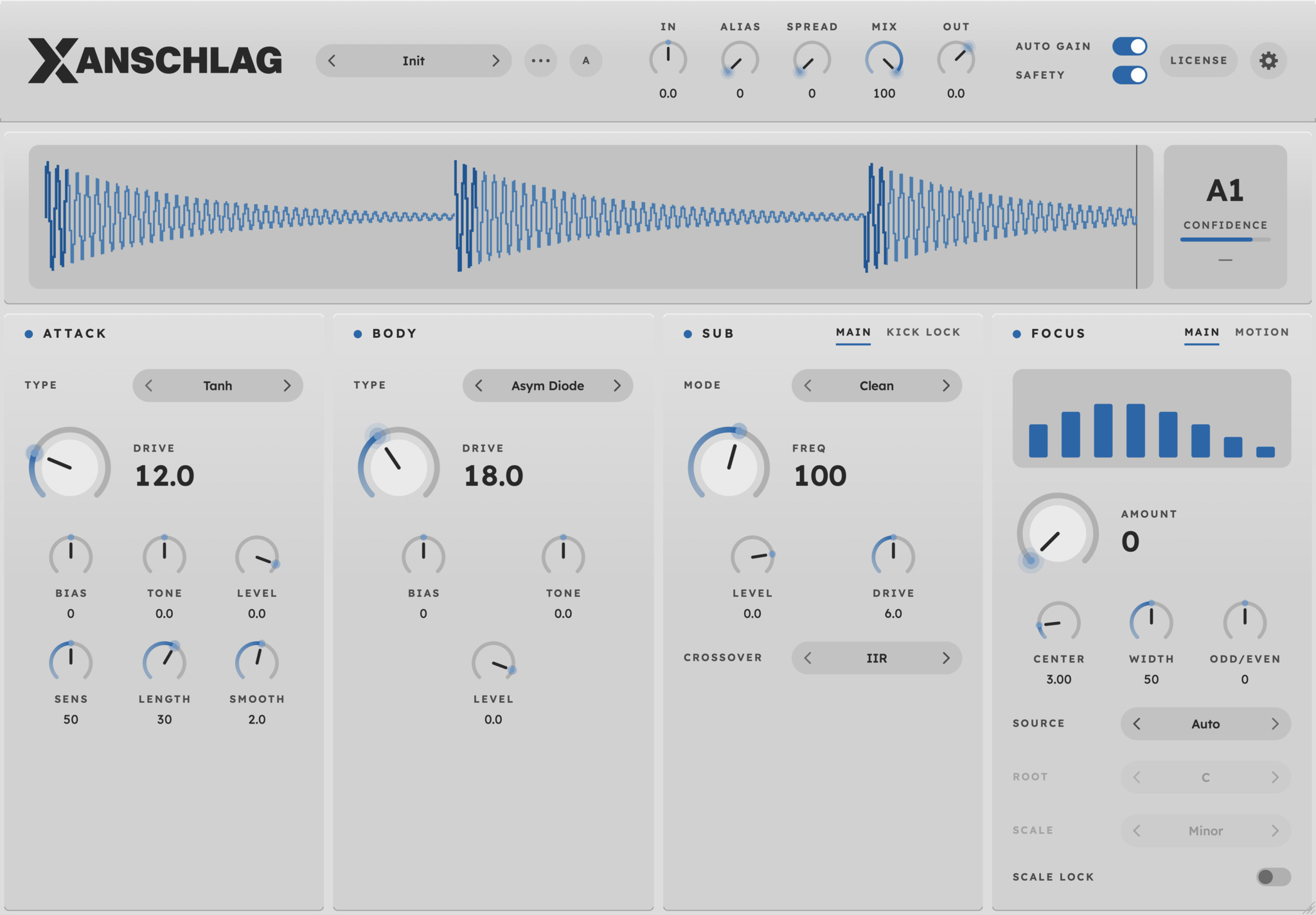
First a crossover separates the sub from the rest. The sub goes mono and bypasses the distortion. Everything above goes into the splitter, which divides it into attack and body. Each runs through its own distortion chain, and then the two are joined again. After that comes FOCUS, which boosts harmonics of the note being played. At the end, the sub and the distorted part meet again, AUTO GAIN matches the loudness, and MIX blends in the dry signal.
The reason for this order: the distortion should create harmonics you can hear, without making the foundation of the bass wide, unsteady or shifted in phase.

While your project is playing, the display shows exactly one bar. You can see at a glance whether every note of the bassline gets its attack.
ATTACK: you decide what counts as attack
The splitter belongs to the ATTACK section and has three controls.
- SENS: the sensitivity. More if soft attacks are not detected, less if held notes trigger false attacks.
- LENGTH: from 1 to 200 ms. Short values catch only the click, long values also catch the start of the note.
- SMOOTH: from 0.1 to 20 ms. Small values make the change between the two chains hard, larger values make it soft.
Set both chains the same way and ANSCHLAG sounds like one single distortion across the whole signal. So you give nothing up. You get a second knob on top, and that knob makes the difference.
Two chains, five curves
ATTACK and BODY are two complete distortion chains, each with its own curve, its own DRIVE, BIAS, TONE and LEVEL. A hard clipped, bright attack over a warm, dark body: the bassline cuts through the mix without getting louder or harsher overall. Or the other way round, an almost clean attack in front of a folded body, and the reese growls without smearing.
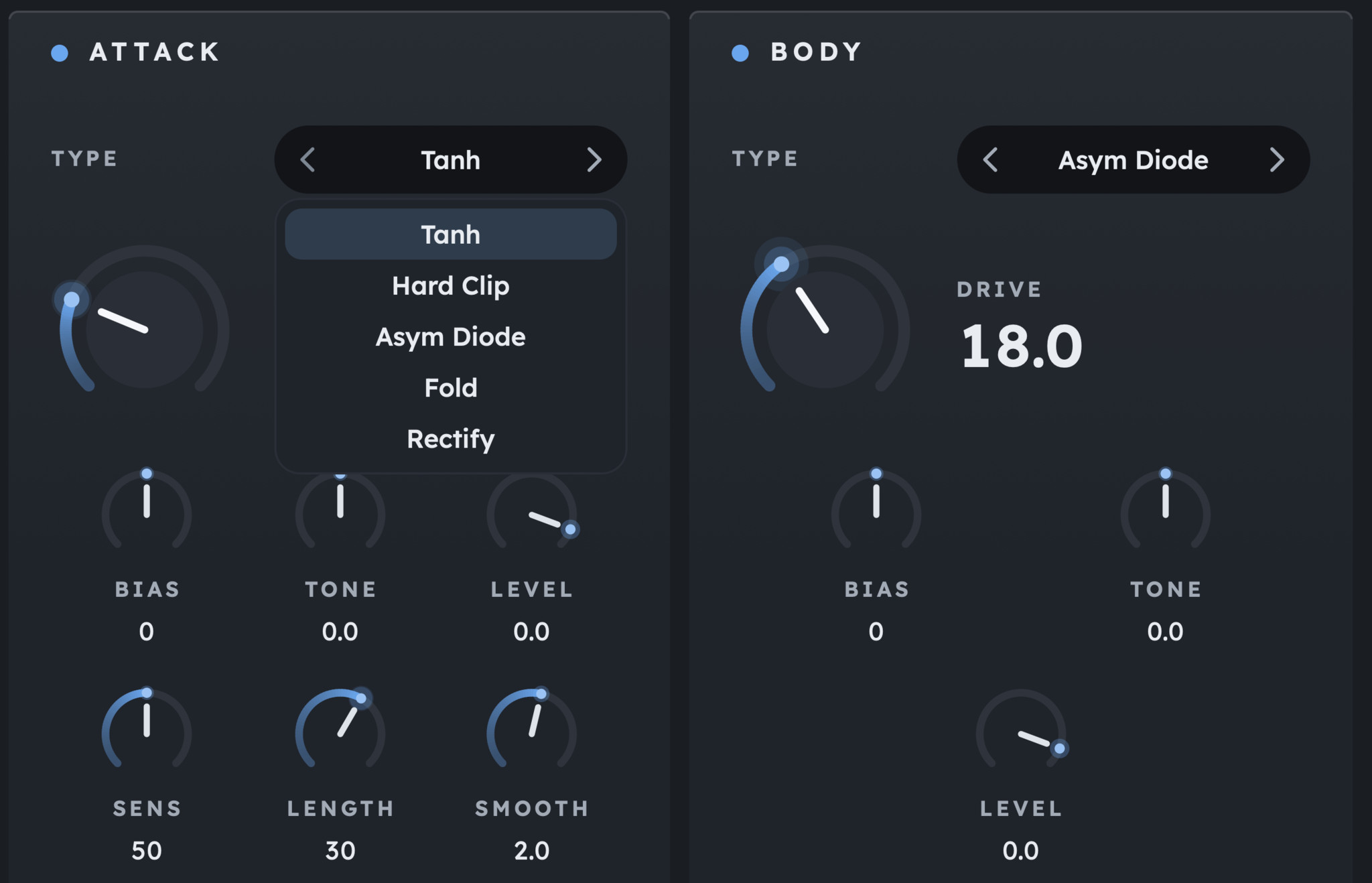
- Tanh: soft, symmetrical saturation. Without bias it creates only odd harmonics. Warmth for any bass.
- Hard Clip: cuts off hard. The more drive, the closer the note gets to a square wave.
- Asym Diode: saturates the two half waves differently. That adds even harmonics even without bias, and the note gets fuller.
- Fold: folds the signal back as soon as it crosses the limit. The more drive, the denser the harmonics. The road towards neuro.
- Rectify: flips the negative half wave upwards, which adds the octave above the note. For hollow octave tones and fuzz.
Each chain has the same four controls. DRIVE pushes up to 48 dB into the curve. BIAS shifts the signal before the curve and adds even harmonics. TONE is a tilt EQ around 1 kHz after the curve, brighter to the right, darker to the left. LEVEL sets the level of the chain, independent of the drive.
The two LEVEL controls are more than volume. Because attack and body add up to exactly the signal, you use them to shift the balance between attack and body, like a transient shaper. Turn LEVEL in BODY all the way down and only the attack is left.
The sub stays clean
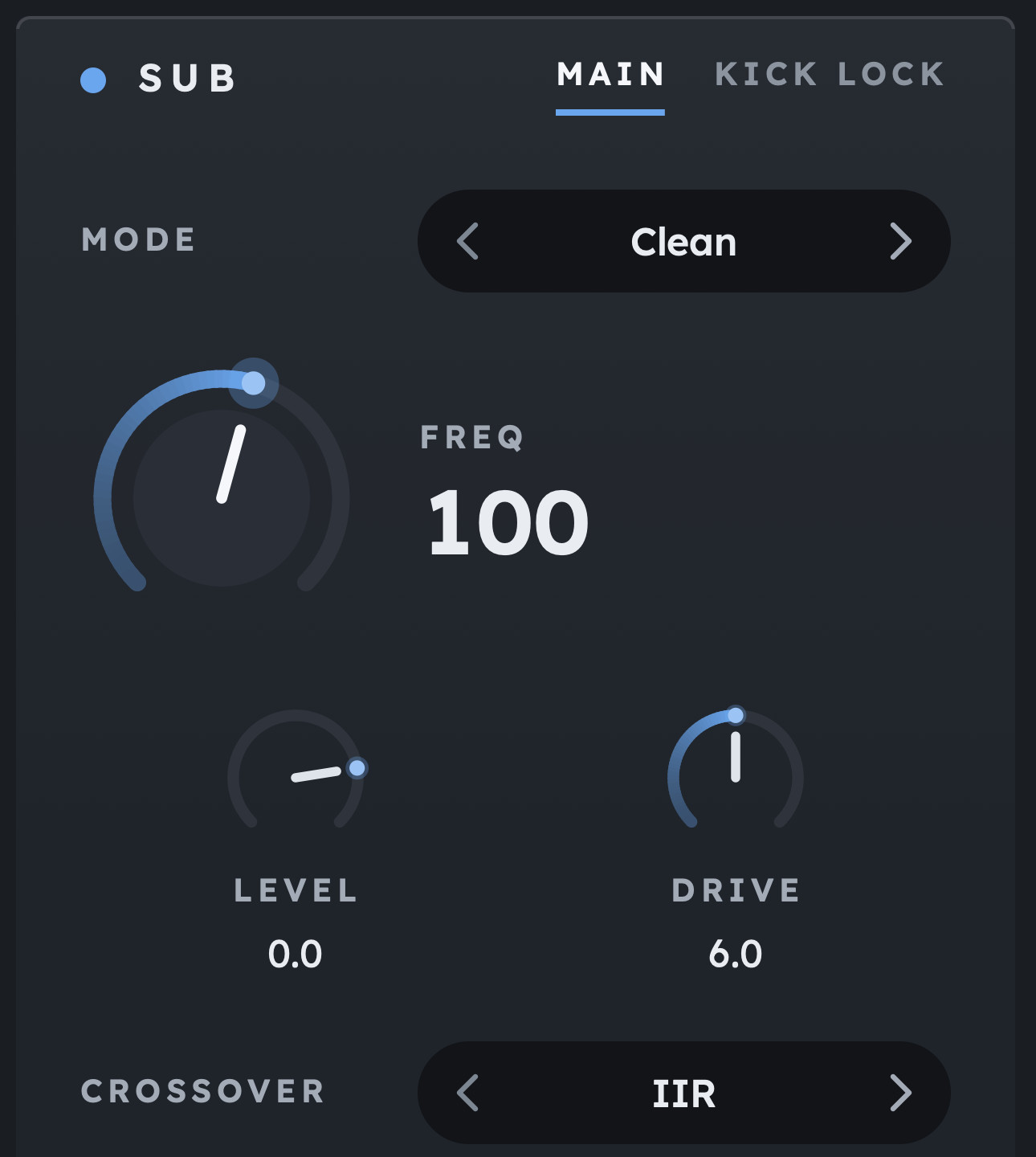
Below FREQ, adjustable from 30 to 250 Hz, ANSCHLAG splits off the sub first. It runs in mono in every mode and stays clean by default. A higher value keeps more of the bass clean, a lower one sends more of the note into the distortion.
- Clean: The sub passes through unchanged.
- Drive: The sub is lightly saturated, with its own drive control.
- Resynth: A sine on the detected fundamental replaces the sub. Even when the bass is detuned and wide up top, there is a clean sine underneath. If the tracker loses the note, ANSCHLAG fades back to the original sub.
There are two types of crossover. IIR has practically no latency and is the choice for playing and for most tracks. Linear Phase does not shift the phase, so sub and the rest add up to exactly the input. In return it costs about 63 ms of latency, which your host compensates.
KICK LOCK: kick and sub in the same pocket
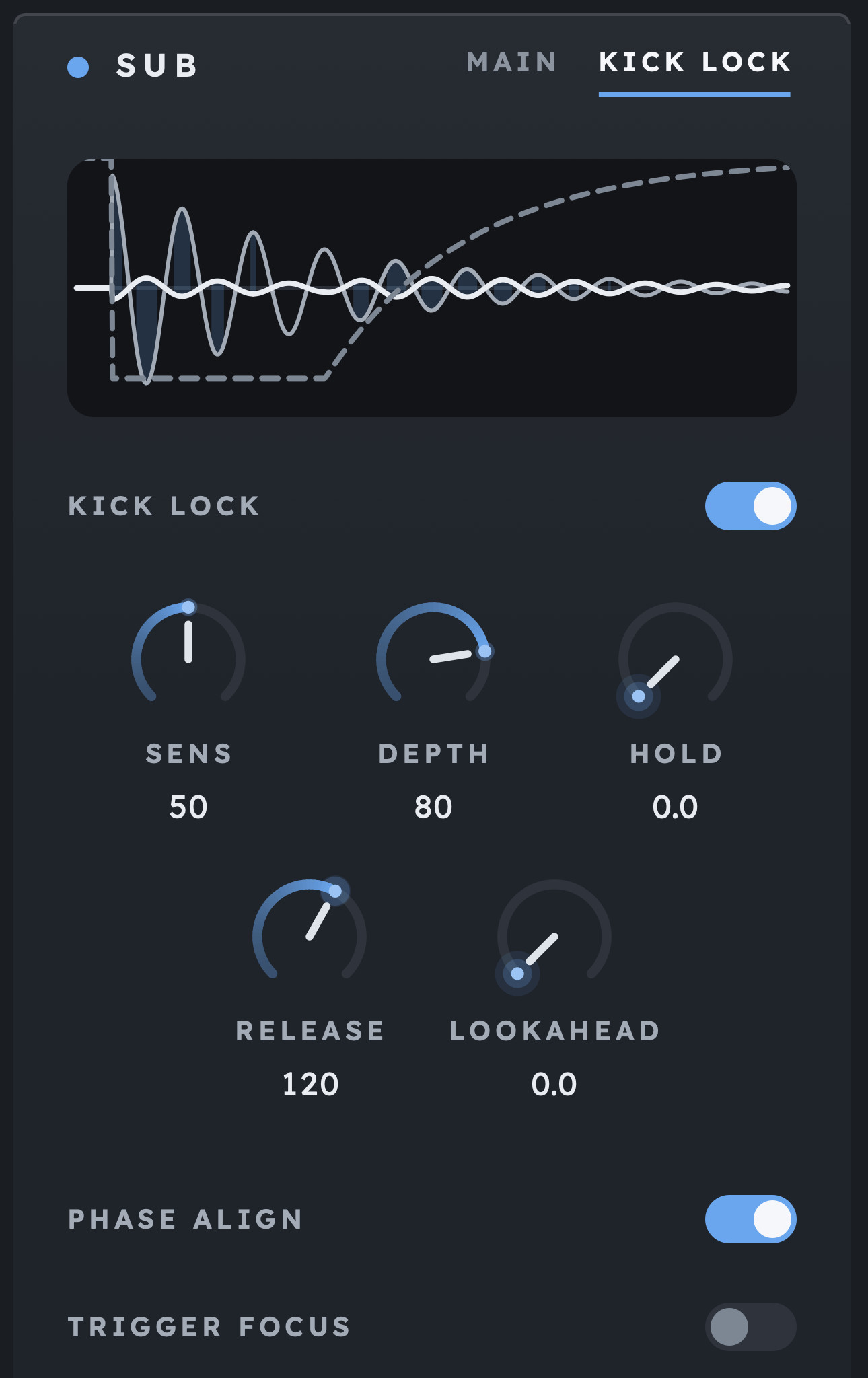
Send your kick to the sidechain and KICK LOCK ducks the sub on every kick, and only the sub. Everything above keeps playing, so the bass does not drop out of the track on every kick the way it does with a sidechain compressor across the whole track. The kick track itself stays untouched, ANSCHLAG only listens to it.
- DEPTH: how far the sub is ducked on every kick.
- HOLD and RELEASE: how long the ducking holds and how fast the sub comes back, from 10 to 500 ms.
- LOOKAHEAD: up to 5 ms of lookahead, so the ducking starts before the kick does.
- PHASE ALIGN: In Resynth mode the sine of the sub starts in phase with every kick. Kick and sub no longer cancel each other out.
- TRIGGER FOCUS: Every kick starts the MOTION envelope.
The display puts kick and sub on top of each other and marks the spots where the two run out of phase. You see the problem before you hear it on the system.
FOCUS: harmonics that follow the note
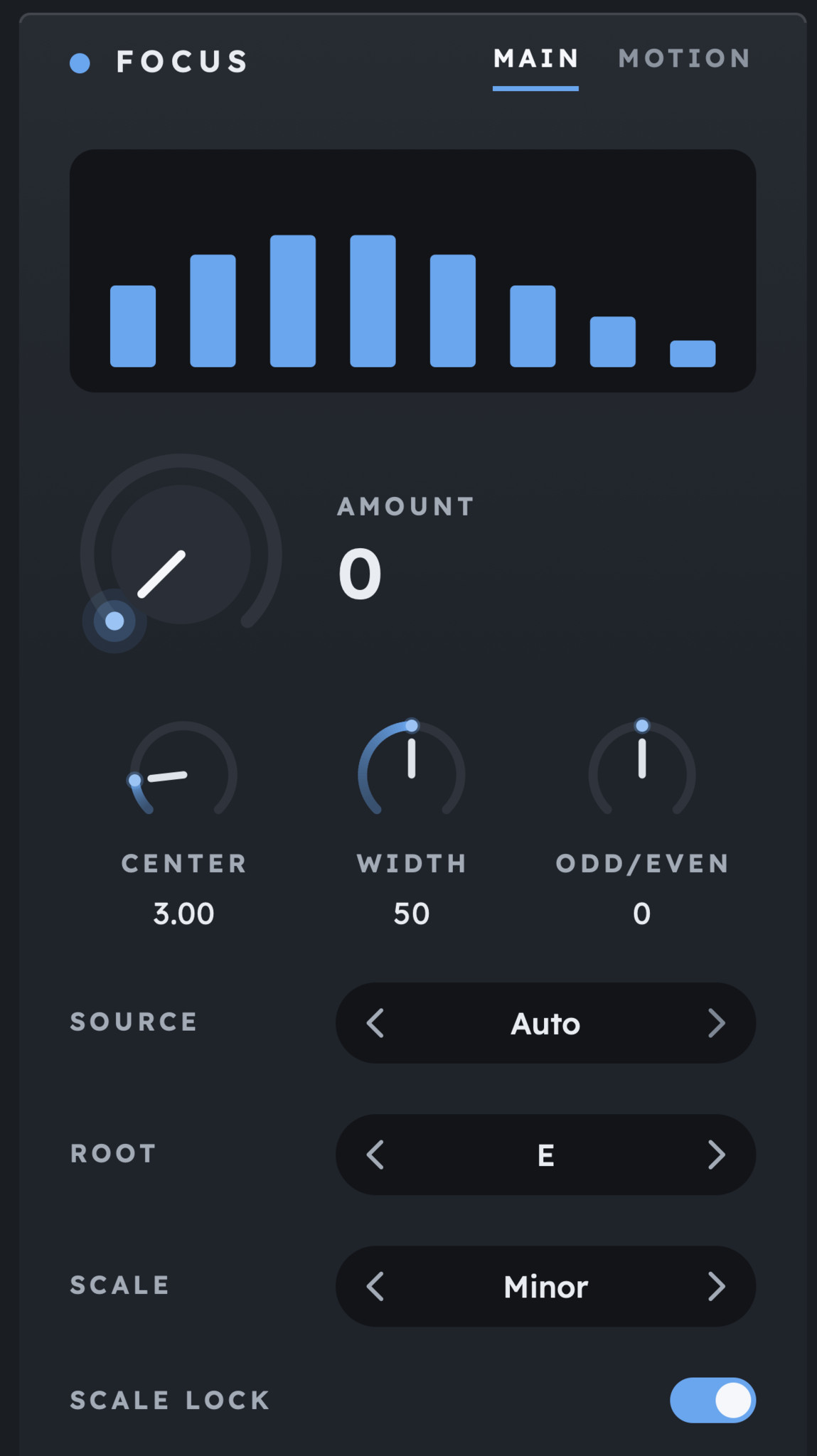
A pitch tracker detects the fundamental of your bass. FOCUS uses it to boost individual harmonics, and unlike a fixed EQ the boosts move along: play a fifth higher and the boosted frequencies move up a fifth as well.
- AMOUNT: the strength of the boost, up to 12 dB.
- CENTER: the harmonic in the middle, from 2 to 9. The 2 is the octave above the fundamental, the 3 the fifth above that.
- WIDTH: at 0 the focus works almost only on the harmonic in the middle, at 100 several neighbours come along.
- ODD/EVEN: all the way left only the odd harmonics stay in focus, all the way right only the even ones.
FOCUS sits after the distortion. So it also boosts the harmonics that only exist because of the distortion. First you create harmonics with drive, then you use FOCUS to pick which of them come to the front. The result sounds like a formant that sits in the same place on every note.
The pitch comes from the audio, from MIDI or automatically from both. For synth basses with detuned oscillators, simply send the MIDI track of the bass along, and the pitch comes straight from the notes. SCALE LOCK keeps the tracker on the notes of your key through slides and vibrato, with seven scales from Minor to Phrygian.
MOTION: the bass starts to talk
MOTION moves the focus across the harmonics, and this is where ANSCHLAG turns from a distortion into a sound design tool.
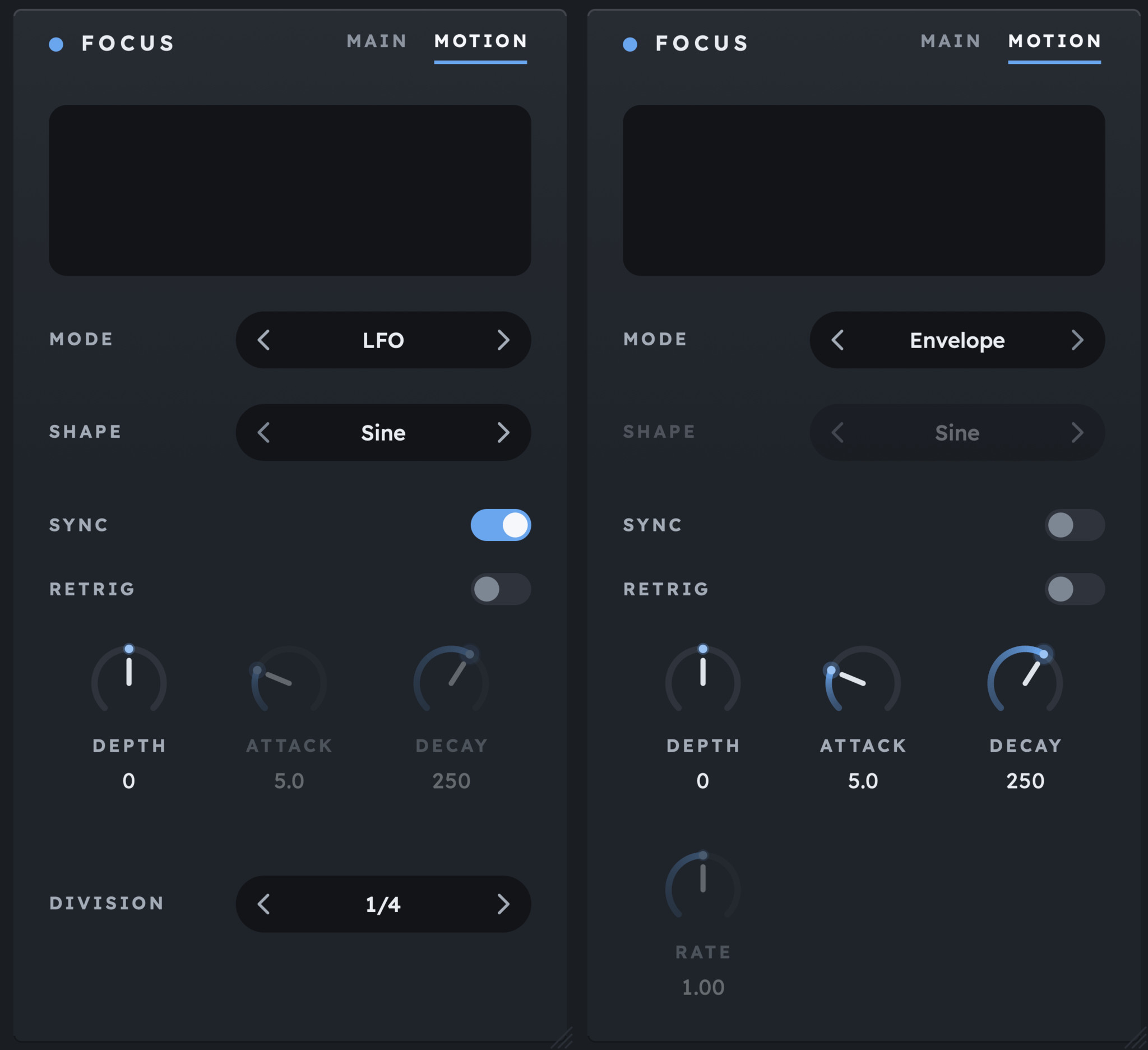
- Tempo-synced LFO: A sine over one bar, and the focus sweeps through the harmonics of the bassline once per bar. With Sample & Hold on sixteenths, every note gets a different vowel.
- Envelope: Every note starts bright and falls back to a low formant, the bass talks. Short decay for plucks, long decay for growls.
- Kick as trigger: With TRIGGER FOCUS every kick starts the envelope, so bass and kick move together.
DEPTH sets how far the movement goes: turned all the way up, the focus travels across up to seven harmonics. The LFO has five shapes, Sine, Triangle, Saw Up, Saw Down and Sample & Hold, and runs synced from 1/32T to 4 bars or free from 0.05 to 20 Hz. With RETRIG it restarts on every note. The envelope starts with every new note, with every detected attack or with every kick.
The synced LFO follows the position in the project. The movement lands on the same spot in the bar on every playback and in every export. That is true for Sample & Hold as well: the sequence is the same on every pass.
The header: IN, ALIAS, SPREAD, MIX and OUT

- IN: works like a drive for the whole plugin. Presets leave IN alone, you set it once per track.
- ALIAS: Normally anti-aliasing keeps the distortion clean. ALIAS deliberately blends in aliasing as a colour.
- SPREAD: Left and right get slightly different drive and bias, and everything above the sub gets wider. The sub stays mono.
- MIX: Parallel distortion in one knob. The dry signal is aligned so that nothing cancels at the crossover frequency.
- OUT: the level at the end of the chain.
Auto Gain: you hear the tone, not the level
A louder signal almost always seems better. That is why AUTO GAIN matches the loudness of the output to the input. You turn the drive and hear how the tone changes, not how it gets louder. The A/B button compares two settings at the same loudness. SAFETY rounds off the peaks at the end, so the output stays below 0 dBFS.
82 factory presets in eleven categories
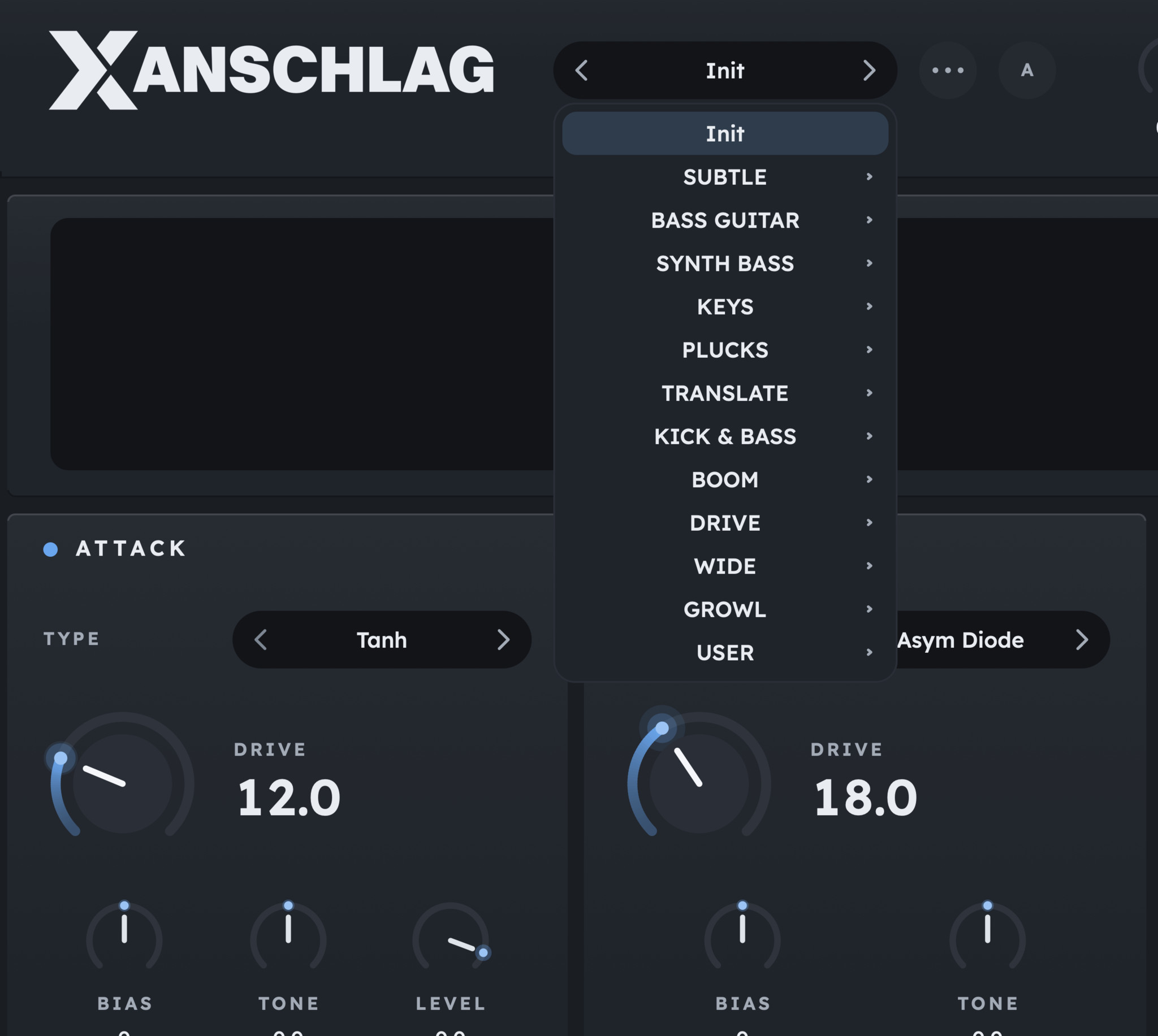
The presets are matched in loudness, so you can step through them without touching the fader. Input level, key, oversampling and the settings for your kick stay where they are when you change presets.
- SUBTLE (7): gentle colour, for example Faint Glow, Satin Body, Fine Grit.
- BASS GUITAR (8): for electric bass, for example Pick Bite, Slap Snap, DI to Amp.
- SYNTH BASS (13): many with tempo-synced movement, for example Rolling Low, Heavy Machine, Strobe Line.
- KEYS (5): for keys and chords, for example Soft Keys, Organ Grit.
- PLUCKS (5): for short sounds, for example Snap Pluck, Fold Pluck.
- TRANSLATE (5): so the bassline stays audible on small speakers, for example Phone Lift, Earbud Clarity.
- KICK & BASS (5): with a kick in the sidechain, for example Kick Anchor, Deep Pocket, Hard Lock.
- BOOM (8): bite at the start of the note over a long, clean sub, for example Round Knock, Shatter Boom.
- DRIVE (6): from amp to fuzz, for example Amp Crunch, Fold Fuzz, Broken Speaker.
- WIDE (12): wide, moving sounds, for example Velvet Drift, Steel Swarm, Serrated Wall.
- GROWL (8): talking formants, for example Talking Stab, Vowel Riot, Total Shred.
Your own presets are saved in the USER category.
Who is ANSCHLAG for?
For producers who want to distort bass without the sub suffering for it. For techno and acid basslines that need to click on the system, for reese, neuro and growl in drum and bass and bass music, for 808s with bite, but also for bass guitar, keys and plucks. ANSCHLAG is a tool for single tracks and groups, not for mastering.
Technical highlights
- Event splitter: detects attacks in the audio signal without MIDI, length 1 to 200 ms, attack and body sum exactly to the input
- Two distortion chains: five curves, up to 48 dB of drive, bias, tilt EQ and level per chain
- Anti-aliasing: ADAA in every curve, plus 1x, 2x or 4x oversampling
- Crossover: Linkwitz-Riley, IIR or linear phase, 30 to 250 Hz
- Sub: always mono, modes Clean, Drive and Resynth
- Pitch tracker: fundamental from 25 to 500 Hz, source Audio, MIDI or Auto, Scale Lock with seven scales
- FOCUS: eight bell filters on harmonics 2 to 9, up to 12 dB of boost
- MOTION: LFO with five shapes from 1/32T to 4 bars or free from 0.05 to 20 Hz, envelope with attack and decay
- KICK LOCK: ducking in the sub only, phase alignment, up to 5 ms of lookahead
- Auto Gain: loudness matching with K-weighting according to ITU-R BS.1770
- CLAP: five remote pages and parameter modulation
- Automation: 48 of 51 parameters
With the default settings ANSCHLAG reports 3 samples of latency at 48 kHz, less than 0.1 ms. The linear phase crossover costs about 63 ms, which your host compensates. For playing live, use IIR.
Formats & Systems
Formats: VST3, AU (macOS), CLAP, standalone
Systems: macOS 11 Big Sur or later (Universal Binary, Intel and Apple Silicon), Windows (64-bit), Linux from Ubuntu 22.04
GUI: 1280 x 890 px, zoom from 50 to 150 percent, light and dark theme.
KICK LOCK needs a host with a sidechain input for effects.
License and demo
The demo has the full feature set. Every 60 seconds you hear 3 seconds of white noise, and after 30 starts the output stays silent. Your serial number turns the demo into the full version, without a new installation.
Activation contacts the license server exactly once. After that the plug-in starts with no network access at all, it never phones home. Your serial allows three concurrent activations. The only data transmitted is the serial number, an anonymous hardware fingerprint and the product name, never audio, project data or analytics.
Demo: 0.00 EUR
Full version: 49.00 EUR (incl. 19% VAT)
License Information
This product includes a professional license system with the following features:
- Online activation with hardware fingerprinting
- Up to 3 device activations included
- Automatic license delivery via email
- Customer portal for license management
After purchase, you will receive your license serial number via email within minutes.