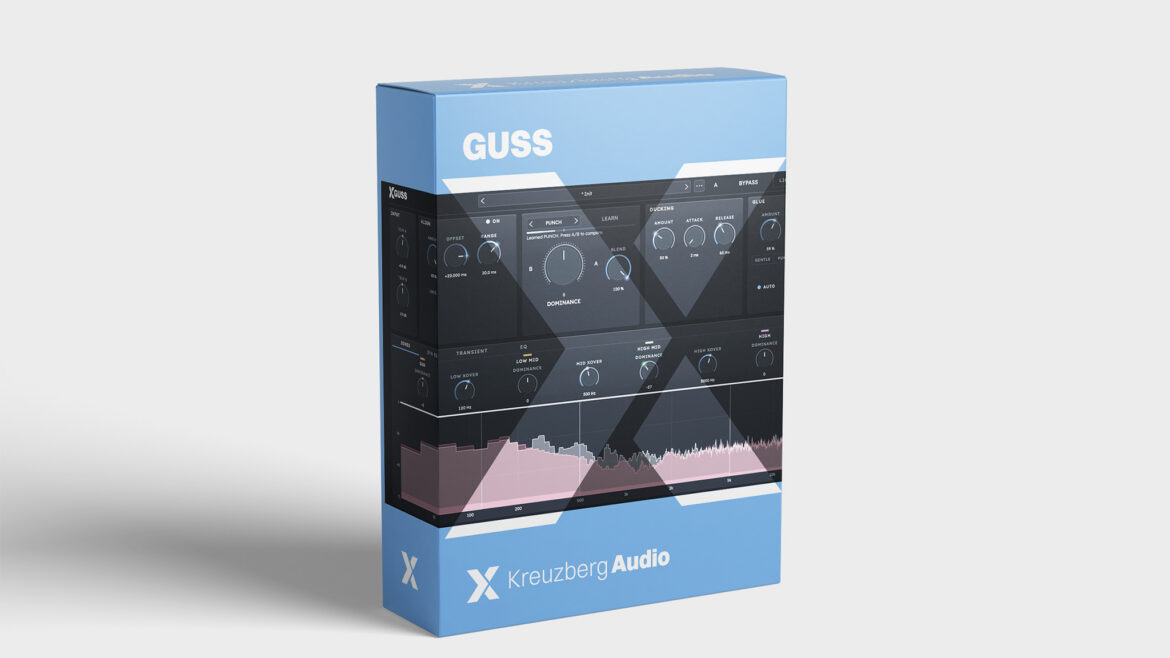
Two drum loops. One sound.
Two loops that get in each other's way
You have a break with groove and a loop with the kick that hits. Each one sounds good on its own. Stacked, they turn to mud. The hits land a few milliseconds apart, every kick becomes two, the snare flams. If one loop has its polarity flipped, the low end partly cancels and the kick gets thinner even though you added something. And wherever both fill the same band, in the sub, in the body of the snare, up in the hats, they fight for the same space. The result is louder, not fatter.
You know the manual routine: nudge loop B in the arrangement by ear until the flams are gone. Flip the polarity and compare. Carve room with an EQ on both tracks, sidechain B under A, put a bus compressor over both. An hour later this section works, and with the next pair of loops you start from zero again.
GUSS does that job in one plugin. Loop A sits on the track, loop B comes in on the sidechain. GUSS lines B up with A in time and polarity, decides frequency by frequency which loop leads, and glues both into one drum sound.
LEARN listens and sets it up
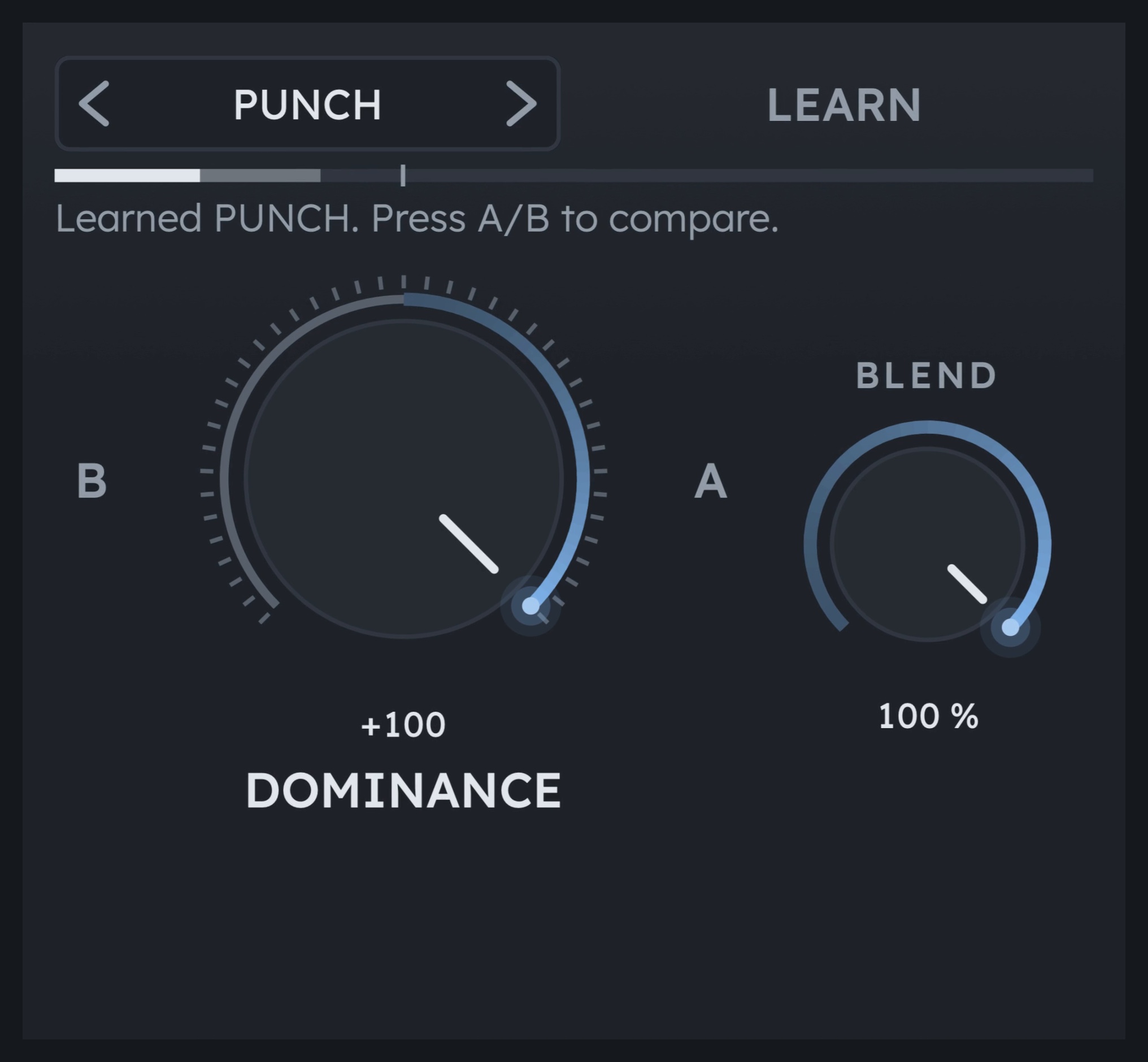
First you pick how the two loops should go together. CLEAN gives each loop its own place, PUNCH stacks them for impact, EVEN keeps both equally present. Then you press LEARN and let the track play. After four seconds in which both loops are playing, GUSS has enough to work with, after ten it tells you it has heard enough, and at 30 seconds it stops on its own.
In that time GUSS measures what you would otherwise judge by ear: the loudness of both loops, how many milliseconds B runs early or late against A, whether the low ends work against each other, how the energy spreads across 31 third-octave bands and where the hits sit. From that it sets up to 56 values: levels, offset and polarity, the borders of the four zones, who leads where, how far the losing loop ducks, the dynamics per zone and the compressor at the end. Then GUSS renders a test pass, two to four times, and corrects until the output peaks at minus 1 dBFS or lower.
Your previous settings move to the other side of A/B. One click and you hear before against after.
LEARN works with fixed, traceable rules and measures once, when you press the button. If it finds no common hits, it leaves ALIGN as it is and tells you so. If the kick on B is so late that you are better off moving it in your DAW, the status line says that too.
After that, every control is yours
Whatever LEARN sets ends up on the controls, and you can fine-tune every one of them: the offset down to a single sample, the lead per zone, the threshold of every dynamics stage, the pressure at the output. All 59 parameters can be automated. You can also skip LEARN entirely and start from Init or a factory preset.
ALIGN: one hit instead of two
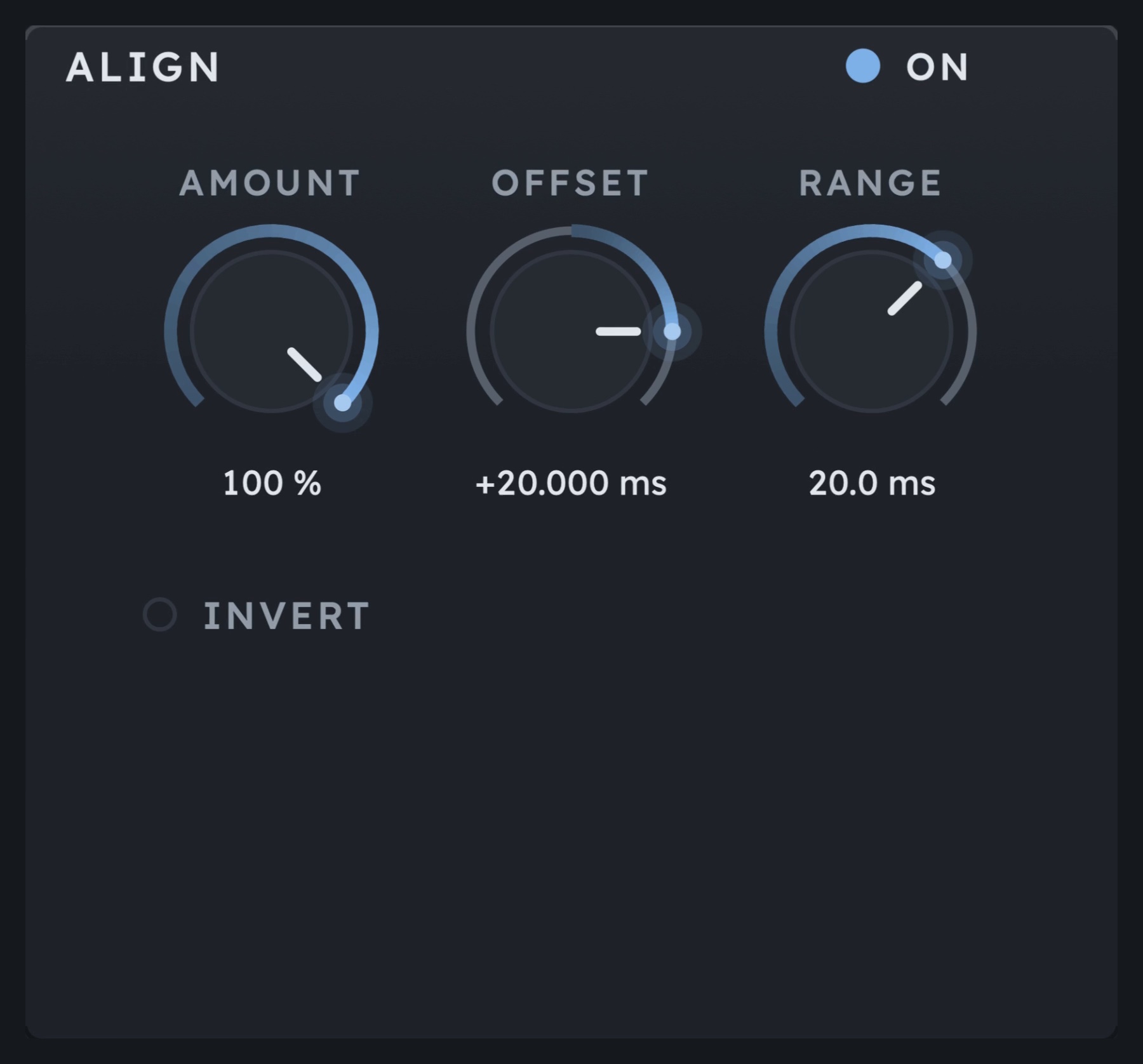
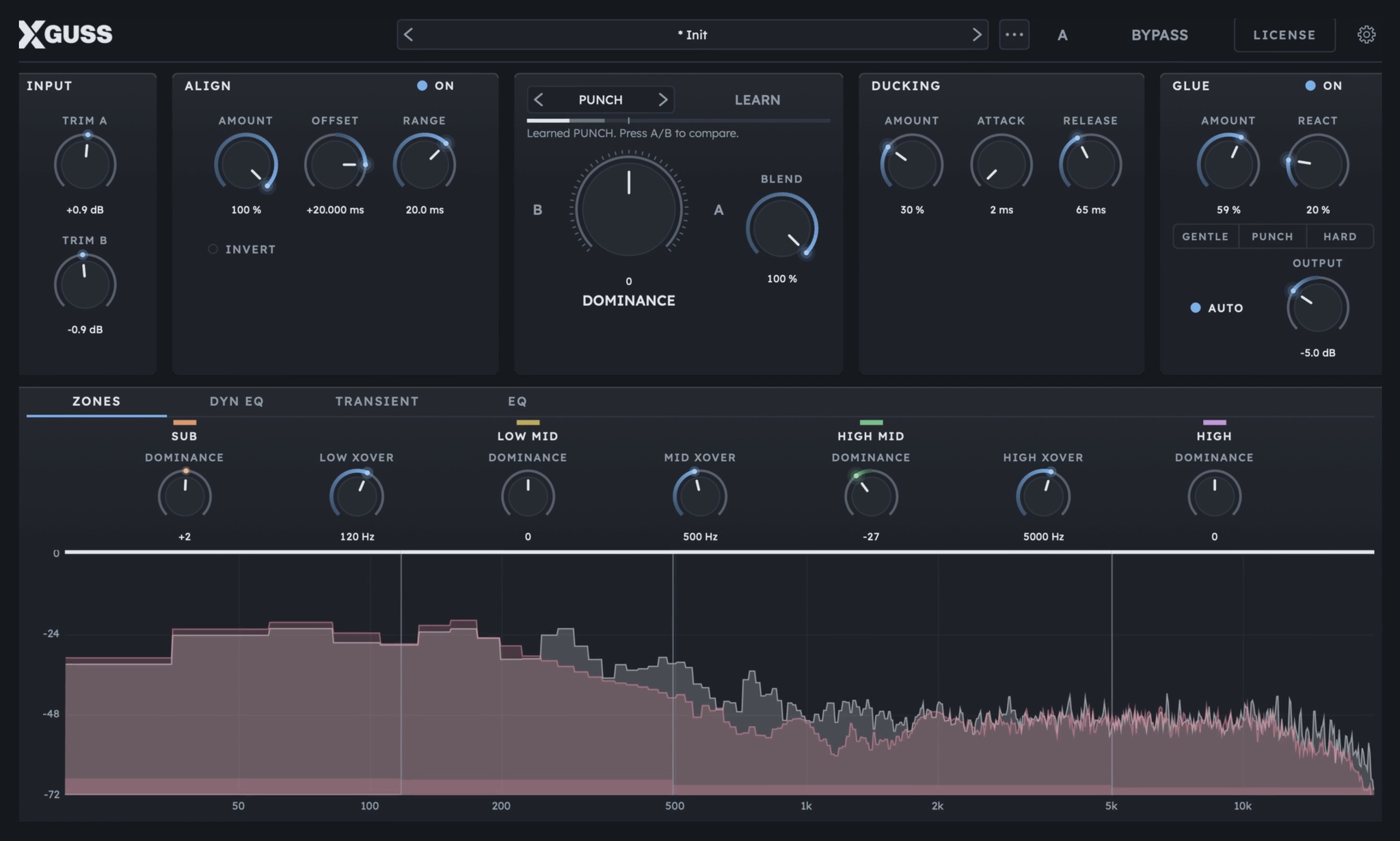
OFFSET moves B up to 30 ms earlier or later, accurate to the sample. INVERT flips the polarity of B so the kicks add up instead of cancelling. AMOUNT sets how much of the offset is applied: 100 percent pulls B exactly onto A, less leaves a bit of flam in place when one loop is meant to drag. RANGE limits how far LEARN searches for the offset.
If you change the offset during playback, GUSS crossfades from the old to the new value over 20 ms, without clicks.
DOMINANCE: who leads where
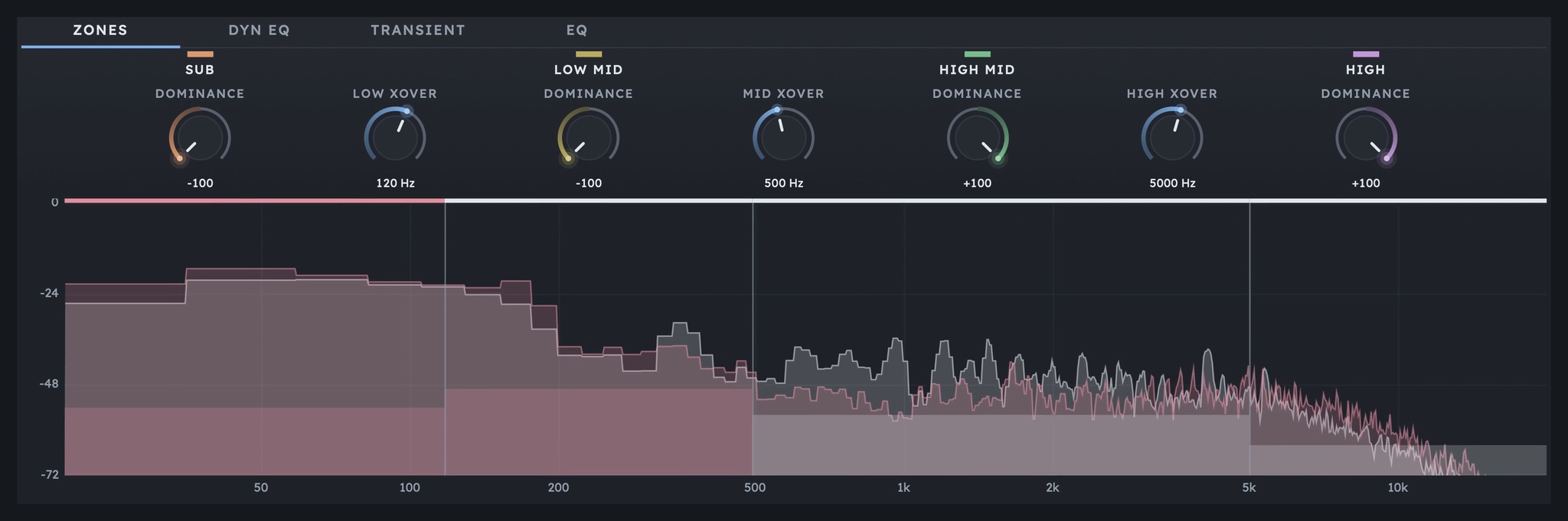
GUSS splits both loops into four zones: SUB, LOW MID, HIGH MID and HIGH. You drag the borders between them right in the spectrum. In every zone, DOMINANCE decides which loop gets the lead. The global control shifts the balance across everything, the four zone controls shift it where you need it, and the two add up. With DOMINANCE at zero, whichever loop is louder at that moment wins.
Inside the zones GUSS works finer than an EQ. A spectral ducker compares both loops frequency by frequency and lowers the losing loop exactly where the winner is playing, by up to 24 dB. Where A is silent, B plays at full level. DUCKING sets depth, attack and release of that dip. When a loop starts a hit, it gets its level back at once instead of waiting for the release, so the losing loop keeps its transients too.
An example with the 808 + Acoustic Kick preset: the 808 leads in the SUB, the acoustic kick keeps its body in the LOW MID and its click on top.
Shape each loop before they meet
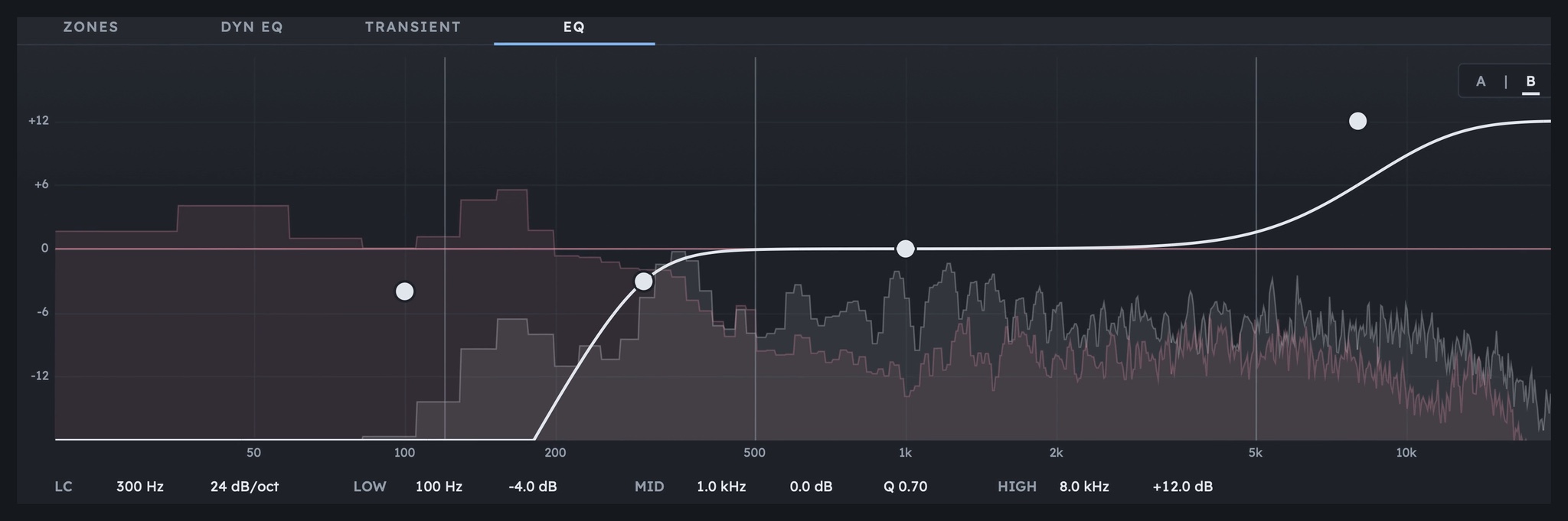
A/B EQ gives each loop its own EQ: LOW CUT from 20 to 300 Hz at 12 or 24 dB per octave, a low shelf, a mid band with adjustable Q and a high shelf, each ±12 dB. On top of that, TRIM for each loop with ±24 dB. The typical move: cut the low end out of the break before it goes up against the 808 in the SUB.
Dynamics per zone, on the combined signal
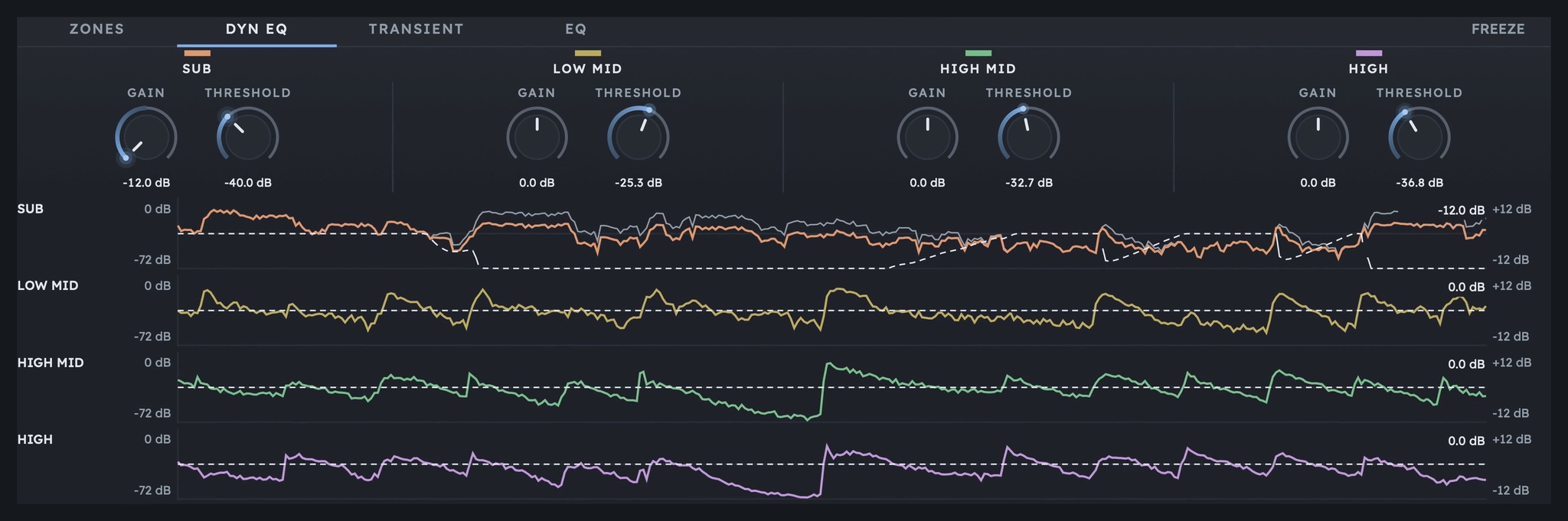
DYN EQ works on the sum, separately in each of the four zones. It only acts when a zone goes over its threshold, and then cuts or boosts it by up to 12 dB. That keeps the low mids calm when both loops hit there at the same time, and in the gaps nothing changes.
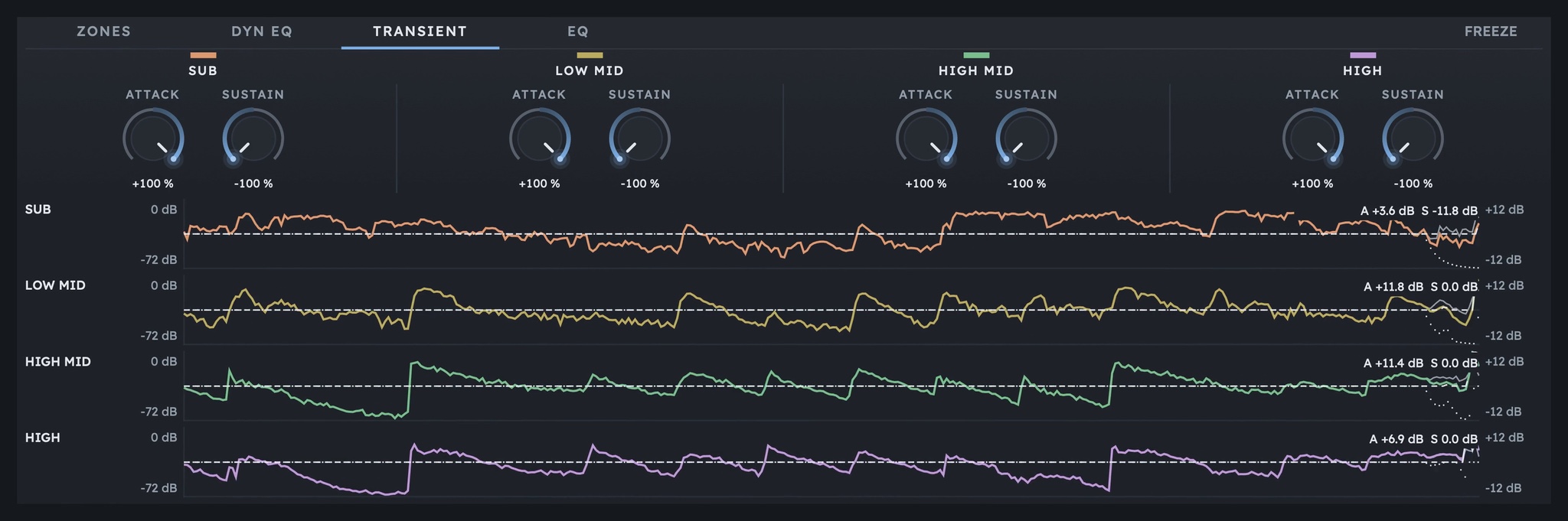
TRANSIENT shapes attack and sustain of each zone, ±12 dB each. More attack in the HIGH MID gives the snare an edge, less sustain in the SUB makes the kick shorter and drier.
GLUE: two loops, one drum bus
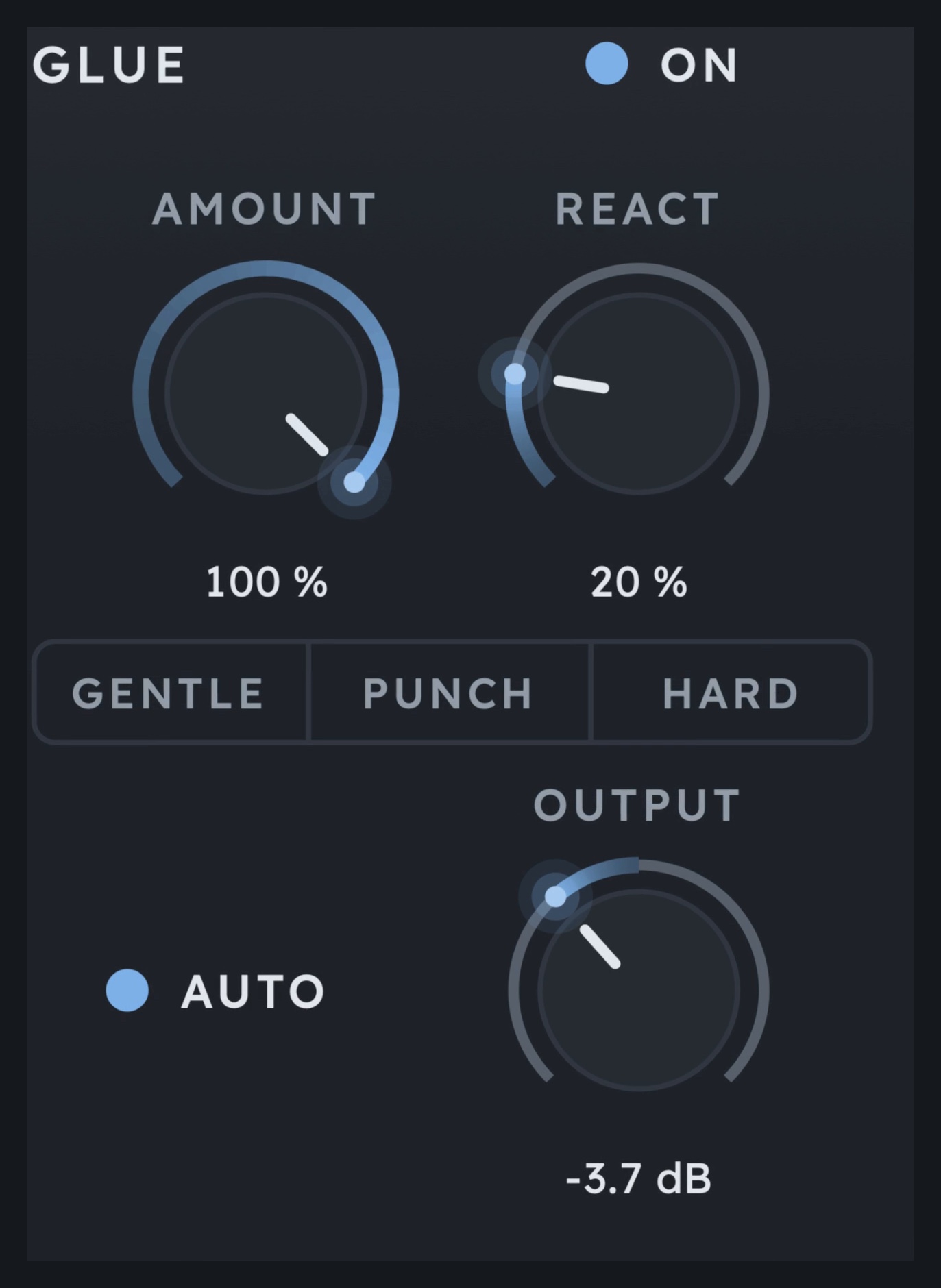
At the end, GLUE presses both loops into one bus: a compressor at 4:1 with 30 ms attack, 5 ms lookahead and a release that follows the material, from 100 to 1000 ms. AMOUNT sets the threshold relative to the running level of your material, so GLUE grabs a quiet break the same way as a loud one. REACT sets how fast that threshold follows the level. GENTLE, PUNCH and HARD are the quick start with AMOUNT at 25, 50 and 80. AUTO makes up the level, OUTPUT gives you ±12 dB.
BLEND sets how strongly the two loops react to each other. At zero, ducking and DYN EQ are off, and you hear A and B side by side, only aligned and shaped.
Seven factory presets for the typical pairs
Each preset stands for a situation in which two drum sources meet. Init comes on top as a neutral starting point.
- Two Loops Neutral: Neither loop leads, a light spectral clean-up and gentle GLUE.
- Light Touch: Half the weld, for loops that almost fit already.
- Breaks Weld: A sampled break on A and a layer on B turn into one kit, with PUNCH on GLUE.
- 808 + Acoustic Kick: Acoustic kick on A, 808 on B. The 808 owns the sub, the acoustic kick keeps body and click.
- Kick Over Loop: Kick on A, loop on B. The kick cuts its own room in the loop without any pumping.
- Snare Stack: Two snares. A brings the crack, B brings the sizzle.
- Aggressive Weld: Full ducking, sharp transients and HARD on GLUE for one loud slab of drums.
You can save as many presets of your own as you like, and A/B compares two states directly.
Who it is for
For producers who build drums from two sources. Drum and bass and breaks: two breaks stacked without the snares flamming. Techno: a kick over a percussion loop that cuts its own room instead of smearing into the loop. House: a top loop from a sample pack over your own programming. Trap and bass music: an 808 under an acoustic kick, each in its own zone. And if you blend a sample kit with a played kit, you get both in time and without a fight in the low end.
GUSS takes exactly two sources and is tuned for drums.
Technical highlights
- Two sources: loop A on the main input in stereo, loop B on the sidechain in mono or stereo
- ALIGN: offset up to ±30 ms, accurate to the sample, polarity, AMOUNT from 0 to 100%, 20 ms crossfade
- LEARN with the styles CLEAN, PUNCH and EVEN: measures loudness to ITU-R BS.1770-4, offset, polarity, 31 third-octave bands and hits, sets up to 56 values and checks the result with a test render
- Four zones with Linkwitz-Riley crossovers, 24 dB per octave, borders LOW 40 to 250 Hz, MID 250 to 1200 Hz, HIGH 2 to 10 kHz
- Spectral ducker with FFT 2048 and Hann window, decision per frequency, up to 24 dB of ducking, attack 2 to 100 ms, release 20 to 500 ms, transient protection
- DOMINANCE global and per zone, together up to 24 dB of lead for A or B
- A/B EQ per source: LOW CUT 20 to 300 Hz at 12 or 24 dB per octave, low shelf 40 to 400 Hz, mid band 100 Hz to 10 kHz with Q 0.5 to 4, high shelf 2 to 16 kHz, each ±12 dB
- DYN EQ and TRANSIENT per zone on the sum, ±12 dB each
- GLUE: 4:1, 30 ms attack, 5 ms lookahead, program-dependent release from 100 to 1000 ms, threshold relative to the program level, AUTO makeup, OUTPUT ±12 dB
- Spectrum from minus 72 to 0 dB with ducking and winner per zone, two-second history for DYN EQ and TRANSIENT with FREEZE, EQ curves
- 7 factory presets plus Init, A/B compare, 59 automatable parameters
- Constant latency, reported to the host: 3592 samples (81.5 ms) at 44.1 kHz, 3728 samples (77.7 ms) at 48 kHz, BYPASS delay-compensated
- Interface 1100 x 650 px, zoom from 50 to 150%, dark and light theme
The latency has three causes: 30 ms of room for ALIGN in both directions, the FFT window of the ducker and the GLUE lookahead. It stays constant whatever you set, because hosts cope badly with a latency that changes during playback. Your DAW compensates for it. GUSS is made for mixing and production, not for a live set with direct monitoring.
Formats & Systems
Formats: VST3, AU (macOS), CLAP, AAX (macOS and Windows), Standalone
Systems: macOS 11 Big Sur or newer (Universal Binary, Intel and Apple Silicon), Windows 10+ (64-bit), Linux from Ubuntu 22.04 (VST3, CLAP, Standalone)
Routing: loop A on the main input, loop B on the sidechain. Without a sidechain, B stays silent. In the standalone, A comes in on inputs 1 and 2, B on 3 and 4.
Made in Berlin
GUSS was developed entirely in Berlin. The DSP is based on JUCE, while ALIGN, the spectral ducker, the per-zone dynamics, GLUE and the LEARN rules are written from scratch. No white label, no generic toolkit compressor. Our secret weapon is the joy of detail.
Tools by producers, for producers.
License and demo
The demo runs with the full feature set, LEARN included. Once a minute, three seconds of quiet white noise are mixed in. The demo allows 30 launches, and every new instance counts as a launch, including the one when your DAW scans its plugins. After that GUSS stays silent until you enter a serial number.
Activation contacts the license server exactly once. After that the plug-in starts with no network access at all, it never phones home. Your serial allows three concurrent activations. The only data transmitted is the serial number, an anonymous hardware fingerprint and the product name, never audio, project data or analytics.
Demo: 0.00 EUR
Full version: 49.00 EUR (incl. 19% VAT)
License Information
This product includes a professional license system with the following features:
- Online activation with hardware fingerprinting
- Up to 3 device activations included
- Automatic license delivery via email
- Customer portal for license management
After purchase, you will receive your license serial number via email within minutes.