
In June, AMAZONA.de reported on the KA-303. What interested us more than the news item itself was the discussion underneath. Because there, put quite bluntly, was exactly the question we had asked ourselves before we even started: who is supposed to buy yet another 303 clone?
That is a fair question. Here is our honest answer.
The question is fair
There is Phoscyon. There is ABL3. There is a whole range of good emulations, some of them maintained for over ten years. And there is hardware: a TD-3 costs less than our plug-in, an RE-303 sounds superb, and anyone who tracks down a real TB-303 does not need advice from us anyway.
If our only goal had been to copy the original as closely as possible, we would have left it alone. Other people have been doing that job well for years. The reason we started anyway is a different one, and at first it has nothing to do with sound.
What bothered us about every 303
Entering patterns. On the original it is a nuisance, and by now that is folklore rather than criticism. But in software it is usually just a row of buttons you click one at a time. You build a line, it does not quite sit, you keep clicking, and at some point the idea you actually had is gone.
So we built the sequencer first and the synthesizer around it. Scales with a SNAP switch, so that only the notes which fit the key can be placed. Scramble and Mutate, which scramble or gently alter an existing line instead of replacing it. Octave jumps. Five groove modes from Tight through Shuffle to Laid Back. And once a pattern sits, you drag and drop it straight into your DAW.
We are not writing this because it reads well. We are writing it because this is precisely the part the reviews singled out independently of one another: bonedo calls the Composing Engine the secret strength of the plug-in, and a user on KVR Audio calls it the real highlight. That was the bet, and it paid off.
The sound still had to be right
A good sequencer does not rescue a bad filter. So we modelled the circuit instead of imitating the sound.
The diode ladder filter runs on zero delay feedback and consists of four cascaded integrator stages with asymmetric coefficients. That asymmetry is the whole point: a cleanly symmetrical filter sounds sterile, and the original never was one. On top of that comes soft clipping saturation modelled on the behaviour of 1S2473 silicon diodes, and the original 150 Hz high pass in the feedback path, which keeps the bass from collapsing as you turn the resonance up.
The oscillator works along the same lines. A real 303 does not produce a perfect square wave. Depending on the unit, the duty cycle sits somewhere between 46 to 54 and 48 to 52, and that small error is part of the sound. Pulse Bias shifts the switching point bipolar and turns it into a control. Analog Drift decides whether the comparator clips hard or a transistor saturates softly. In unison mode each of the up to seven voices gets a slightly different switching point, plus its own filter, its own envelopes and its own slide processor.
And then the things the original cannot do
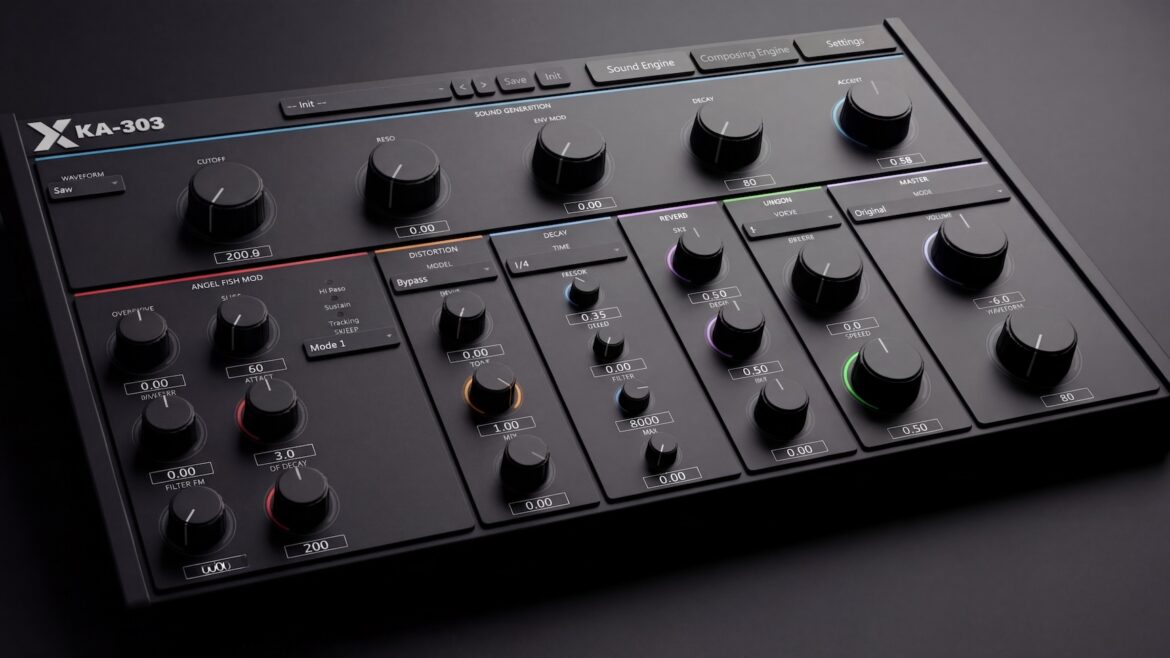
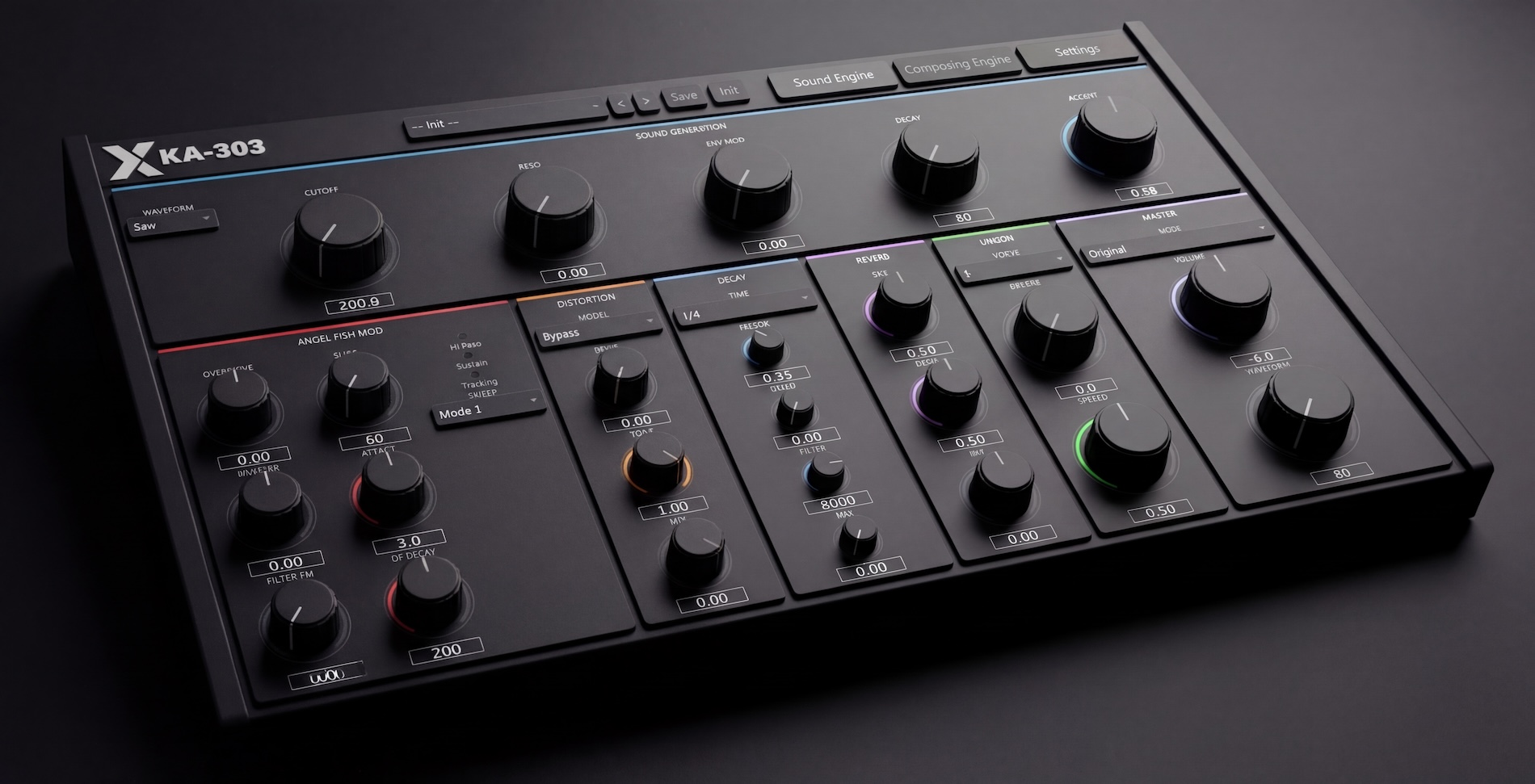
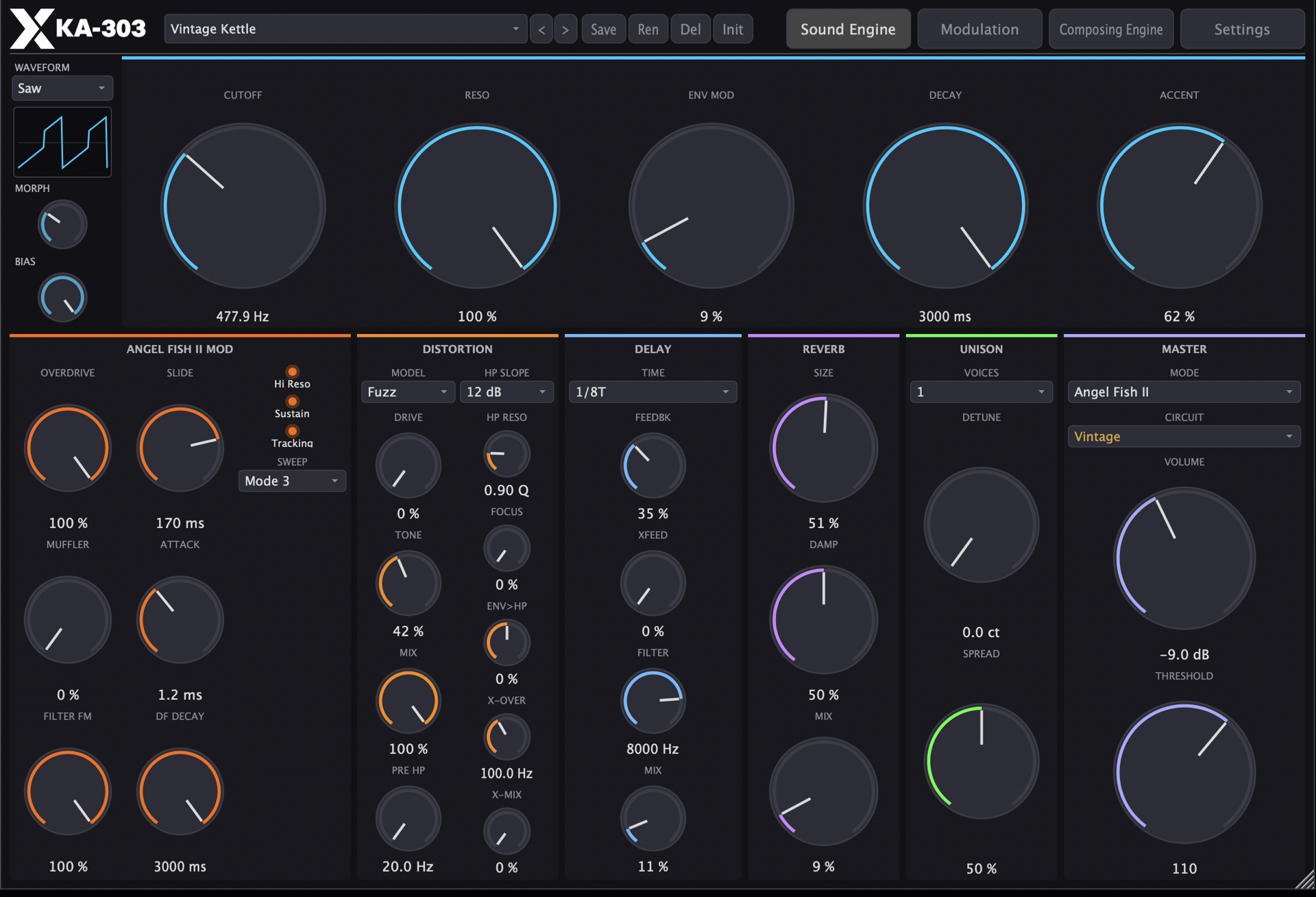
The Angel Fish section is our nod to the Devil Fish modification: overdrive, hi reso, filter FM and a separate accent path. Since version 1.7 there is also Angel Fish II with considerably more extreme values, going as far as wavefolding and filter modulation at audio rate. If you want the tame sound, leave it switched off. If you want to make the line scream, you now have a way to get there.
On top of that, four distortion models, DS-1, Tube, Rat and Fuzz, with a crossover placed before the distortion. It separates the sub bass from the mids, so that only the upper range distorts and the foundation stays put. That is exactly where a lot of acid tracks fall apart in the mix.
On price, without excuses
The discussion raised the objection that 69 euros is too much for software when a hardware bassline costs less. On the arithmetic the objection holds, and we are not going to talk it away.
If you want hardware, buy hardware. Nothing replaces a box with knobs under your fingers, and we have plenty of them in the studio ourselves. What you get here instead: the KA-303 runs on macOS, Windows and Linux, as VST3, AU, CLAP and as a standalone application. It needs no space and no extra controller. And every update is free, from version 1.0 to today's 1.8, with no surcharge and no subscription.
On the interface, an admission
The look was the most frequent criticism in the discussion. Too plain, too minimal, no photographed silver grey. That is a deliberate decision: we wanted the space for the sequencer rather than for screw heads, and photorealistic interfaces tend to age badly.
One point goes squarely to the comment section, though. There has been a light colour scheme in the settings for a long time. The fact that an editor had to point it out because nobody had found it is not a design problem, it is our mistake in the documentation. We are writing it more visibly into the manual and onto the product page.
Better still, listen for yourself
Everything above is a manufacturer making claims about its own product. That is why there is a demo which costs nothing and needs no sign-up. It has the full feature set, mixes in a short burst of noise every 30 seconds and goes silent after 30 launches. That is far more than enough to work out whether the filter and the sequencer suit you.
If they do not, you have lost nothing. If they do, you know exactly what you are paying for.
Thanks to AMAZONA.de for covering it, and explicitly to everyone who joined the discussion underneath. Criticism that gets specific is far more useful than applause. You can find the piece here: amazona.de/kreuzberg-audio-ka-303-synthesizer-plug-in
Cheers,
Frank