
Second instalment of our artist portrait series, this time with someone whose music plays in a wrestling ring, in a Sonic game and on festival stages from Moscow to the Czech Republic. Zardonic answered seventeen questions for us, at far greater length than we had dared to hope. About the mask, about doing everything alone, about an album that frightens him, and about a remark on piracy that most producers would never make in public.
And yes, about Amen Machine too. But one thing at a time.
Who is behind the mask
Federico Augusto Ágreda Álvarez, born 1985 in Barquisimeto, Venezuela. He did not start in drum and bass but in black metal: as Gorepriest he released War Against Humanity in 2003 and was named best keyboardist at the Premios Metal Hecho en Venezuela. The Zardonic project has existed since 2004.
What has happened since reads like a list that should not fit together and is coherent for exactly that reason. Five studio albums: Vulgar Display of Bass (2012), Antihero (2015), Become (2018), Superstars (2023) and this month DIGICIDE. Deals with Entertainment One, JVC Kenwood Victor, Owsla, Human Imprint and MMC Records. Number one on the Beatport drum and bass chart, number one on the Deutsche Alternative Charts, Best Producer at the Drum & Bass Awards Germany.
Remixes for Fear Factory, Bullet for My Valentine, Hypocrisy, Noisia and Hocico. Plus the work you hear without reading the name: the theme for AEW Revolution on TNT, the World Series of Fighting theme on NBC Sports, soundtracks for Superhot: Mind Control Delete and Redout 2. And most recently two tracks for Sonic Racing: CrossWorlds.
The Sega job clearly mattered to him:
I was always a Sega kid, and being able to work with the same team that developed video games that marked my childhood was a great honor for me.
The three moments that moved the needle
Asked which two or three moments actually changed something, he names a show that many here would not have on their list:
The first big moment for me was playing at Pirate Station Revolution in Moscow in 2013. This was really a before-and-after for my career, because it was the first time that my music was exposed to larger audiences. After this, other promoters started paying attention.
That led to Beats for Love and Let It Roll in the Czech Republic. The second moment was not a show but a move: leaving Venezuela and signing with Entertainment One, now MNRK Music. The third was Sega.
Why drum and bass of all things is what stuck
He tried a lot of things in parallel. His own explanation for why this one project remained is pleasantly unheroic:
That's a good question. But I'm not sure why. I mean, I tried different projects because I wanted to express myself in different ways. I basically went through almost the entire gamut of all the music that I like and listen to, from black metal through drum and bass all the way to minimal techno, believe it or not.
Zardonic was simply the project that got the most attention. It has been his name ever since.
The mask, and why it is an idea
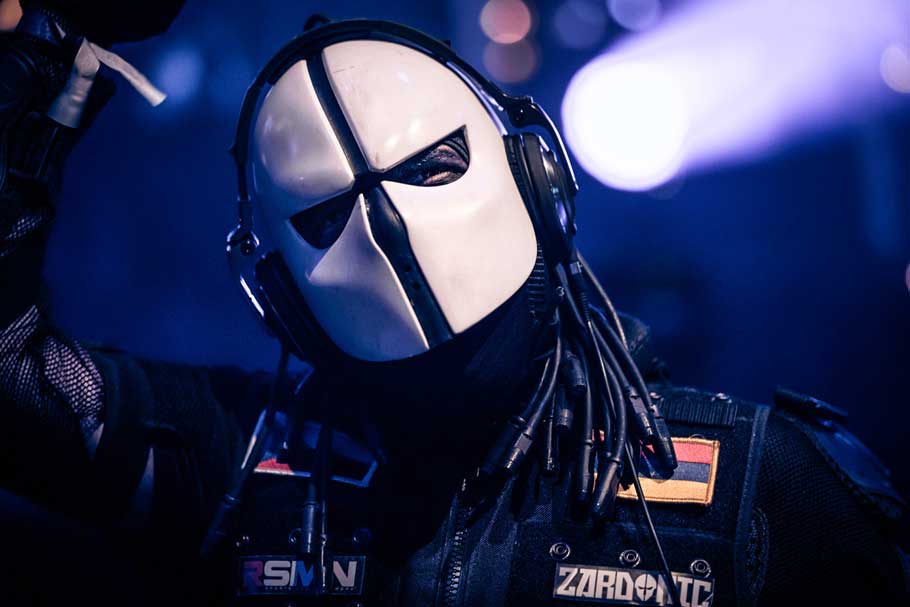
The mask is based on a logo, and the logo is based on his own face. He designed both himself. The thinking behind it goes further than you would expect from a stage mask:
I wanted people to remember it. I wanted the project to become an idea, to immortalize it in a way. Because humans are, well, finite. But I think ideas can last forever as long as people remember them.
Whether it still does the same thing for him today, he is not sure. The answer he gives instead is a line from Oscar Wilde:
Give a man a mask and he will tell you the truth. In a way, wearing this mask allows me to be myself completely when I am on stage. If I should disappear tomorrow, the memory of the mask will always stay, and I can be forgotten while the idea lives on.
He dropped one remark in passing that we leave here without comment: the idea has been stolen by quite a few others within the scene, and he is fairly sure everyone knows who he means.
A room that is almost ruler-flat
His studio was designed and built by Dennis Busch of Acoustic Spaces , the same company behind Rotor Film, Brainworx and Snipes among others. Zardonic calls him an absolute genius and describes the result as almost ruler-flat in its response. On top of that sits a Trinnov ST2 Pro for room correction.
He monitors on two Quested V2108 with an SB10 subwoofer. The reason he gives is one you hear often from people who work long hours and rarely hear put this plainly:
I really, really like the response of the Questeds because it helps me to work in long sessions without feeling ear fatigue.
For headphone work there is an SPL Phonitor 2 in the rack, plus OLLO Audio X1 and Dan Clark Audio Ether CX. The DAW is FL Studio, and he leaves no doubt about that. Asked what he would give up last, the answer takes the wind out of any hardware fetish:
If I would lose everything at the end of the day, I think just having FL Studio in my machine would be enough to move forward. Having that and just my ears.
Why he does all of it himself

Producing, mixing, mastering: all in house. The reason is not a principle but dissatisfaction:
I decided to do everything myself because whenever I tried to have somebody else do it, I was never satisfied, because it didn't fit with my vision. It was either too loud or not loud enough, or too much dynamic or too little dynamic range, or too much bass or too little bass. So I realized that to do what I wanted to do, I really, really had to learn how to do it myself.
He now works full time as an audio engineer for other artists. The sound signature he originally developed only for himself apparently works for other people too.
Metal and drum and bass in one mix
Technically the conflict is concrete, and he names it precisely: a lot of metal has almost no sub bass, which bothers him because there is so much that could be done there. In drum and bass, by contrast, there is often so much going on in the sub area that nothing else has room.
It gets more interesting when you ask him about the cultural side. There a question about mixing turns into a position:
I always tried to make it a point of rejecting the tribe. I really do not understand tribalism or why anyone would think that something should not mix with the other. I think metal purists or drum and bass purists are akin to me to political radicals.
And straight after it, the part that makes it honest:
Some like it, some don't. And that's their freedom as well. I don't hold it against anybody if they don't like what I do, but I also don't owe anyone really any explanations about why I do the things I do. I simply do them because I need to do them.
DIGICIDE, the hardest album
The fifth studio album comes out this month on MMC Records and deals with algorithms, surveillance and manipulation. It began with months of research, and what he found shifted the subject:
What I didn't know was that I would end up going down a rabbit hole and realizing that these were really symptoms of something much bigger: the speed of information. The faster information travels and the more it gets amplified, the harder it becomes to tell the difference between truth and lies. And unfortunately, truth is at a huge disadvantage in online communication.
On artificial intelligence he has an observation that captures the dilemma: it can help filter misinformation, but it can equally be manipulated, and the proposed solution to that is more artificial intelligence. At the end comes a sentence you would not expect from him:
I think this is the first time I've created an album that isn't empowering, uplifting or positive, if you will. It's an album that confronts the darkest parts of the human condition. And accepting it is difficult, which is probably why most of us refuse to recognize our own faces in it.
For the guest list he brought in people with legend status in their own scenes: Dino Cazares of Fear Factory, Charles Hedger of Mayhem and MC Coppa. His own comment explains the album better than any press release:
Imagine an album where someone like Coppa appears alongside members of Fear Factory and Mayhem. That's something nobody would have ever thought of putting together. But to me, the one thing we all have in common is that we're human. Humanity has a lot more in common than we think.
Amen Machine in his workflow
Now the part where we are biased, and we are saying so. We asked him where Amen Machine sits in his workflow. His answer:
Amen Machine has been instrumental in developing a lot of my most recent Amen breaks. I had a very, very big Amen folder that I'd made in the past, together with breaks made by other producers. It's such a ubiquitous sound that I could never really let go of it.
Zardonic
And then the line we were honestly pleased about:
I don't think I've ever seen a plugin that allows me to come up with so many different ways of mangling an Amen break in one place. It's genius stuff.
Zardonic
Asked what the tool does that his previous way of working did not, he names no single feature but the time saved:
You can go from the usual, classic processing techniques to completely new and unexpected approaches, all within the same environment. And I think that makes the process a lot faster. Time, as we know, is a very finite resource for all of us. So the faster we can translate an idea from our brains into a finished product, the better it is for me.
Tools, and an uncomfortable remark about piracy
Asked which tools are set in stone for him, he names Pigments and PhasePlant, almost anything by Arturia and GForce, the Magnetismus rack by Tegeler, a Polivoks Pro, Error Instruments modules, a Prophet 10 and an OB-6.
Then the conversation turns in a direction we had not anticipated. Software, he says, democratised music production because it gave people in countries with less purchasing power access in the first place. And out of that comes a statement:
I think a lot of people haven't really considered their own privilege enough. There's too much hardware elitism, and at the end of the day, you have to remember that buying a synthesizer, even a very cheap one, is a privilege that countries like Venezuela very rarely had.
He recounts that his family lived in a well off neighbourhood and that even a cheap M-Audio controller was out of reach. And then comes the sentence very few would say this openly:
Don't get me wrong, today I don't have a single piece of software that hasn't been properly paid for. But if it wasn't for all the pirated software back in the day, I think a lot of people around the world would never have been able to start making music. I realize this might be a divisive conclusion, but it is the truth. And not recognizing that would be hypocritical.
We sell software. We could have left that paragraph out. We are keeping it because it is the most honest one in the whole conversation.
What he tells people starting out
Finally we asked what he would say to someone starting today with no scene around them. The answer opens with a line that could come from the Bhagavad Gita:
You're entitled to your actions, but not to the fruits of your actions. You can try as much as you want, but whether people will like what you do or not is completely secondary. You have to fall in love with the process and with the result itself, rather than with the response.
I don't think we should focus so much on creating a scene. We should focus on being authentic and putting ourselves out there as much as possible. Eventually, if you're lucky, you'll get a response. It might be positive or negative, but it will be a response nevertheless. As long as you keep pushing forward, you'll eventually find the people who resonate with you.
The interview was conducted in English and the quotes appear in his own words. DIGICIDE is released in September 2026 on MMC Records. More about Zardonic at zardonic.net.
The Amen Machine is a slice sampler and sequencer for breakbeats. The demo has the full feature set.