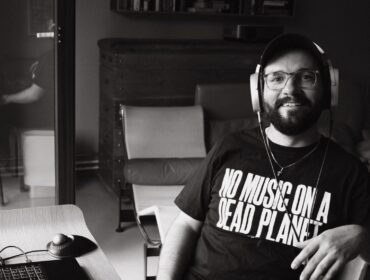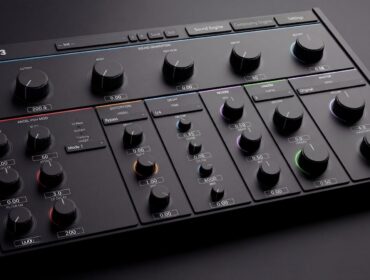

To open our new artist portrait series, I want to start with someone whose work you have been hearing for a long time without knowing his name. Helge Ohlenbostel built the 68 presets for Reecer. And not only those.

Under the name Sonic Sirius he has built 234 sound sets for 152 synthesizers . Software and hardware, from the Waldorf Blofeld and the Access Virus TI Snow all the way to Serum, Omnisphere and Pigments. And now comes the part that makes this unusual: he gives them away. All of them. For fourteen years, under a licence that allows commercial use as well.
By trade, he is a trained chef.
One record, and that settled it
It started with the guitar, acoustic and electric, at seventeen. Amp, effects, rehearsal room. The turn came through a gift:
Someone once gave me a Klaus Schulze record and I knew right there that I wanted to do that too. So I bought myself a Roland synthesizer and practised hard, and I also recorded science fiction samples off video.
The first computer arrived in 1998. Before that, everything ran through a four track cassette recorder. Then came years of waiting, and this passage describes that time better than any hindsight could:
Somehow it took a few more years before a DAW actually worked, before CPUs were fast enough and memory got bigger. Only when Steinberg invented the VST format did things move quickly.
One manual, thirty minutes a day
At some point the virtual synthesizers started sounding good enough. Then came the Waldorf Largo, and with it the idea of building the presets himself. How he taught himself subtractive synthesis is perhaps the most unfashionable and the best answer in the whole conversation:
I started with a Waldorf Largo manual and every day I read the manual for about 30 minutes and applied it in practice, until I knew what every control does and how it sounds. Because the sound combinations are so vast, it takes its time before you understand all of it.
No course, no video, no promise of a shortcut. A manual and half an hour a day.
What came out of it reads like a cross section through twenty years of software synthesis: Arturia, u-he, Xfer, Spectrasonics, Native Instruments, Rob Papen, Reveal Sound, Synapse Audio, Image Line, Waldorf, Korg, Novation. The full list of his clients and instruments is so long it would break this article, you will find it on his site.
The desk, and why the headphones had to go
Office chair, wooden desk, a mounted wooden board for the Roland A-800 Pro. A vertical mouse in front of it, Yamaha HS 50M as monitors and an Audient iD14 as the interface. Nothing exotic, but every piece has a reason.
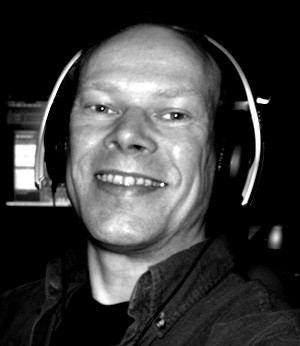
Asked whether he monitors on speakers or headphones, the answer was not what I expected:
For years I made presets with a Beyerdynamic DT-990 Pro headphone, it is very comfortable and you can make music for many hours without hot ears. At some point I developed trigeminal nerve pain in my face and had to switch to the monitors.
He tells it without any drama, as if it were a footnote. It is not. Anyone who builds sounds for many hours at a stretch knows the strain, and here it has been given a name.
How a preset comes about
His process is straightforward and never starts at the machine, it starts in his head:
It always starts with an idea, or with something you want to realise. The first thing you do is pick a waveform in the oscillator that comes closest to what you have in mind, a sawtooth for trance sounds for example. Then comes the filter, then the envelopes and modulation such as LFOs, and last the effects like reverb, delay and chorus, to make the sound bigger and wider.
A preset is finished for him when two versions exist: a basic one and one that sounds punchier or more interesting. And when every level sits below zero dB. What he says about quality is worth noting, because it contradicts what preset libraries usually suggest:
I also make basic presets as a matter of course, ones that do not sound extraordinary, so that you can actually use them in a song later. As you all know, number one hits are rare. It is no different with preset design for synthesizers.
A preset that impresses while you click through the list is not the same as a preset you actually use in a track. Anyone who has ever bought a library of 500 sounds and then used three of them knows exactly what he means.
The 68 presets for Reecer
Roughly thirty minutes per preset, one to two hours a day, done after two to three weeks. Asked which preset gave him the most trouble, the answer came back like this, and I am leaving it in full because it is honest and it concerns me:
There was no trouble. The beta testing was something else though, when controls do not do what they are supposed to, there is a bit of stress!
That is the friendliest possible way of telling a developer his beta still had bugs. Thank you for that, and sorry.
His advice for anyone starting out
In German, the word for profession comes from the word for calling. I would always say: try it and see whether you stick with it, whether the fever grabs you or the love of sound catches fire. Learn playfully, do not under challenge yourself and do not overwhelm yourself. It is like every instrument, you have to commit to it and be patient, play and practise every day, and success will come on its own.
Where to find his work
234 sound sets, free, royalty free including for commercial projects. If you own one of the 152 synthesizers he has built for, chances are good that something there is waiting for you.
Helge, thank you for the 68 presets and for your patience during beta testing.
That was the first part of our artist portrait series. We introduce people here whose work is inside our plugins, or who work with them. If that is you and you fancy it, get in touch.