


RASPEL is in the shop as of today, and it costs nothing. No serial number, no activation, no demo limit. It is a resonant filter that saturates inside every one of its stages, with a wavefolder after it. Here I explain why we built it, who it is for and why it sounds the way it does. If you want to get going right away: kreuzberg-audio.com/en/downloads/raspel
The idea: filter and distortion in one tool
Anyone who builds acid lines knows the problem. Put the saturator in front of the filter, and the distortion lands exactly where the filter is about to cut it away. Put it after the filter, and the first thing it flattens is the resonant peak. The line that was squealing a second ago now sounds like carpet.
So you build workarounds: two plugins, matching levels, turning RESO further up to rescue what the distortion swallowed, then matching levels again because everything is louder now. On the next bass you start over. RASPEL turns that into one move. You turn RESO and DRIVE up together, the line gets rough and dirty and still keeps its peak.
Why the resonance gets thicker under DRIVE instead of collapsing
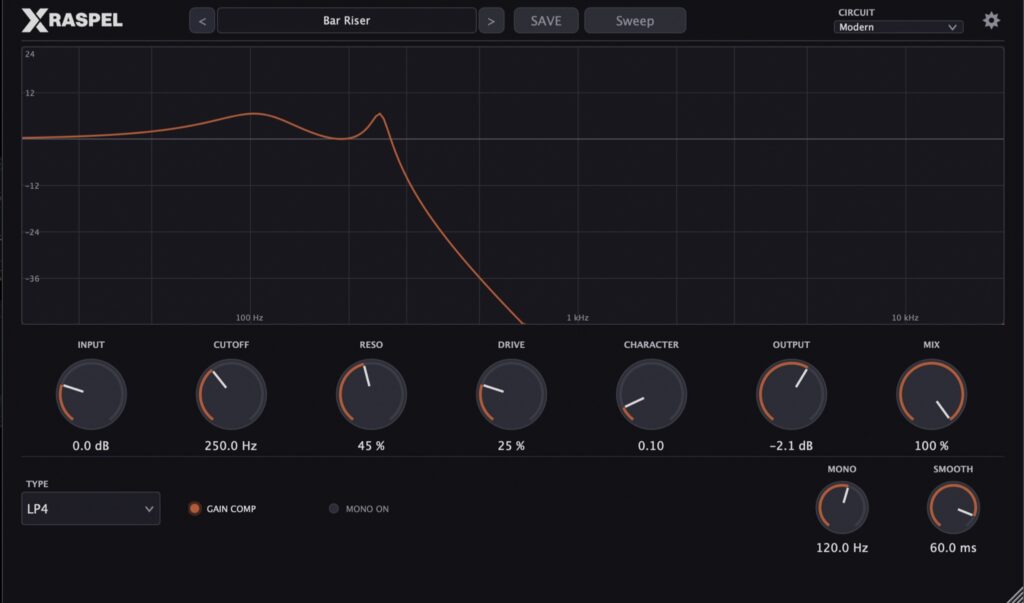
RASPEL is not a saturator with a filter bolted on, and not a filter with a drive knob that only hits the input. DRIVE saturates the input of every single filter stage. In front of the filter the level is raised by up to 30 dB, and afterwards the boost is taken back out. So the distortion happens inside the filter, stage by stage, not before or after it.
The key point is the feedback. It stays linear, even when the stages themselves are already saturating hard. That is why the resonance gets thicker under saturation instead of unstable, even with DRIVE all the way up. With many filters that have a drive, this is exactly where things start whistling or fall apart. Here the peak stays put, and around it things get rougher.
On top of that, automatic gain compensation is always running. DRIVE makes the sound denser, not just louder. That sounds like a detail, but it is the reason you get to a result quickly with RASPEL: you judge character, not volume, and louder does not automatically sound better. With GAIN COMP on, every filter stage also sits at 0 dB in its passband, so RESO lifts the peak and not the whole sound. If you want it fatter, switch GAIN COMP off and drive the saturation even harder.
Who RASPEL is made for
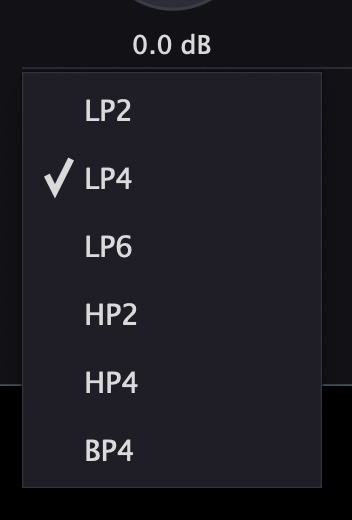
For people who make techno, acid, house, breaks or drum and bass and do not want to run their basses and leads through three plugins in a row. RASPEL is built for use inside the track, not for mastering. The six filter types cover the jobs that come up in the studio all the time:
- LP4, 24 dB per octave, is the standard for acid and basslines.
- LP2 stays open and round, for chords, pads and basses that should not go dark.
- LP6 cuts the steepest at 36 dB per octave and takes a Reese bass properly dark.
- HP2 and HP4 clear the low end of drum loops for kick and bass, and pull the bass out slowly in a build-up.
- BP4 is the bandpass for vocal sweeps, telephone sound and percussion.
Changing the type crossfades over 20 ms. So you can switch in the middle of a bar, even in the drop, without a click. And because RASPEL costs nothing, it can sit on the twelfth channel of a session without anybody counting licenses.
What makes the sound
After the filter sits CHARACTER, a sine wavefolder. It folds the signal back as soon as it crosses a limit, creating new harmonics along the way. That is something different from clipping: the harmonics move with the level, and the sound turns metallic instead of just louder. Between 0.1 and 0.3 a sub gains presence without getting thicker, and you can still hear it on small speakers. Between 0.4 and 0.6 a round bass turns into a metallic lead. Above that CHARACTER folds hard, for industrial, hardgroove and breaks. At 0 it is fully off and passes the signal bit for bit.
DRIVE goes from warmth on a bus at 20 to 40%, through a strong acid bass at 50 to 70%, to real distortion on drums from 80% up. Because the gain compensation runs along, you can travel that whole range without touching the fader.
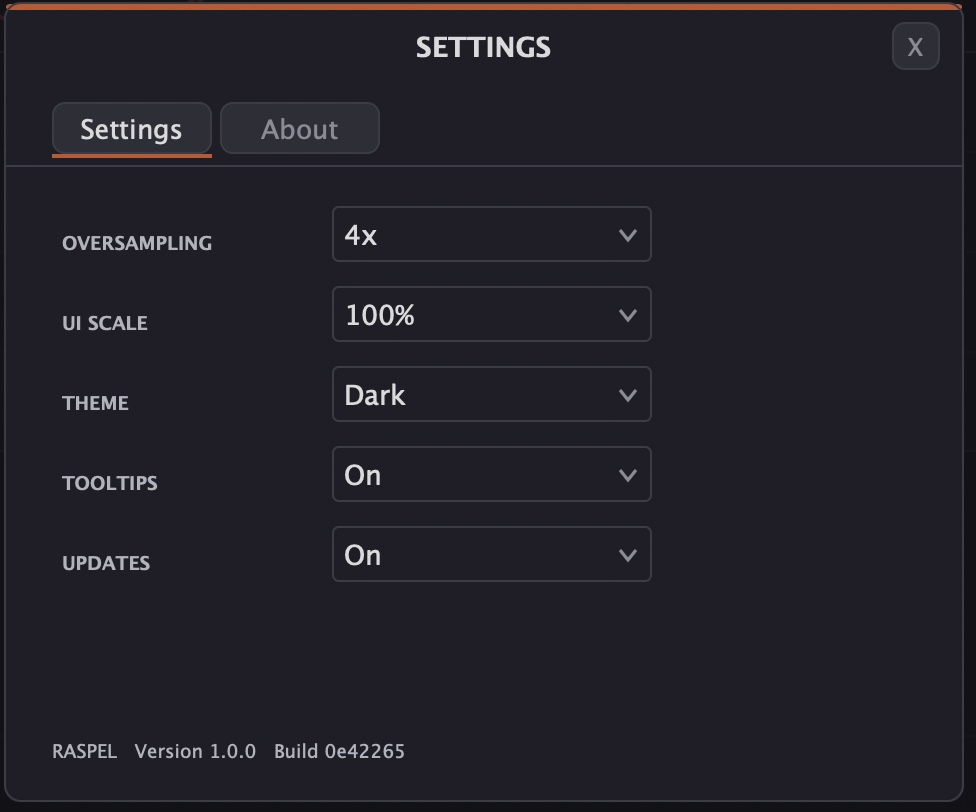
Distortion creates harmonics far above 20 kHz. Without countermeasures they fold back into the audible range and make the highs scratchy, the typical digital sound of cheap distortion. That is why filter, DRIVE and CHARACTER in RASPEL run oversampled, 4x by default, optionally 1x, 2x or 8x. The highs stay clean even while you wreck them.
And then there are two things you do not hear as long as they are done right. MIX is true parallel processing: the dry signal is tapped before INPUT and delayed to stay in time, so no comb filtering appears. MONO puts everything below the set frequency in the center, with zero latency and phase compensated, from 20 to 500 Hz. Because MONO sits at the end of the chain, it also acts on the dry signal.
CIRCUIT Vintage: steps instead of a smooth sweep
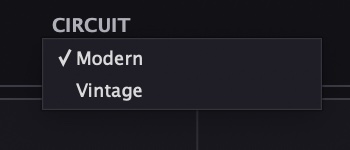
Modern software filters sweep perfectly smoothly. That is clean, but it is also exactly how you recognise them. CIRCUIT Vintage snaps the frequency of the filter poles to third-octave steps and the damping to coarser steps, plus a soft limit inside the filter. That is how a filter behaves in an old digital system.
You hear it in the bass. A slow sweep below 150 Hz moves in steps, and with resonance the movement turns stepped and slightly rough. That is exactly what sets a sub sweep apart from a smooth software sweep. In the highs Vintage sounds almost like Modern, so your top end stays as it is.
Four recipes to get started
RASPEL has no LFO of its own, all 14 parameters run from your DAW's automation. SMOOTH decides how the filter follows, from 1 to 100 ms, and turns the same automation curve into two different movements.
- Acid line: LP4 on a sixteenth line, CUTOFF around 300 to 600 Hz, RESO 60 to 75%, DRIVE 40%. SMOOTH at 3 to 6 ms and automate CUTOFF in steps, then the filter jumps hard with every step and the line squelches.
- Build over 16 bars: HP2 on the drum bus, CUTOFF slowly from 20 Hz to a few hundred hertz, SMOOTH long. In the drop the filter snaps back and the kick is there again.
- Parallel distortion on drums: MIX at 50% with lots of DRIVE. Kick or snare keep their punch and the saturation sits underneath.
- Bass in the club: MONO at 100 to 140 Hz on the bass or kick bus. The sub stays in the middle while the width above it survives.
50 presets, all equally loud
All factory presets are level matched within 1 dB, measured at -18 dBFS. Browsing does not make the volume jump, so you hear what a preset does instead of just hearing it louder. That mattered more to us than a big number.
- Init (1): the neutral starting point, filter open, no saturation.
- Warm (16): warmth and saturation for buses, pads, chords and basses, from Soft Lid to Melted Wax. The bass presets switch the mono maker on, Parallel Warmth shows parallel distortion.
- Sweep (16): starting points for filter moves, short for stepped sixteenths like Squelch Step, long for builds like Bar Riser and Tension Build, vocal with Formant Rise and Vowel Ride.
- Break (17): highpasses and bandpasses for drums, loops and percussion, from a clean Kick Clear to the wrecked Crushed Break and Factory Floor.
What RASPEL cannot do
RASPEL has no LFO and no envelope. Movement comes from your DAW's automation. That was a deliberate decision for an interface that fits on one page, but if you are looking for a filter with built-in modulation, this is not it.
The oversampling costs latency: at 48 kHz RASPEL reports 59, 108, 120 or 124 samples to the host depending on the setting, so between 1.2 and 2.6 milliseconds. Part of that comes from a band limit at 19.5 kHz that is always in the signal path. Your DAW compensates for it, and a bounce sounds the same on every pass. When you play live through the plugin, though, you may notice it.
On Linux RASPEL only runs on x86_64 from Ubuntu 22.04, ARM machines are left out there for now.
Try RASPEL yourself
RASPEL is free, with no serial number, no activation and no demo limits. It runs as VST3, AU, CLAP and standalone on macOS 11 or newer (Universal Binary, Intel and Apple Silicon), Windows 64-bit and Linux x86_64. Installers and manuals in German and English are on the product page: kreuzberg-audio.com/en/downloads/raspel
If you build an acid line with RASPEL that screams under DRIVE instead of collapsing, send it to me. That is exactly what we built it for.
Cheers,
Frank