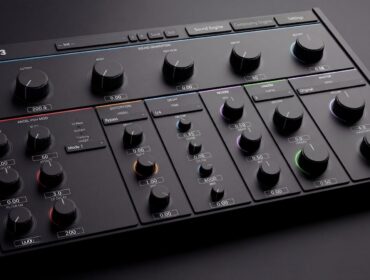



STAFFEL is in the shop as of today. It is our first filter plugin, and it grew out of a question that has been on my mind for years: why does every filter sweep in the club sound the same? Here is what we were thinking and how STAFFEL works inside. If you just want to hear it, the demo is here: kreuzberg-audio.com/en/downloads/staffel
The idea: move the filter itself, not its cutoff
I wanted a knob that does not shift the cutoff frequency but transforms the filter. A six-pole lowpass on the left, a formant on the right, and in between something that is neither. For basses and leads in the club, that is the difference between a build everyone knows and one that makes the floor look up for a moment. The only question was how the in-between stays stable and does not click.
Why two complete filters and no morphing
The obvious route would be morphing: interpolating the coefficients of A and B. But a value halfway between two coefficient sets is not a filter anyone designed. The poles wander along paths that sound like nothing, and in some places it goes unstable. That is where the clicks and level jumps you know from morph knobs come from.
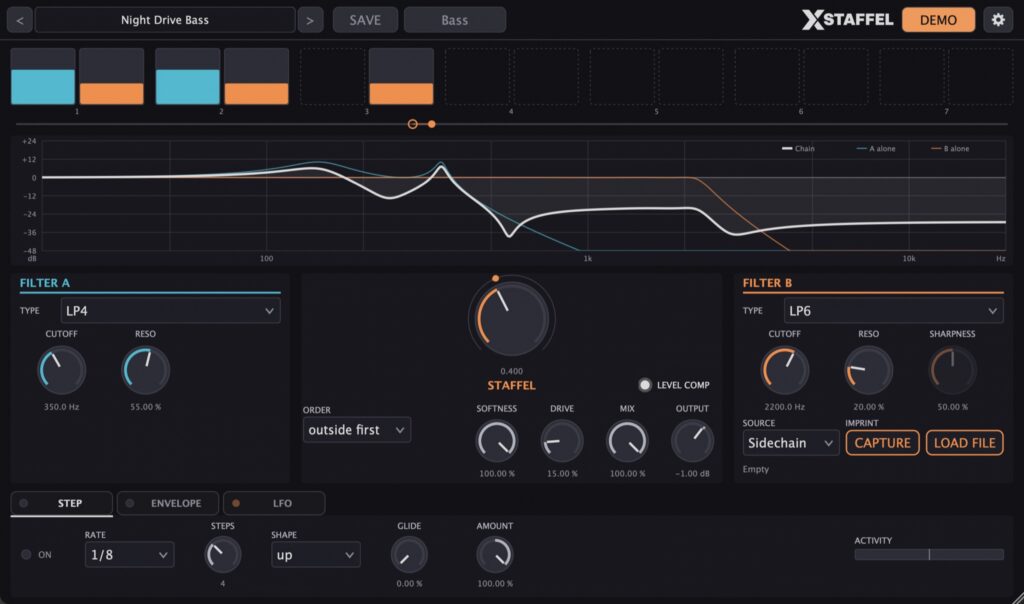
So STAFFEL never computes in-between values. Both filters are designed in full and run as second-order sections in a chain with 14 slots: seven ranks, and in each rank one slot for a section of A and one for a section of B. Each slot only computes a crossfade between its input and what its section makes of it: at 0 an exact pass-through, at 1 exactly the filter. That is why the far left is bit-identical to A and the far right bit-identical to B, and every position in between is stable, because no pole ever moves. Only crossfades move.
What happens during the handover: the travelling notches
Turn the STAFFEL knob and the chain switches from A to B rank by rank, like a baton in a relay. Each rank has its own switching point along the knob's travel. SOFTNESS sets how wide that point is: at 0 a rank snaps over hard, at 100 percent all seven glide into each other. ORDER sets which rank goes first: the low ones, the high ones, from the middle outwards, from the outside in, or random. The random order has a seed from 1 to 99, so a sweep you found today is still the same tomorrow.
It gets interesting exactly where a rank is half switched. Then half the signal runs through a resonant section of A and half through its counterpart from B, and at the same frequency the two parts have different phases. They partly cancel each other out. That produces notches in the spectrum, and because the crossfades shift as you turn, the notches travel with them. A lowpass on its way to a highpass does not sound like both in the middle, it sounds hollow, vowel-like or comb-like, depending on what is set on either side. We measured this with an LP4 at 500 Hz against an HP2 at 2 kHz in 100 steps: the notches are no accident, and you can shape them with ORDER and SOFTNESS.
LEVEL COMP keeps the level in check: a compensation computed from the frequency response of the current position, not from the signal, so it never pumps. You compare sound, not loudness.
IMPRINT: a captured sound becomes filter B
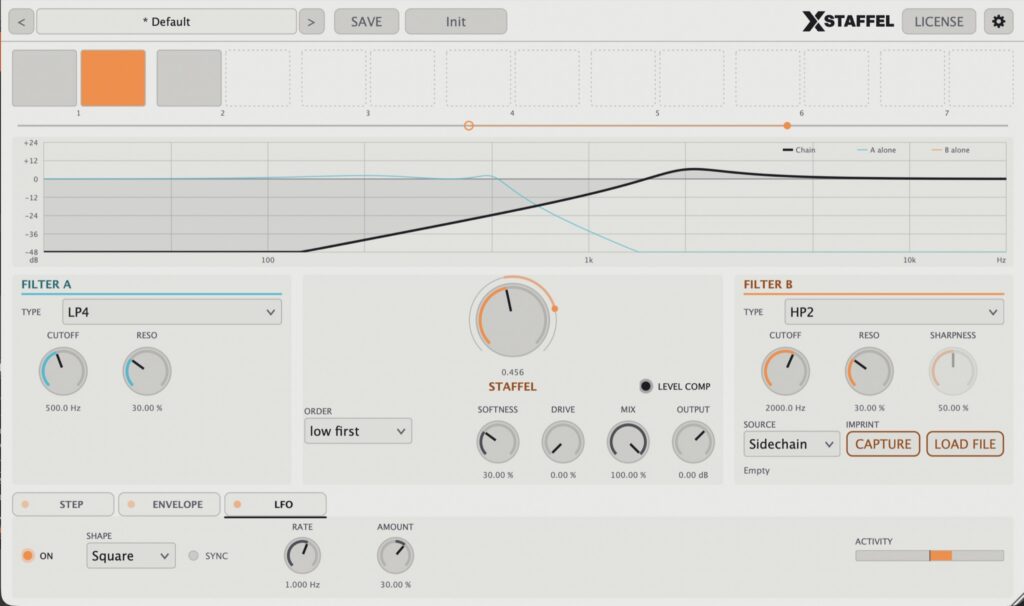
Up to here, both filters come from recipes. With IMPRINT, filter B comes from your own material. You hit CAPTURE, and STAFFEL searches the last two seconds of the sidechain for the loudest 85 millisecond window. A 14th-order linear prediction pulls out of that window the resonances that shaped the sound: 14 poles, meaning seven resonators, each with a frequency and a decay time. From then on, those seven resonators are filter B.
Because the imprint consists of nothing but frequencies and decay times, you are allowed to bend it like any other filter. SHARPNESS lengthens the decay times, CUTOFF B shifts all resonances in octaves, RESO B makes them wider or narrower. And then you hand over with the STAFFEL knob from an LP4 to the body of a snare or the vowel of a vocal chop, section by section. A new imprint fades in over 25 milliseconds while a second chain keeps computing the old one for that long. So you can capture in the middle of a take without a bang.
The modulation only moves the handover
STEP, ENVELOPE and LFO all aim at the same point: the STAFFEL knob. Their contributions are simply added, each with its own amount, positive or negative. What they never reach is the design of the filters themselves. No modulator moves a pole, none recomputes a coefficient. They move nothing but the crossfades of the 14 slots.

That sounds like a detail, but it is the reason you can stack the three sources without anything clicking. A STEP on sixteenths with an LP4 against a formant gives a bassline a different filter on every step. The ENVELOPE on the kick makes a pad pump between two filters in time instead of in volume. STEP and the synced LFO read the transport position straight from the host, so a bounce sounds exactly like playback, at any block size.
What STAFFEL cannot do
Oversampling is always on, 2x or 4x, with 49 or 61 samples of latency. There is no setting without oversampling, because that is where the resonance of the LP6 piled up near 20 kHz. The latency is reported to the host, but you will still feel it when playing through the plugin live. There is no MIDI control, everything runs through the host's automation. And in some hosts the sidechain stays silent as long as nothing is routed to it; the status line tells you so.
Try STAFFEL yourself
The demo is the full version: full feature set, three seconds of quiet noise per minute, 30 launches. It runs on macOS, Windows and Linux as VST3, AU, CLAP and standalone. The full version costs 49 euros including VAT, three activations, no network access after activation. Installers and manuals in German and English are on the product page: kreuzberg-audio.com/en/downloads/staffel
If you build a build with it that sounds more exciting in the middle than at the drop, send it to me. That is exactly what we developed it for.
Cheers,
Frank