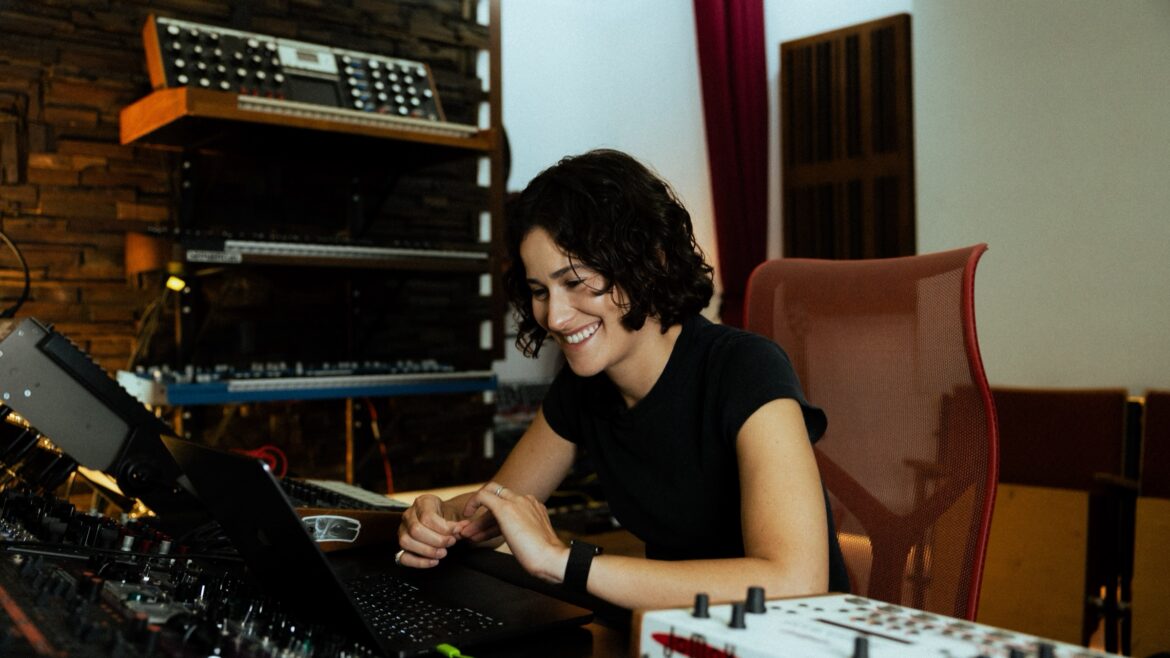

Part four of our artist portrait series, and this time we stay in Berlin. Julia Borelli is a mix and mastering engineer working with electronic artists such as Anyma, Ben Böhmer and Richie Hawtin. Forbes put her on its 30 Under 30 list in 2025, and she is a voting member of the Recording Academy. She worked at Riverside Studios for years. Right now she is setting up a new room, and until it is ready, she mixes in her living room.
We sent her ten questions. Her answers are short and direct, and in two places not what we expected: she never does the car test, and when we asked about her most important tool, she asked back whether her ears count.
How her band's first EP turned into a career
Julia never felt at home on just one side:
I was always a STEM kid, but I was just as obsessed with music. Pure science felt like it was missing something, and pure music left the problem-solving part of my brain hungry.
Then her band went into the studio to record their first EP:
I fell straight down the rabbit hole. I was more fascinated by what was happening behind the glass than in the live room, and somewhere in those sessions I thought: this is the job.
Not long after, she started working in a studio. Julia is originally from Brazil, and she gained her first experience as an assistant engineer on Latin Grammy-winning recordings, including Anavitória and Tiago Iorc. Engineering, she writes, turned out to be the perfect in-between, the place where her technical and her creative side could finally work together.
What opened the doors to Anyma, Ben Böhmer and Richie Hawtin
She went from assisting to working with these names fast. According to her, there was no single big break:
Honestly, it was less one big break and more a chain of people. One artist trusted me with a record, liked how it turned out, and passed my name to the next one.
Berlin helps a lot here, she says, because so much of the work happens through people and not through cold emails. What keeps the doors open afterwards is what she calls the boring part:
Delivering on time, every time, and making the artist feel like the record got better without losing what made it theirs.
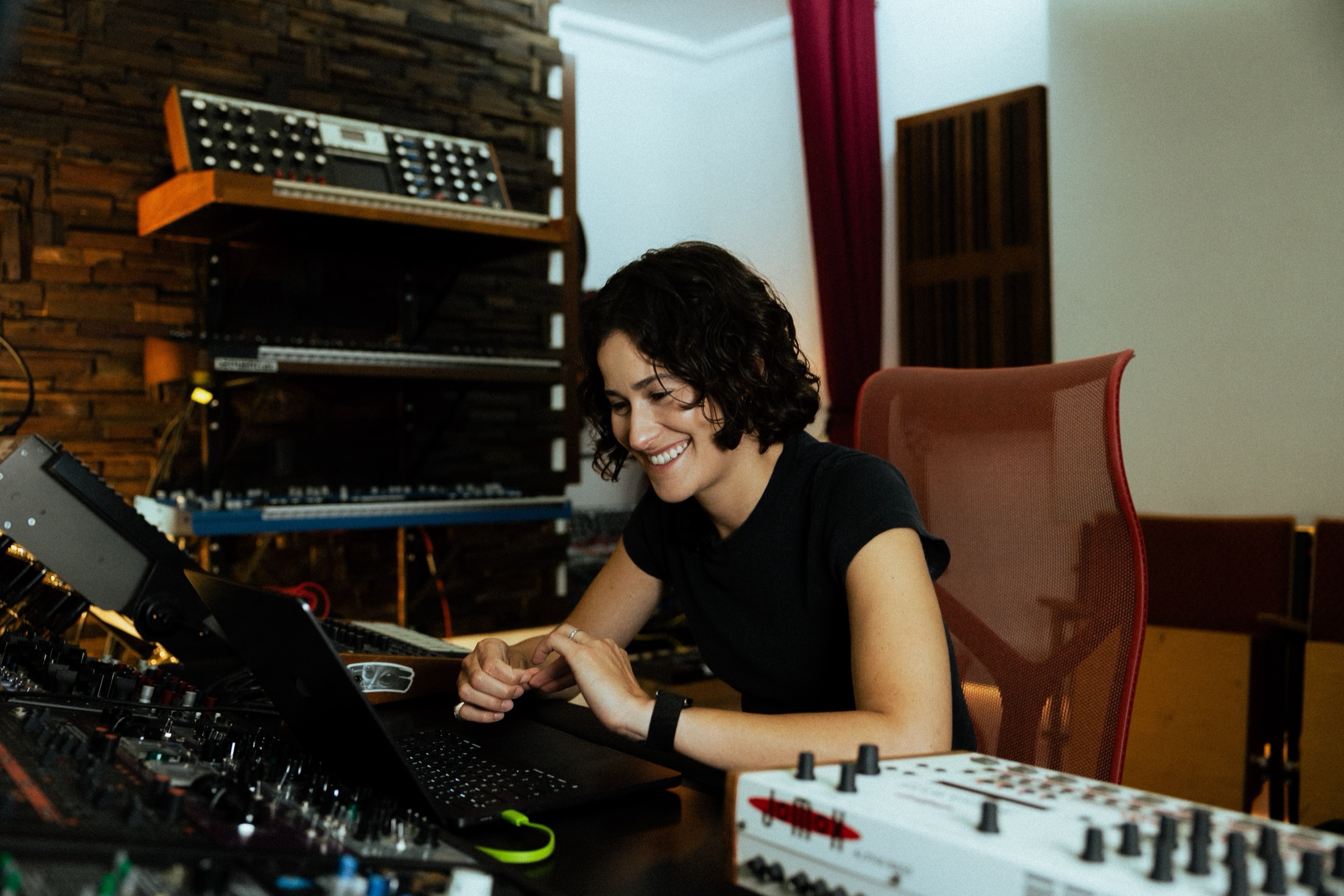
A living room as control room, until the new room is ready
After years at Riverside Studios, Julia is between two rooms. While she sets up the new one, her setup and acoustic panels have moved into her apartment:
Right now my room is technically my living room, haha.
She still mixes on her Adam Audio S3Vs, and her Audeze MM500s are, as she puts it, basically glued to her head. Monitors from PMC and Neumann are on their way for the new room. From the makeshift setup she draws this conclusion:
It's a good reminder that a great mix is more about knowing your room than having a perfect one.
The tool she would never give up
Her answer starts with a question of her own:
Do my ears count? Haha. Honestly, I don't think I'm attached to any one plugin or piece of gear.
Her toolkit keeps changing. Something new comes along, a different record asks for a different approach, and she is always happy to try things. What stays the same is the listening:
Tools are great, but they only matter as much as your ability to hear what a track needs.
What she uses right now is on a page of its own: juliaborelli.com/jubospicks. We sell plugins, and we still think she is right.
Where a mix starts and how she knows it is done
Before she touches a fader, there is a picture in her head:
I start by imagining the vision: where I want the track to go, what it should feel like, and what the artist is reaching for. Once that picture is clear, every decision after it is just about getting closer to it.
Knowing when a mix is done is simpler than people think, she says. She listens through the whole song with fresh ears:
If nothing bothers me, nothing pulls me out of the music and nothing makes me want to reach for a plugin, it's done. That's the moment I stop working on the track and just enjoy it.
Why she never does the car test
We wanted to know how she checks that a mix holds up on a club system, a festival stage and a phone speaker. She trusts her monitoring. She knows her speakers and headphones really well, and after years of hearing her mixes come back from clubs, festivals and phones, she knows how what she hears in the studio translates there:
That's what experience gives you: you stop guessing and start knowing. So no, I never do the car test, haha. If you know your room and your speakers inside out, you don't need to run down to the parking lot to find out whether your mix works.
Where mixing ends and producing starts
In electronic music, the mix engineer often gets a finished production. For Julia, mixing means enhancing that production and every element in it:
The artist has already made the creative decisions: the sounds, the arrangement, the emotion. My job is to bring all of that out, so every element has its space and the track hits the way it's meant to.
She draws a clear line:
Once I'm changing those decisions, by swapping sounds, adding parts or reworking the arrangement, that's producing, and it's a different conversation with the artist.
What Dolby Atmos brings to electronic music
For Julia, Atmos is a tool when it is used with intention. Electronic music is already built on space, movement and immersion, so the two fit. It gets exciting when a track is produced for Atmos from the start, with elements written to move around you and the space treated as part of the composition. Her own credits include Jan Blomqvist's album Mute in Dolby Atmos. For that case she writes:
Then it's a really cool experience: you're not just listening to the track, you're inside it.
She also says where it does not work:
Where it falls flat is when it's an afterthought, like an upmix done to tick a box. The format can't add intention that was never there.
Why she teaches and shares what she knows
I hate gatekeeping, and I love sharing what I've learned over the years, because I think it's important. It's how I learned too.
Julia assisted mentors in the studio and learned the craft there: watching, asking questions and doing it. Those opportunities are much harder to find now, because studios run with smaller teams and there are fewer assistant spots. At some point so many people were asking in her DMs how she did things that she started a Patreon to share it properly. What she gets out of it:
I love passing on what someone once passed on to me.
Her advice for beginners with a laptop and headphones
You've got everything you need! Seriously, a laptop and a good pair of headphones is more than enough to start.
The most important thing, she says, is to learn your headphones:
Listen with intention to as much music as you can on them, especially records you love, until you know exactly how a great mix sounds in your ears. Once you know your tools inside out, you can trust what you hear, and that matters far more than any gear upgrade.
More on working with headphones is in the third part of the series: Flo Siller explains why he now masters almost entirely on headphones.
Julia Borelli answered our questions in writing. Photo: Margaux Contant (@http.margaux). More about Julia's work at juliaborelli.com, her current favourites at juliaborelli.com/jubospicks. She shares what she knows on Patreon, and posts from the studio on Instagram as @juliaborelli.
Thanks to Julia for her time and her open answers, and to her management for making it happen.